eBook - ePub
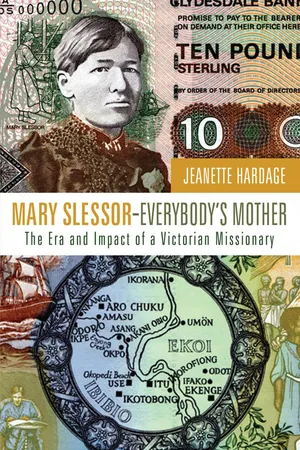
Mary Slessor—Everybody's Mother
The Era and Impact of a Victorian Missionary
- 382 pages
- English
- ePUB (mobile friendly)
- Available on iOS & Android
eBook - ePub
About this book
How did a petite redhead from the slums of Dundee become a role model for a hundred years? How did she come to wield influence in the land known to her compatriots as "the white man's grave"? Why are there statues of her holding twins in Nigeria? How did she develop her missionary fervor combined with down-to-earth common sense? How did she overcome difficult situations throughout her life in ways that set her apart from many Victorians?
Her "eccentricities" are often cited: She climbed trees, marched barefoot and bareheaded through the forest, declined to filter her water, and shed her Victorian petticoats. On the other hand, because of her understanding of and rapport with the Africans among whom she lived, the British government appointed her their first woman magistrate anywhere in the world and later awarded her the highest honor then bestowed on a woman commoner.
Mary Slessor--Everybody's Mother examines the era and influence of this extraordinary woman, who spent thirty-eight years serving as a Presbyterian missionary in Calabar. The work answers questions about the public Mary Slessor. It also looks at her private life. The author makes use of materials not found elsewhere, including Slessor's own writings and those of others of her era, reminiscences of her adopted Nigerian son, and assessments from contemporary sources.
Slessor's audacity in remote areas of Nigeria contrasted with her timidity in public meetings in Scotland. She shunned the limelight and wondered why anyone would want to know about her. Her fame continues, especially in Nigeria and Scotland. She was certain God called her to serve in Calabar, the home she claimed as her own, where she became eka kpukpru owo--everybody's mother.
Information
Topic
Theology & ReligionSubtopic
Christian Theologypart one
Preparing and Going
1848–1879
1
Early Influences
I have a note from Miss Crawford asking me to send you the exact date of my birth: that’s rather a large order isn’t it! To a gentleman I do not have the honour of knowing personally either. But as I am settled in a large family, having 13 of my own rearing in hand, I need not blush, need I? Well, I don’t know whether I was born in 1848 or 49, & the old Family Bible is given away, & the “Act & Testimony” in which also our births were registered was eaten by the ants here [in Africa] years ago, so I don’t know when I can get it. But it was the 2nd day of December of one of those years, that had the doubtful honour of my entrance into this world.
—Mary Slessor, 19011
Shoemaker Robert Slessor and teenaged weaver Mary Mitchell, both born in Aberdeen, Scotland, were married there on May 16, 1840. Their daughter Mary is listed as second of seven children by other biographers, though two of the children’s names are not known, and birth and death records are scanty. Mary Mitchell Slessor was born December 2, 1848 at her maternal grandmother’s house in Gilcomston, a suburb of Aberdeen.
Mary’s brother, Robert, was born in Aberdeen two years later, then sister Susan in 1855. John and Jane were born in Dundee, John in 1857 and Jane in 1862.2 No available records mention the other two Slessor children, who probably died in infancy.
Mrs. Slessor took her children to services at Belmont Street United Presbyterian Church in Aberdeen. She, like hundreds of other Scottish Presbyterians, eagerly read each issue of The Missionary Record. Churches circulated the monthly magazine to inform members of mission comings and goings, progress, problems and needs. The chronicled exploits of David Livingstone, as well as stories of those serving in Calabar and elsewhere, enthralled Mrs. Slessor. She communicated her enthusiasm to her young children, telling them missionary stories.
The mission work at Calabar became a part of Mary’s earliest memories. She often played “church” and “missionaries” with her siblings. With a fiery temper to match her red hair—Mary wrote years later about her brothers and sisters calling her “Carrots” and “Fire”—she was upset when Robert insisted that women couldn’t be preachers or missionaries. She didn’t intend to let him have all the glory she imagined went with being a missionary. When he relented and told her he would take her with him into the pulpit, Mary was satisfied.
Mary’s childhood had a dark side. The skeleton in the closet was her father. Mrs. Slessor tried to keep her husband’s drinking and its dismal results hidden from those around them. He lost his job in Aberdeen in 1857 because of his increasing dependence on alcohol, and the family moved to Dundee. They hoped Mr. Slessor could get a fresh start and that the family’s financial situation would improve. He worked briefly at his old occupation as a shoemaker, then in one of the city’s textile mills. Soon, though, he joined the ranks of the many unemployed men in Dundee and reverted to his old lifestyle. His alcoholism, which one biographer attempts to blame on Mrs. Slessor,3 played its part in molding Mary’s character.
W. P. Livingstone, Mary Slessor’s first biographer wrote: “She was usually reticent regarding her father, but once she wrote and published under her own name what is known to be the story of this painful period of her girlhood. There is no need to reproduce it.”4
Later biographers would wish he had reproduced this manuscript. It is nowhere to be found today, as Livingstone’s papers were destroyed during World War II. His biography first appeared the year Mary Slessor died and went through many reprints. It presents many details of her life that are not available elsewhere. Mary’s report apparently expressed the dread that came with a father who arrived home drunk late on Saturday nights and threw food saved for him into the fire. She told of being locked out at night in tears and waiting until her mother could let her sneak back inside. She told of the embarrassment of often carrying a parcel to the pawnbroker for enough funds for the week’s needs, then rushing off to pay the most urgent bills. All the while, she and her mother tried to keep the facts hidden from the family’s younger children, the neighbors and, more especially, church members.
Mrs. Slessor, already a skilled weaver, began work in one of the mills to help support the family. Mary went to work in the mill, too, probably before she was eleven. Dundee’s 1861 census shows Mary working as a power loom weaver at age twelve, her brother Robert employed as a power loom worker at age ten. Both children were listed as “partly at school,” and both contributed to family sustenance.5
The conversion of the young “wild lassie,” as she called herself later in life, came through the frightening counsel of an old widow who lived nearby. She invited several girls into her warm room from their play. Once they were inside, she began to tell them of their need for a savior. With her strong Calvinist beliefs, she compared the fire in her hearth to the horrors of hell. Their souls would burn in hellfire “for ever and ever” if they did not repent, she told them.6 Mary was appalled. She decided that “repent and believe” was her only option, and once she made that decision she never looked back. Hellfire-and-damnation was never a part of her own mode of operation. In her years of ministry she emphasized a loving God and freedom from fear to a people who already had too many fears.
When she was eighteen Mrs. Slessor took Mary and John (nine years younger) to hear Calabar missionary William Anderson speak in Dundee. She hoped that one of her sons would go as a missionary to Calabar, but Robert died of tuberculosis in 1870. (Mr. Slessor also died a few months later.) That left only thirteen-year-old John as a possible missionary candidate, but John, too, developed tuberculosis—one of the diseases that plagued slums everywhere. Advisors thought a warmer climate might help. He emigrated to New Zealand in 1873 but died a week after arriving there, leaving behind only Mary, her mother and two younger sisters.7
Education and Work
In 1550, Scotland’s Protestant reformers produced their Book of Discipline, which served as a guide for three centuries. Parishes were admonished to provide education. “Elementary schooling for all, girls and boys alike, was the means to salvation: no longer to be gained through the intercession of priests or saints, but by a justification of faith achieved by an individual and personal reading of the Scriptures.”8
Government became involved in education in the 1800s, partly at the behest of church leaders requesting financial aid. The Argyll Commission and others made enquiries and wrote reports, but the major changes came with Scotland’s Education Act of 1872. It outlined strict regulations and required annual inspections of schools, but this came after Mary Slessor’s school days.
It is possible that Mary obtained some schooling at Belmont Street United Presbyterian Church in Aberdeen in her early childhood. As a half-timer at Baxter’s Lower Dens Factory in Dundee, Mary attended Baxter...
Table of contents
- Title Page
- Introduction
- Prologue
- Part One: Preparing and Going—1848–1879
- Part Two: Branching Out—1879–1890
- Part Three: New Possibilities—1890–1900
- Part Four: Queen Mary—1900–1909
- Part Five: A Life Spent—1909–1519
- Part Six: A Legacy—1915 and Later
- Acknowledgements
- Author’s Notes
- Mary Slessor and Mission Chronology Highlights
- Appendix
- Abbreviations
- Bibliography
Trusted by 375,005 students
Access to over 1.5 million titles for a fair monthly price.
Study more efficiently using our study tools.
Frequently asked questions
Yes, you can cancel anytime from the Subscription tab in your account settings on the Perlego website. Your subscription will stay active until the end of your current billing period. Learn how to cancel your subscription
No, books cannot be downloaded as external files, such as PDFs, for use outside of Perlego. However, you can download books within the Perlego app for offline reading on mobile or tablet. Learn how to download books offline
Perlego offers two plans: Essential and Complete
- Essential is ideal for learners and professionals who enjoy exploring a wide range of subjects. Access the Essential Library with 800,000+ trusted titles and best-sellers across business, personal growth, and the humanities. Includes unlimited reading time and Standard Read Aloud voice.
- Complete: Perfect for advanced learners and researchers needing full, unrestricted access. Unlock 1.5M+ books across hundreds of subjects, including academic and specialized titles. The Complete Plan also includes advanced features like Premium Read Aloud and Research Assistant.
We are an online textbook subscription service, where you can get access to an entire online library for less than the price of a single book per month. With over 1.5 million books across 990+ topics, we’ve got you covered! Learn about our mission
Look out for the read-aloud symbol on your next book to see if you can listen to it. The read-aloud tool reads text aloud for you, highlighting the text as it is being read. You can pause it, speed it up and slow it down. Learn more about Read Aloud
Yes! You can use the Perlego app on both iOS and Android devices to read anytime, anywhere — even offline. Perfect for commutes or when you’re on the go.
Please note we cannot support devices running on iOS 13 and Android 7 or earlier. Learn more about using the app
Please note we cannot support devices running on iOS 13 and Android 7 or earlier. Learn more about using the app
Yes, you can access Mary Slessor—Everybody's Mother by Jeanette Hardage in PDF and/or ePUB format, as well as other popular books in Theology & Religion & Christian Theology. We have over 1.5 million books available in our catalogue for you to explore.