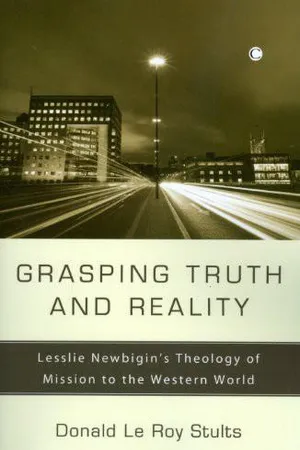
eBook - ePub
Grasping Truth and Reality
Lesslie Newbigin's Theology of Mission to the Western World
- 308 pages
- English
- ePUB (mobile friendly)
- Available on iOS & Android
eBook - ePub
Grasping Truth and Reality
Lesslie Newbigin's Theology of Mission to the Western World
About this book
When Lesslie Newbigin returned to Britain in 1974 after years of missionary service, he observed that his homeland was as much a mission field as India, where he had spent the majority of his missionary career. He concluded that the Western world needed a missionary confrontation. Instead of the traditional approach to missions, however, Newbigin realized that the Western world needed to be confronted theologically.
From his earliest days at Cambridge University, Newbigin developed certain theological convictions that shaped his understanding of the Christian faith. Newbigin utilizes these theological convictions as criteria for evaluating the belief system of Western culture and for providing an answer to Western culture's dilemma.
It is Newbigin's contention that the West is suffering from a loss of purpose because at the time of the Enlightenment, it rejected a belief system that gave it purpose. This was also a belief system that made it uniquely different from the rest of the world, particularly Asia.
The Enlightenment reintroduced humanism and dualism into Western culture, which resulted in the loss of purpose and the rise of skepticism. Modern science and the scientific method, in the form of scientism, added to the problem, making human reason the measure of truth, and limiting facts to only that which could be verified through controlled experiment.
Newbigin's solution is to reintroduce the Christian belief system into Western culture in order to restore purpose and truth to Westerners and to put them into contact with true reality through Jesus Christ. He desires to do this in the context of both modernism and post-modernism.
This book will discuss Newbigin's theological convictions and how they factored into both his critique of and his solution for Western culture's spiritual and worldview problems.
Information
Topic
Teología y religiónSubtopic
Teología cristiana1
A Brief Sketch
of Newbigin’s Life and Work
Each generation since the modern missionary movement began in the eighteenth century has produced a few great missionary statesmen, persons whose thought and work were a major influence on the global missionary enterprise during their particular era and who have influenced subsequent missionary thinking as well. At the end of the twentieth century this honor, it would seem, fell upon Lesslie Newbigin, long time missionary to India and global ecumenical leader.
Before we address his theological and missiological thinking, we need to take a brief look at his life in order to get a clear understanding of the context that produced his theology of mission to the Western world.
A Preliminary Assessment of Newbigin’s Contribution
The Church of England Newspaper, in a banner headline at the top of an article reporting the death of Newbigin, states that he was “one of the century’s foremost Christian statesmen,” an assessment shared by many.1 While much of his missionary career was spent in India or somehow related to the ecumenical movement, the work for which he became best known began after he retired to Britain in 1974. Upon his return, he was confronted with a situation he had not fully anticipated, a church that seemed in retreat and a land, once thought to be Christian, which was in need of serious missionary work. With many decades of missionary experience behind him, Newbigin set out to approach ministry in the Western world with the same assumptions that he had in doing missionary work in Asia.
The same article states that “in any discussion of values in public life and faith and culture, Newbigin’s influence will remain seminal for years to come.”2 David Jenkins, Moderator of the General Assembly of the United Reformed Church, is quoted as saying that Newbigin “will be remembered as an outstanding figure in the Church of the twentieth century. He has proclaimed unity with great courage, probed for truth in turbulent times and has led Christians deeper into faith.”3
George Hunsberger, the North American coordinator of The Gospel and Our Culture movement and author of a significant book on Newbigin, remarked that Newbigin’s “vision of modern Western culture was clear and incisive.”4 Newbigin’s theological thinking did not begin after retirement but began very early in his ministry and remained fairly consistent throughout his life.5 There is evidence of the development of certain themes that appear early but blossom later in the heat of the challenge of a missionary confrontation with Western culture. Additionally, some new themes appear in his response to Western culture that are not present in his earlier writings, primarily because they emerge as a result of the demands of the context.6 Vinoth Ramachandra believes that Newbigin “has mounted one of the most vigorous theological critiques of modern secular culture.”7
A Family Inheritance
Newbigin was, as are all people, a product of his time but also a recipient of certain personal characteristics inherited from his parents. A description of his father’s personality leads one to believe that Newbigin inherited a great deal of his personal characteristics from his father. In his autobiography, Unfinished Agenda, Newbigin mentions his father’s energetic public life, which he somehow managed in addition to his work as a businessman. His father was a broad reader and ‘radical’ in politics, but, Newbigin observes, this “remarkably vigorous and effective public life was not what I perceived as a child.”8 He may have not been aware of it as a child, but he apparently inherited this same knack for public life, because for much of Newbigin’s life he served the church in public positions with enormous energy both in the West and in India.
Newbigin has been described as a “small, polite but insistent man, whom his colleague Martin Conway calls ‘an indefatigable terrier’ in pursuing his convictions.”9 This characteristic can be observed as one reads his many books and articles. His vision is bold and his thinking is focused. His views are clear and repeated often with great force and passion. He does not seem to have a tentative bone in his body nor in his theological thinking. Geoffrey Wainwright, who first met Newbigin in 1963 and had the opportunity of seeing him on various occasions until 1996, says: “the physical and mental impression he made on me was one of disciplined energy.”10 As Wainwright followed Newbigin’s ministry over the years, he was impressed “by the strength and consistency of his vision and its practical enactment.”11 Wainwright’s perspective of Newbigin reflects the enormous role that he has played and continues to play on the global missionary scene:
Throughout his life, his analytical penetration, his conceptual power, and his mental agility ensured the intellectual quality of his practical wisdom; and his ideas remain to be drawn upon by all those who still engage as he did in the tasks of commending the Gospel and defending the Christian faith, of the spiritual formation of individuals and the edification of the believing community, of reforming the Church and restoring its unity.12
Formation of Newbigin as a Christian
Newbigin was born in Newcastle-upon-Tyne on the eighth of December 1909, the son of Presbyterian parents. He went on to attend the Quaker boarding school in Leighton Park where he recalls that he abandoned the Christian assumptions of his upbringing and his childhood. There was a strong deterministic view of history that was being advocated at the school at that time and he recalls a chemistry teacher remarking that “life is a disease of matter.”13 In the midst of such teaching, Newbigin’s faith seemed to disappear.
There were, however, some positive influences for Christian faith on him as well. A book entitled The Living Past by F. S. Marvin had a strong influence upon him during his last year of school. He was strongly influenced later by The Will to Believe by William James.14 James made a remarkable case for belief even though, Newbigin remarks, he was not convinced at the time.15 The seed was planted, however, and it would sprout many years later into a full blown, mature, and well-reasoned faith.
It was during this period when his eyes were opened to ‘structured sin.’ He came to realize the economic and social consequences of competition in the business world. If his father’s firm succeeded, he observed, it would mean the demise of another firm, thus putting people out of work. It was this awareness that would lead him later into the socialist political camp, at least in theory.16 In an actual social situation that Newbigin would later encounter, he saw the shortcomings of socialism, and this led him to reconsider faith as a radical answer to the social situations of the world. His predisposition to action required him to be interested and involved in the public arena.
It was during his Cambridge years (1928–31) that he re-entered the Christian stream, although he approached th...
Table of contents
- Grasping Truth and Reality
- Introduction
- 1 A Brief Sketch of Newbigin’s Life and Work
- 2 Missionary Theologian
- 3 Grasping Truth and Reality
- 4 Humanity’s Need for Salvation
- 5 Newbigin’s Critique of Western Culture
- 6 Newbigin’s Response to Western Culture’s Crisis
- 7 Living in Truth and Reality
- 8 Putting Newbigin in Perspective
- Bibliography
Trusted by 375,005 students
Access to over 1.5 million titles for a fair monthly price.
Study more efficiently using our study tools.
Frequently asked questions
Yes, you can cancel anytime from the Subscription tab in your account settings on the Perlego website. Your subscription will stay active until the end of your current billing period. Learn how to cancel your subscription
No, books cannot be downloaded as external files, such as PDFs, for use outside of Perlego. However, you can download books within the Perlego app for offline reading on mobile or tablet. Learn how to download books offline
Perlego offers two plans: Essential and Complete
- Essential is ideal for learners and professionals who enjoy exploring a wide range of subjects. Access the Essential Library with 800,000+ trusted titles and best-sellers across business, personal growth, and the humanities. Includes unlimited reading time and Standard Read Aloud voice.
- Complete: Perfect for advanced learners and researchers needing full, unrestricted access. Unlock 1.5M+ books across hundreds of subjects, including academic and specialized titles. The Complete Plan also includes advanced features like Premium Read Aloud and Research Assistant.
We are an online textbook subscription service, where you can get access to an entire online library for less than the price of a single book per month. With over 1.5 million books across 990+ topics, we’ve got you covered! Learn about our mission
Look out for the read-aloud symbol on your next book to see if you can listen to it. The read-aloud tool reads text aloud for you, highlighting the text as it is being read. You can pause it, speed it up and slow it down. Learn more about Read Aloud
Yes! You can use the Perlego app on both iOS and Android devices to read anytime, anywhere — even offline. Perfect for commutes or when you’re on the go.
Please note we cannot support devices running on iOS 13 and Android 7 or earlier. Learn more about using the app
Please note we cannot support devices running on iOS 13 and Android 7 or earlier. Learn more about using the app
Yes, you can access Grasping Truth and Reality by Donald Le Roy Stults in PDF and/or ePUB format, as well as other popular books in Teología y religión & Teología cristiana. We have over 1.5 million books available in our catalogue for you to explore.