eBook - ePub
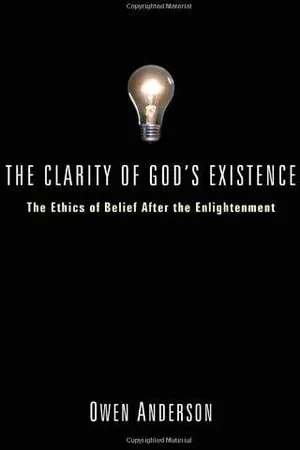
The Clarity of God's Existence
The Ethics of Belief After the Enlightenment
- 224 pages
- English
- ePUB (mobile friendly)
- Available on iOS & Android
eBook - ePub
About this book
The Clarity of God's Existence examines the need for theistic proofs within historic Christianity, and the challenges to these since the Enlightenment. Historically (and scripturally), Christianity has maintained that unbelief is inexcusable. If failing to know God is a sin, the implication is that humans can and should know God. Humans should know God because his eternal power and divine nature are clearly revealed in the things that are made. And yet, Anderson argues, more time is spent on avoiding the need for clarity to establish inexcusability than on actually providing an argument or proof. Proofs that rely on Aristotle or Plato and that establish a Prime Mover or designer are thought to be sufficient. But the adequacy of these, not only to prove the God of theism, but also to prove anything at all, has been called into question by Enlightenment thinkers like David Hume.
After considering the traditional proofs, and tracing the history of challenges to theistic proofs (from Hume to Kant and down to the twentieth century), Anderson argues that the standard methods of apologetics have failed to sufficiently respond. Classical Apologetics, Evidentialism, Presuppositionalism, Reformed Epistemology, and others fail to adequately answer the challenges of the Enlightenment. If this is the case, what is the outcome for Christianity?
Anderson offers an explanation as to why traditional proofs have failed, and for what is necessary to offer a proof that not only responds to Hume and Kant but also establishes the clarity of God's existence. The traditional proofs failed precisely in not aiming at the clarity of God's existence, and they failed in this because of a faulty view of the goal of Christian life. If the blessed life is to be attained in a direct vision of God in heaven, then there is little to no reason to ask for more than the bare minimum required to get into heaven (justification). Furthermore, if the highest blessing is this direct vision, then the glory of God revealed in his work is considered as less important and even set aside. By way of contrast, if God's eternal power and divine nature are clearly revealed in his works, and the blessing comes in knowing God, then it is of the utmost importance for Christianity to demonstrate the clarity of God's existence.
Information
Topic
Theology & ReligionSubtopic
Christian Theology8
The First Step toward the Clarity of God’s Existence
If contemporary Christian philosophers has not provided the foundation for inexcusability and clarity, is such a foundation possible? Hume and Kant denied that reason can be used to know God. Is this the case, or can the use of reason be defended? And can reason be used to show that it is clear that God exists so that there is no excuse for unbelief? If so, what would such an argument look like, what would the steps be for showing this? In this chapter we will consider such steps, and consider if Hume and Kant were inexcusable in their worldview.
8.1. Showing the Clarity of God’s Existence
If there is to be a successful demonstration of the clarity of God’s existence, it must begin by demonstrating that reason can be used to know that something has existed from eternity. The failure of previous arguments was in not aiming to establish clarity (the impossibility of the alternatives) and overextending from premises to conclusion (“highest being = God,” “first mover = God,” “designer = God”). A successful argument must avoid these mistakes. It must be able to identify alternatives to belief in God, and it must be able to show that these are contradictory. It must then show that what is eternal is a spirit, and that this eternal spirit is infinite and unchanging in properties such as knowledge, power, and goodness.
Identifying the alternatives requires defining “God.” In Historic Christian theism, God is a Spirit who is infinite, eternal, and unchanging in being, wisdom, power, holiness, justice, goodness, and truth.1 Unbelief is the denial that this God exists, and the affirmation that something else is eternal (has existed from eternity). If clarity is to be established, it must be proven that only God is eternal, and all other claims about what is eternal are contradictory. It requires showing that there is a clear distinction between eternal and non-eternal. The first step in doing this requires proving that something must have existed from eternity, and that reason can be used to know this. The alternative to this is that there was an uncaused event in which being came from non-being. Locke was quoted earlier as saying that nothing could be more absurd than holding that being came from non-being. But the following two chapters are going to consider this possibility in order to argue that it is clear that something has existed from eternity. To do this requires clearly defining what “being from non-being” and “uncaused event” mean, and considering important philosophers who have maintained that it is possible that being came from non-being. This analysis will help to show what is meant in saying “it is clear that something has existed from eternity,” and that the alternative to clarity is a self-contradiction which ends in silence. One must be silent when one’s assertions are self-contradictory and thus are not about anything. They are about nothing.
8.2. Steps for Showing the Clarity of God’s Existence
Beyond finding such a proof, we must also come to understand why it is inexcusable to not know God. This entails understanding what steps are needed to show that God exists. I have maintained that the traditional proofs overextend themselves in that they do not support theism. What is necessary to arrive at theism and then successfully defend it from challenges? Here I am going to suggest 10 steps that are based on work by Surrendra Gangadean in his book Philosophical Foundation: A Critical Analysis of Basic Beliefs, and in his chapter “The Necessity of Natural Theology” in my book Reason and Worldviews. They are:
1. Show that there must be something eternal.
Show that only some is eternal by showing:
2. Show that matter exists (vs. spiritual monism, and idealism).
3. Show that matter is not eternal (vs. material monism).
4. Show that the soul exists (vs. material monism and Advaita Vedanta)
5. Show that the soul is not eternal (vs. Dvaita Vedanta and other forms of spiritual monism).
6. Respond to the problem of evil (moral and natural).
7. Respond to natural evolution (vs. uniformitarianism and materialistic reductionism).
8. Respond to theistic evolution (the original creation was very good—without evil).
9. Respond to deism (the necessity for special revelation).
10. Show that there is a moral law that is clear from general revelation.
This approach avoids the criticism of overextension because it identifies what must be proven: God is a spirit who is infinite, eternal, and unchanging in being, wisdom, power, holiness, justice, goodness, and truth. It then identifies the historic challenges to this position and argues against them: material monism, spiritual monism, and dualism. It then further identifies the major challenges to theism from cosmology and teleology: evolution, theistic evolution, and the problems of evil and suffering. For a development of each of these steps and how they are worked out the reader can follow-up with Philosophical Foundation. Here my concern is to ask: Can the challenge to reason from the Enlightenment be successfully answered, and can reason help us in making the first step toward a proof for the clarity of God’s existence?
8.3. Clarity and the Inexcusability
of Hume and Kant
What does it mean to be without excuse? Persons can come up with excuses for just about anything in order to justify themselves, so we must distinguish between being without an excuse and seeing that oneself has no excuse. Being without excuse is objective and can be seen by others who know what to look for. Earlier it was stated that one is inexcusable if:
1. One holds to self-contradictory beliefs.
2. One does not have integrity—does not live according to the principles one teaches.
3. One does not know what is clear—since thinking is presuppositional (the less basic assumes the more basic), if anything is clear, the basic things are clear. Thus, one is inexcusable if one does not know what is basic.
4. One does not see what is clear. Clarity requires distinguishing between a and non-a. An example of a basic belief that is clear is the distinction between being and non-being. There is no excuse for failing to distinguish these because their distinction is the foundation of all thought—to give an excuse requires this distinction.
As I move from arguing about the necessity for clarity and inexcusability within Christian theism, and the failure to provide these, to a criticism of Hume and Kant, I want to lay out the steps that would lead to a successful proof for God’s existence. These steps are necessary to show that God as understood in Christian theism exists. In this book I mainly deal with the first step because the challenges from the Enlightenment are challenges to reason’s ability to make even this step. Once we have laid the foundation for how reason can indeed make this step, then the important work of the following steps can be addressed.2 I want to sharply distinguish my approach from the common method of apologists who believe that if they have shown that the material universe had a beginning, and perhaps that the cause of that beginning is personal, then they have just about exhausted the content of general revelation and somehow moved us closer to Christian theism. But this does not move us closer to Christian theism—it does not address the possibility of dualism, or spiritual monism both of which have been maintained by influential world religions. If general revelation cannot get us past simply a first mover who might be personal, then it cannot provide the inexcusability necessary for the redemptive claims of Christianity.
Consider the steps for showing the clarity of God’s existence given previously. These steps avoid one of the major problems of the traditional proofs—they clearly identify the opposites to theism. But they are still susceptible to the challenge from Hume and Kant because those challenges aimed to undermine reason’s ability to make even the first step. Therefore, the following will ask if Hume and Kant were consistent in their own position, or if their positions can be used to show that something must be eternal, and therefore that they were inexcusable in their failure to know God (Kant may have believed, but he provided a basis for objections and never moved from believing to knowing).
In light of those considerations, we must first consider if a response can be given to the challenges of the Enlightenment, the essence of which is that reason cannot provide a proof for God’s existence. We have studied the challenges to theistic proofs from Hume and Kant. What does a response to these challenges require? Hume criticized the theistic proofs by limiting knowledge to the relation of ideas and sense data. Kant argued that reason cannot tell us about being and what exists. One move is to respond to these challenges by challenging their assumptions about the sources of knowledge. Indeed, the empiricism of Hume has many problems, as does Kant’s phenomenal/noumenal distinction. But an even more potent response is one that shows how both Hume and Kant have no excuse for their unbelief, and that while they may have issued important and relevant corrections to the theistic proofs, showing the need for more work, they could have and should have gone further themselves and provided a clear proof for God’s existence. Here I will argue that working within the confines of Hume’s epistemology, and Kant’s critique of reason, there is no excuse for their unbelief.
To say that Hume and Kant are inexcusable is to say that they did not see what is clear, they were not consistent within their own worldviews, and they did not live the implications consistently. To not see what is clear is to confuse and distort what is basic—it is to confuse being and non-being in alleging that there could be unca...
Table of contents
- The Clarity of God’s Existence
- Foreword
- Preface
- Acknowledgments
- Inexcusability, Redemption, and the Need for Clarity
- Attempts to Avoid the Need for Clarity
- Attempts to Avoid the Need for Arguments
- Theistic Arguments before Hume
- Enlightenment Challenges to Theistic Belief
- Victory Over Theism?
- Theistic Responses to the Challenge of Hume and Kant
- The First Step toward the Clarity of God’s Existence
- Historical Overview of Being from Non-Being
- Conclusion: Where Do We Go from Here?
Trusted by 375,005 students
Access to over 1.5 million titles for a fair monthly price.
Study more efficiently using our study tools.
Frequently asked questions
Yes, you can cancel anytime from the Subscription tab in your account settings on the Perlego website. Your subscription will stay active until the end of your current billing period. Learn how to cancel your subscription
No, books cannot be downloaded as external files, such as PDFs, for use outside of Perlego. However, you can download books within the Perlego app for offline reading on mobile or tablet. Learn how to download books offline
Perlego offers two plans: Essential and Complete
- Essential is ideal for learners and professionals who enjoy exploring a wide range of subjects. Access the Essential Library with 800,000+ trusted titles and best-sellers across business, personal growth, and the humanities. Includes unlimited reading time and Standard Read Aloud voice.
- Complete: Perfect for advanced learners and researchers needing full, unrestricted access. Unlock 1.5M+ books across hundreds of subjects, including academic and specialized titles. The Complete Plan also includes advanced features like Premium Read Aloud and Research Assistant.
We are an online textbook subscription service, where you can get access to an entire online library for less than the price of a single book per month. With over 1.5 million books across 990+ topics, we’ve got you covered! Learn about our mission
Look out for the read-aloud symbol on your next book to see if you can listen to it. The read-aloud tool reads text aloud for you, highlighting the text as it is being read. You can pause it, speed it up and slow it down. Learn more about Read Aloud
Yes! You can use the Perlego app on both iOS and Android devices to read anytime, anywhere — even offline. Perfect for commutes or when you’re on the go.
Please note we cannot support devices running on iOS 13 and Android 7 or earlier. Learn more about using the app
Please note we cannot support devices running on iOS 13 and Android 7 or earlier. Learn more about using the app
Yes, you can access The Clarity of God's Existence by Owen Anderson in PDF and/or ePUB format, as well as other popular books in Theology & Religion & Christian Theology. We have over 1.5 million books available in our catalogue for you to explore.