- 134 pages
- English
- ePUB (mobile friendly)
- Available on iOS & Android
eBook - ePub
About this book
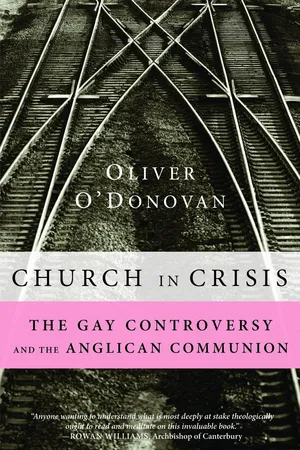
What if the challenge gay men and women present the church with is not emancipatory but hermeneutic? Suppose that at the heart of the problem there is the magna quaestio, the question about the gay experience, its sources and its character, that gays must answer for themselves: how this form of sensibility and feeling is shaped by its social context and how it can be clothed in an appropriate pattern of life for the service of God and discipleship of Christ? But suppose, too, that there is another question corresponding to it, which non-gay Christians need to answer: how and to what extent this form of sensibility and feeling has emerged in specific historical conditions, and how the conditions may require, as an aspect of the pastoral accommodation that changing historical conditions require, a form of public presence and acknowledgment not hitherto known? These two questions come together as a single question: how are we to understand together the particularity of the age in which we are given to attest God's works?
Information
Topic
Theology & ReligionSubtopic
Christian Church1
The Failure of the Liberal Paradigm
Your treaty with death will be annulled, and your pact with Sheol will not stand.
(Isa 29:18)
Eighty years ago the poet Robert Frost penned an affectionately mocking portrait of his home state: endowed with every feature and advantage, it was proud of having nothing to sell, nothing “in commercial quantities.” But did it perhaps have “an idea to sell”—like the man who once tried to persuade him to write a political pamphlet in verse? No, Frost declares—unpresciently, as it now seems. “It never could have happened in New Hampshire!”1
In 2003 New Hampshire had an idea to sell. On all sides it was agreed, it was the principle of the thing. No one pleaded in defense of the consecration that, after all, the Anglican Communion could surely wink an eye at one gay bishop! What was on trial was quite simply a proposition: a divorcé in an active homosexual partnership may be a worthy chief pastor of a Christian flock. Two years earlier a diocese in Canada had stepped forward, probably outside its legal competence, to enact another proposition: the church may solemnize a same-sex union with a rite of blessing. In the subsequent row, the two propositions have become inextricably associated; in the future, if the Anglican Communion has a future, they will need to be disentangled again.
What was implied in the propositions? What did they mean to say about the creation of Adam and Eve, about Natural Law and history, about principle and pastoral accommodation? The difficulty was that we did not know, and still do not. They had the virtue and the weakness of all political propositions: they could be read in many ways, with different interpretations put on them and different inferences drawn from them. In defending them the North American churches followed the counsel that it was wiser not to be too explicit. They spoke to the world about a “discernment” they had been privileged to make over a long time and from the grassroots up, leaving the ontology of the question strictly to one side.2 The Windsor Report thought it surprising that the actions of the Canadian and US churches were so unaccompanied by theological explanation or interpretative commentary.3
The North American initiative presaged a worldwide drought of trust and understanding in the Anglican churches, in which every spring of traditional affection seemed to dry up and the communion seemed near to death. At the Dromantine meeting of 2005, the Primates themselves declined to receive communion together. Responding to the emergency, the Primates’ meetings of 2003 and 2005, together with The Windsor Report (2004) which they commissioned and endorsed, attempted to create a new kind of worldwide conciliar process such as Anglican churches had never had before and had never needed. It has moved painfully slowly, so slowly that some have wanted to declare it stillborn. The Archbishop of Canterbury’s measured statement of June 27th, 2006, however, still showed a resolve to carry it forward in the wake of the resolutions of the 2006 General Convention of the Episcopal Church of the USA (ECUSA). As Lambeth 2008 approaches, there may be a cloud no bigger than a man’s hand to be seen on the horizon. It is too early to be sure.4
The task these essays address is that of sketching in outline the content of a consultative endeavor still very difficult to conceive in detail. If the “miscarrying womb and dry breasts” with which Newman reproached his mother-church in his valedictory sermon, “Parting of Friends” were a rhetorical extravagance on the part of one who had lost his sense of proportion, there are plenty who, with greater or less exaggeration, repeat the charge today.5 Can we find an answer to it? That will certainly depend on the Anglican churches’ ability to sustain a disciplined common deliberation about Christian life in the world. But to pave the way for that, we must engage with the situation to which the churches have come in a manner that will strike some as polemical. To sketch broad lines of opinion, to subject them to broad lines of criticism, is a rough-and-ready business at best and inevitably a contentious one. If the sketch is any good, some will see their opinions reflected in it; if it has any breadth, they will complain that justice has not been done to their subtleties. How can it be otherwise? I know no way of escaping the problem but to ask for as much charity and fairness in return as my reader may think I have offered.
For it has to be said at the beginning: the crisis in Anglican Christianity is quite specifically a crisis in its hegemonic tradition and the manner in which it has managed and controlled differences in the past. The church’s old habits of negotiating stubborn oppositions by synthesizing them within a central, undogmatic stream of opinion—let us follow the convention and call the paradigm “liberal,” without prejudice to any person or group claiming that title as their own—seem to have fallen away. When from as early as Queen Victoria’s day British prime ministers preferred liberal bishops, it was because they seemed to be able to stop the church from falling apart; they seemed to have made a covenant with death and a pact with Sheol. They mediated effectively between antithetical dogmatic poles, catholic and evangelical, that marked the extremes of Anglican identity since the Oxford movement in the 1830s. In the late twentieth century, it began to be apparent that this traditional spectrum might be reconfigured; what the New Hampshire crisis announced was that this had finally occurred. The historically centripetal middle had become a new centrifugal pole.
Recent essays advocating a revisionist approach to homosexuality afford an interesting perspective on the present state of liberal Anglican thought.6 It appears to be in deep denial: denial about the record of the past, denial about the traditional role of the Lambeth Conference and its authority, denial about the crisis of the present. (One theologian actually counsels us to deal according to the old proverb “If it ain’t broke, don’t fix it!”) In deploring what the Primates have done, it offers little acknowledgment that the Anglican Communion is in sore need of doing something. There are times, of course, when it is the higher wisdom not to produce answers to every practical dilemma others thrust on us. Like a breach birth, a moral crisis may present itself from the wrong angle and need rotation before it can be brought into the daylight of a sensible answer. It may be that before the problems of the post–New Hampshire churches can be solved, a pas en arrière is required, a reopening of some questionable assumptions. But that defense is not available to liberals who oppose that very strategy when it is pursued by the Windsor-Dromantine process. Stepping back, untangling the skein, reconciling conflicting views, toning down exaggerated positions, forging coalitions, squaring circles, finding commonsense ways through: the whole stock in trade of a tradition once defined by opposition to enthusiasm of every kind, seems to have been mysteriously wiped off the software. In its place are radical postures, strident denunciations and moralistic confessionalism. Here we are at act 1, scene 2, on the opening night, and the production is already going badly: the scenery has collapsed; the villain has fluffed the lines that should have struck terror into the Upper Circle; the curtain has been down too long; the audience is restive. Surely it is time for the hero to appear, and the lovely heroine whose courage and beauty draw the crowds back to see the play a dozen times? And where are the well-drilled extras who will keep them on the edge of their seats with a stunning display of hand-to-hand fighting? The producer looks around, nervously. Good Lord! There they are, up in the gallery, booing and catcalling along with the audience!
Religious liberalism is not an Anglican phenomenon alone, but a pan-Protestant one. “Pan-Christian,” one might say, since Roman Catholicism has had two difficult engagements with its own liberals in the course of the twentieth century, one in the early years with the so-called Modernist Controversy about historical biblical criticism, the other in the postconciliar period about the direction of moral theology. But the hegemonic character of liberalism in the Protestant churches has given it a distinctive profile, which deserves to be treated on its own terms. “Liberal” is a word with many uses, both intellectual and political, and its protean polyvalence can create misunderstanding. Political liberalism and theological liberalism are animals of a single genus but different species. When qualifying a religious posture, “liberal” suggests independence in relation to spiritual authorities—scriptural, hierarchical, or congregational. This distance may be no more than a questioning habit of mind, an independence of judgment that may lead back to a new and clarified recognition of authority. It may, on the other hand, be a deep alienation that fosters resentments which never quite proceed to an open breach. There is no way of telling a priori where on the spectrum of distance any “liberal” proposal will turn out to lie. It may be renewing; it may be subversive. The tree will be known by its fruits, and by nothing else. Yet in the lowering gloom of the Liberal Christian evening, we ought to begin by acknowledging the good that has been wrought in its day. No major theological voice of our age has failed to have its intonations deepened by what the Archbishop of Canterbury describes as its “habit of cultural sensitivity and intellectual flexibility that does not seek to close down unexpected questions too quickly.”7 For what we have received may the Lord make us truly thankful!
The story of theological liberalism could in principle be taken back a long way—certainly to the fission of the established Protestant churches in the seventeenth century, and perhaps to Renaissance humanism, even to Abelard. To understand the twentieth century, however, it makes sense to begin from the nineteenth-century attempt to reconstruct the expression of Christian doctrine by reference to ethics, the program of “the primacy of the ethical,” drawn from the Ritschlian school of post-Kantian theologians in Germany. The interests of this school lay with dogma, which needed adaptation to the scientific climate of post-Enlightenment civilization. Ethics had “primacy,” but only in the sense of being presupposed; it was the starting point of the dogmatic inquiry. To the intelligentsia of this period ethical judgments seemed very much more certain than creedal formulations. Predestination, resurrection, the omniscience and omnipotence of God, each chapter in the catechism could be interrogated as to its expression of the noblest and highest ideals, and rewritten as necessary. Ethics afforded a criterion by which the truth of doctrine could be verified: “belief in truth of a special and practical kind . . . as life-truth, in its central and creative reality for our person, and not in its congruity with other truth. . . . Christ did not come to teach us truth, but to make us true.”8 The ethical conception of truth was the essence of the modern; and this program was ex professo “modernist,” taking for granted that the highest and noblest ideals were being grasped and realized in contemporary history. Standing in no need of independent inquiry to verify them, they were immediately available to verify Christian dogma.
It has often been claimed that liberalism implied no special doctrines but was merely a critical temper of mind. This claim was never quite untrue; but it is an important aspect of our current situation that it was never quite true either. Liberalism related itself to the traditional dogmas of the church and aimed to modulate them. Inevitably, its methodology was reflected in an account of Christian belief with a distinctive shape. The inner shrine of the liberal gospel was its attitude of respectful attentiveness to the world as it is. The term “incarnation,” used without an article, speaks of this embrace of the world. This is something different from the incarnation, the historical birth of Jesus the Son of God from Mary, which is now reconstructed as a paradigm or model for a conjunction of the human and divine to be effected in all times and places. The incarnation of the Word takes place continually. Being party to the positive conjunction of God and world is the distinct form of theosis offered to believers in liberal theology.
In making this conjunction its object, liberalism assimilated a Protestant construction of Christian existence in missiological terms. In assuming it already present and needing only to be affirmed, it assimilated a Catholic, doxological one. Yet the conception is neither Protestant nor Catholic. Both t...
Table of contents
- Title—Church in Crisis
- Preface
- 1 The Failure of the Liberal Paradigm
- 2 The Care of the Churches
- 3 Ethics andAgreement
- 4 Scripture and Obedience
- 5 Hermeneutic Distance
- 6 Creation, Redemption, and Nature
- 7 Good News for the Gay Christian?
- Bibliography
Trusted by 375,005 students
Access to over 1.5 million titles for a fair monthly price.
Study more efficiently using our study tools.
Frequently asked questions
Yes, you can cancel anytime from the Subscription tab in your account settings on the Perlego website. Your subscription will stay active until the end of your current billing period. Learn how to cancel your subscription
No, books cannot be downloaded as external files, such as PDFs, for use outside of Perlego. However, you can download books within the Perlego app for offline reading on mobile or tablet. Learn how to download books offline
Perlego offers two plans: Essential and Complete
- Essential is ideal for learners and professionals who enjoy exploring a wide range of subjects. Access the Essential Library with 800,000+ trusted titles and best-sellers across business, personal growth, and the humanities. Includes unlimited reading time and Standard Read Aloud voice.
- Complete: Perfect for advanced learners and researchers needing full, unrestricted access. Unlock 1.5M+ books across hundreds of subjects, including academic and specialized titles. The Complete Plan also includes advanced features like Premium Read Aloud and Research Assistant.
We are an online textbook subscription service, where you can get access to an entire online library for less than the price of a single book per month. With over 1.5 million books across 990+ topics, we’ve got you covered! Learn about our mission
Look out for the read-aloud symbol on your next book to see if you can listen to it. The read-aloud tool reads text aloud for you, highlighting the text as it is being read. You can pause it, speed it up and slow it down. Learn more about Read Aloud
Yes! You can use the Perlego app on both iOS and Android devices to read anytime, anywhere — even offline. Perfect for commutes or when you’re on the go.
Please note we cannot support devices running on iOS 13 and Android 7 or earlier. Learn more about using the app
Please note we cannot support devices running on iOS 13 and Android 7 or earlier. Learn more about using the app
Yes, you can access Church in Crisis by Oliver O'Donovan in PDF and/or ePUB format, as well as other popular books in Theology & Religion & Christian Church. We have over 1.5 million books available in our catalogue for you to explore.