eBook - ePub
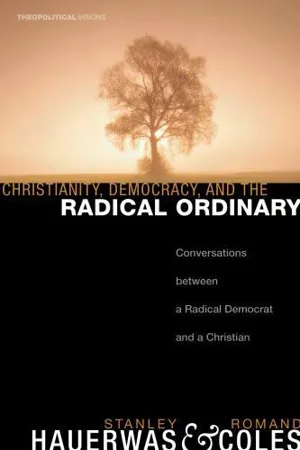
Christianity, Democracy, and the Radical Ordinary
Conversations between a Radical Democrat and a Christian
- 378 pages
- English
- ePUB (mobile friendly)
- Available on iOS & Android
eBook - ePub
Christianity, Democracy, and the Radical Ordinary
Conversations between a Radical Democrat and a Christian
About this book
In Christianity, Democracy, and the Radical Ordinary, theologian Stanley Hauerwas and political theorist Romand Coles reflect about possibilities and practices of radical democracy and radical ecclesia that take form in the textures of relational care for the radical ordinary. They seek to shift political and theological imaginations beyond the limits of contemporary political formations (such as global capitalism, the mega-state, and empire), which they argue are based upon both the denial and production of death.
Hauerwas and Coles call us to a revolutionary politics of "wild patience" that seeks transformation through attentive practices of listening, relationship-building, and a careful tending to places, common goods, and diverse possibilities for flourishing. Both authors translate back and forth across--as well as dwell in the tensions between--the languages of radical democracy and of trial, cross, and resurrection. Engaging each other through a variety of genres--from essays, to letters, to cowriting and dialogue--Hauerwas and Coles seek to enact a politics that is evangelical in its radical receptivity across strange differences and that cultivates power in relation to vulnerability.
The authors argue that there is a strong relation between hope and imagination, as well as between imagination and the encounter with and memory of those who have lived with receptive generosity toward the radical ordinary. Hence, throughout this book they think extensively in relation to specific lives and practices: from Ella Baker and the early Student Nonviolent Coordinating Committee organizing efforts for beloved community and civil rights, to L'Arche communities founded by Jean Vanier, to contemporary faith-based radical democratic organizing efforts in dozens of cities by the Industrial Areas Foundation. Pushing and pulling each other into new and insightful journeys of political imagination, this conversation between a radical Christian and a radical democratic trickster spurs us toward a politics that acknowledges, tends to, and enacts the powers of the radical ordinary.
Information
Topic
Theology & ReligionSubtopic
Christian Theology chapter 1
A Haunting Possibility:
Christianity and Radical Democracy
Why John Howard Yoder Haunts Romand Coles
Near the end of a chapter titled “The Wild Patience of John Howard Yoder,” in his book Beyond Gated Politics: Reflections for the Possibility of Democracy, Romand Coles confesses:
If I see Yoder’s Jesus as a great story, it is not simply because it resonates so much with themes of dialogue and receptivity that I embraced long before my encounter with his writing. More importantly, it is great the way the sublime that is unconquered by sovereign subjectivity is great: It mightily calls into question my perception, sense-making, reach, direction, ethical and political faiths. Yoder haunts me. He is not an easy ghost, but I want to want him with me. I want him opening new doors and windows in my cave, offering new light and air, and occasionally rattling my walls until I feel in my bones “there’s no place like home” and find myself engaged in a new thing.1
By exploring why Coles is “haunted” by John Howard Yoder, I want to open an investigation into the relation between the church and radical democracy. I want to want to do so, because I am haunted by Romand Coles. He is my colleague and friend. We have even co-taught a course on “Christianity and Radical Democracy.” I admire Coles’s willingness and courage to read theologians like Yoder and Rowan Williams and the challenge they present for how he thinks about politics and political theory. To witness Coles reading is a lesson in the generosity he argues is at the heart of the practice of radical democracy. I cannot pretend to possess the same reading habits, but I at least want to use this opportunity to engage Coles’s worries concerning why and how Christian jealousy about Jesus might make Christians distrustful allies in the struggle for radical democracy. I hope I will be able to convince Coles (and myself) that Christians are able to make a constructive contribution to the development of radical-democratic alternatives.
Coles’s worries concerning Yoder’s “jealousy” about Jesus must be understood against the background of his account of radical democracy. According to Coles, the future of democracy depends on finding alternatives to the dominant forms of “disengaged liberal democracy” currently identified with the nations of the West (x). Coles argues that the very clarity characteristic of theorists such as John Rawls conceals liberalism’s fear of our tragic finitude (26). Rawls’s inability to acknowledge “tragedy’s tragedy”—that is, the inescapable reality of the limits of our political vision—is exemplified by Rawls’s setting aside as “extensions” questions of the identity and ethical substance of “a society” in the name of imposing a public reason we allegedly have in common (5). As a result, power is concealed by a flattened political process designed to disqualify in principle advocates of comprehensive doctrines that refuse to be domesticated or marginalized in the name of “peace.”
By contrast Coles argues that democracy cannot be a “possession” but rather is a practice
in search of itself, struggling beyond pasts and presents in which it was unrealized (both for many people and across many domains of life) and in the face of futures threatening to retrench its achievements and aspirations. Democracy happens primarily as a generative activity in which people seek to reinvent it in challenges and contestations concerning the questions of what it might become. Democracy is democratization. And when it has been brought to life historically (by abolitionists, feminists, antiwar activists, populists in the nineteenth century, the civil rights movement, Native American rights activists, grassroots community activists, and so on), it has always hinged upon those who sensed, in their myriad insurgent, inventive, and receptive capacities, that democracy was, is, and will be significantly beyond democracy as “we” know it in its dominant forms: beyond the arbitrary exclusions, subjugations, and dangers that accompany every democratic “we” and their “knowing” and disclose complacency toward present practices as a sham. Democratization has always depended upon those who embark beyond democracy’s dominant forms to invent greater equality, freedom, and receptive generosity toward others. (xi)
“Tension-dwelling,” therefore, becomes one of the essential characteristics of radical democracy, which leads Coles to quite a sympathetic reading of Alasdair MacIntyre. From Coles’s perspective, MacIntyre’s understanding of the conflict between traditions is a constructive alternative to capitalist cosmopolitanism. Yet he fears that MacIntyre’s understanding of the “conflict of the faculties” lacks the basis for a generosity towards others that comes from “a sense of finitude wrought by vulnerable engagements with others whose differences bring it vividly into the foreground” (99). In contrast, Derrida—who at times evokes the radical responsibility for hospitality to the “new born child,”—begins to gesture toward the kind of dissymmetry necessary for democratic engagement.
Coles recognizes that some will find his account of radical democracy far too vague, but to counter such criticism he provides accounts of the concrete political work done by feminists of color as well as by the Industrial Areas Foundation (IAF). The IAF is particularly important for his case because, from Coles’s perspective, the IAF’s practice of the complex art of listening is constitutive of a politics that depends on organizing through the establishment of relationships.2 Through such listening, what is radical about radical democracy becomes apparent: democracy has no stable “table” around which differences can be gathered. Rather the democratic table must move and be transformed in such a way that “the space and lines of separation and relation undergo repeated and unwonted change” (231).
Radical democracy is, therefore, most determinatively exemplified by urban organizing practices that engage a wide spectrum of people by bridging political divisions. Coles does not assume that all forms of radical democracy will be local, but rather that local politics “provides a crucial learning ground for political work on many other scales, and, moreover, that analogous modes of receptivity will have to be invented at these larger scales if democratic efforts are better able to avoid problems of political disengagement, bureaucratic professionalism, and so on” (xxviii).
This finally brings us to why Yoder, whom Coles treats between his chapters on MacIntyre and Derrida, is so important for Coles’s account of radical democracy. Coles, a member of no church, finds in Yoder “a vision of dialogical communities that brings forth very particular and powerful practices of generous solidarity precisely through creative uses of conflict and a vulnerable receptivity to the ‘least of these’ within the church and to those outside it” (110, emphasis in original). Coles notes that what particularly attracts him to Yoder, given the argument of Beyond Gated Politics, is the way Yoder combines bearing witness to his confessedly provincial tradition and remaining vulnerable and receptive to others who do not share his tradition (111).3
Coles acknowledges that he cannot avoid translating and developing Yoder’s vocabulary (and Coles quite rightly knows that vocabulary is everything) into his own idiom. But Coles also refuses to try to “get around” Yoder’s Christocentrism. For Coles recognizes that the characteristics he finds so admirable in Yoder’s account of patience and vulnerability are inseparable from Yoder’s understanding of what is entailed by being a disciple of Jesus. Yoder’s commitment to nonviolence, and the patience required to be nonviolent, are unintelligible if the practice of nonviolence as well as the corresponding virtue of patience are divorced from Yoder’s understanding of the community gathered in the name of Jesus. The name for Yoder’s politics is “church.”
Coles is particularly impressed by Yoder’s account of the necessity of the church’s unending task of “reaching back” to Scripture to test again and again whether it is being faithful to Jesus. To “reach back” is not just another form of proceduralism but rather an expression of confidence that through the dialogical process of confrontation and reconciliation, the church will discern how it may have confused the gospel with worldly pretension. Yoder’s name for the attempt to make the church safe by joining its destiny to worldly powers is “Constantinianism,” which, drawing on his Anabaptist heritage, Yoder argues the church must disavow. That disavowal not only requires the church to give up claims of political, legal, and social establishment, but also, and more importantly, requires the church to abandon all attempts to secure the gospel through foundational epistemological strategies.4
Yoder argues that the church precedes the world epistemologically, but Coles rightly argues that does not mean that Yoder thinks the church has nothing to learn from the world. Rather it means that there can be no “politics of Jesus” that could be coercive, selfish, nondialogical, or invulnerable (121). Therefore, Christians, from Yoder’s perspective, should welcome the diversity of peoples that Babel represents because only by engagements with different communities does the church learn what it means to be a community of truth and love.
Coles therefore admirably presents Yoder’s understanding of the “politics of Jesus” as a refusal to confine the church to a private sphere. “Jesus is Lord” does not have the grammar of a private speech act. Nonetheless Coles worries that the confession “Jesus is Lord” might “constitute a radical deafness to nonbelieves and a confinement of prophesy to those within the church, so that the dialogic conditions of agape within give way to monological practices toward others outside in a manner likely to proliferate blindness and violence” (119). Coles therefore raises the question of whether there might not be an element of complicity between pre-Constantinian proclamations of “fidelity to the jealously of Christ as Lord” and the rise of Constantinianism (133, 135).5
Coles observes that even if these questions point to a problem, they are not, nor are they meant to be, devastating challenges to Yoder’s position. Rather Coles’s commitment to radical democracy makes him think it important to ask if Yoder’s way of affirming Jesus as Lord might weaken his ability to engage in receptive engagements with “some forms of polytheism, atheism, and postsecular modes of enchantment, as well as with a lot of critical work being done by liberation theologians, critical race theorists, feminists, students of postcoloniality, and ecologists” (136). Noting that he has absolutely no authority to urge Mennonite Christians how to think about these matters, Coles nonetheless thinks Yoder would have benefited by engaging these other voices.
Coles ends his chapter on Yoder by articulating some of the challenges Yoder presents to radical democrats. He asks, for example, how radical democrats might develop, as Yoder has, enduring practices of resistance; Coles also asks if radical democrats can show how a certain jealousy might be unavoi...
Table of contents
- Christianity, Democracy, and the Radical Ordinary
- Preface
- Introduction
- Chapter 1: A Haunting Possibility: Christianity and Radical Democracy
- Chapter 2: Letter of July 17, 2006
- Chapter 3: “To Make This Tradition Articulate”: Practiced Receptivity Matters, Or Heading West of West with Cornel West and Ella Baker1
- Chapter 4: Race: The “More” It Is About: Will D. Campbell Lecture University of Mississippi, 2006
- Chapter 5: Letter of April 16, 2007
- Chapter 6: Democracy and the Radical Ordinary: Wolin and the Epical Emergence of Democratic Theory
- Chapter 7: The Pregnant Reticence of Rowan Williams: Letter of February 27, 2006, and May 2007
- Chapter 8: The Politics of Gentleness: Random Thoughts for a Conversation with Jean Vanier
- Chapter 9: “Gentled Into Being”
- Chapter 10: To Love God, the Poor, and Learning: Lessons Learned from Saint Gregory of Nazianzus
- Chapter 11: Letter of January 8, 2005
- Chapter 12: Hunger, Ethics, and the University: A Radical-Democratic Goad in Ten Pieces
- Chapter 13: Of Tensions and Tricksters: Grassroots Democracy between Theory and Practice1
- Chapter 14: Seeing Peace: L’Arche as a Peace Movement
- Chapter 15: A Conversation
- Bibliography
Trusted by 375,005 students
Access to over 1.5 million titles for a fair monthly price.
Study more efficiently using our study tools.
Frequently asked questions
Yes, you can cancel anytime from the Subscription tab in your account settings on the Perlego website. Your subscription will stay active until the end of your current billing period. Learn how to cancel your subscription
No, books cannot be downloaded as external files, such as PDFs, for use outside of Perlego. However, you can download books within the Perlego app for offline reading on mobile or tablet. Learn how to download books offline
Perlego offers two plans: Essential and Complete
- Essential is ideal for learners and professionals who enjoy exploring a wide range of subjects. Access the Essential Library with 800,000+ trusted titles and best-sellers across business, personal growth, and the humanities. Includes unlimited reading time and Standard Read Aloud voice.
- Complete: Perfect for advanced learners and researchers needing full, unrestricted access. Unlock 1.5M+ books across hundreds of subjects, including academic and specialized titles. The Complete Plan also includes advanced features like Premium Read Aloud and Research Assistant.
We are an online textbook subscription service, where you can get access to an entire online library for less than the price of a single book per month. With over 1.5 million books across 990+ topics, we’ve got you covered! Learn about our mission
Look out for the read-aloud symbol on your next book to see if you can listen to it. The read-aloud tool reads text aloud for you, highlighting the text as it is being read. You can pause it, speed it up and slow it down. Learn more about Read Aloud
Yes! You can use the Perlego app on both iOS and Android devices to read anytime, anywhere — even offline. Perfect for commutes or when you’re on the go.
Please note we cannot support devices running on iOS 13 and Android 7 or earlier. Learn more about using the app
Please note we cannot support devices running on iOS 13 and Android 7 or earlier. Learn more about using the app
Yes, you can access Christianity, Democracy, and the Radical Ordinary by Stanley Hauerwas,Romand Coles in PDF and/or ePUB format, as well as other popular books in Theology & Religion & Christian Theology. We have over 1.5 million books available in our catalogue for you to explore.