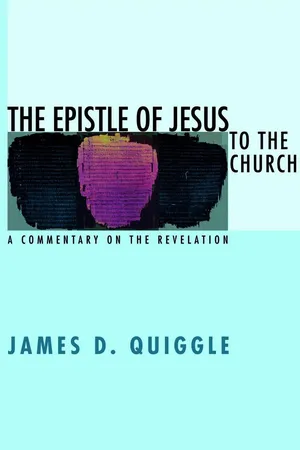
The Epistle of Jesus to the Church is a commentary on the book of Revelation that assumes Jesus was the author and John the reporter of the words and events described. Here one will not find an explanation of an anti-Roman message written by John in hidden codes and apocalyptic motifs to fool Roman authorities. John the apostle and prophet was the faithful scribe, who did not create the message but faithfully and accurately described all that he saw and heard. This commentary follows the principle that the Scriptures explain themselves, because the Revelation is a word from Jesus to his church—a word that is grounded in the Scriptures. The Epistle of Jesus to the Church has been written with teachers, students, and pastors in mind. The interpretation of the book of Revelation is thorough; difficult passages are addressed, and plausible answers are provided to the questions posed by in-depth study of the biblical book. This is a commentary for personal study or classroom instruction, one that may be confidently used to preach and teach the Revelation of Jesus to the church.
- 488 pages
- English
- ePUB (mobile friendly)
- Available on iOS & Android
eBook - ePub
About this book
Information
Subtopic
Commentaire bibliqueRevelation One
1 The Revelation of Jesus Christ, which God gave Him to show His servants—things which must shortly take place. And He sent and signified it by His angel to His servant John, . . .
Charles Hodge (1797–1878) wrote, “It [the exposition of Revelation1] requires great humility and soundness of judgment, great familiarity with the scriptures, and great spirituality of mind.”2 As we study this book may we seek the wisdom, humility, and fellowship with God and the Scripture that Hodge recommended.
The first seventeen verses of the book are from John’s inspired hand (vv. 1–17a). They comprise a title, greeting, blessing, introduction, and the circumstances in which John received the prophecy. John’s introduction was written after he received the prophecy, and is based on what he had heard and seen. “The phrase ‘the apocalypse [revelation] which God granted him [Christ]’ is without parallel in the rest of the book and has a distinct Johannine ring: God is the ultimate source of revelation, and Christ, the agent of that revelation, transmits it to believers.”3 The word “revelation” is the translation of the Greek apokalypsis. The word refers to “a disclosure of what had been concealed . . . and is a convenient vehicle to express the further ideas of ‘a disclosure of divine truth,’ or ‘a manifestation from God.’”4 The book has been categorized as “apocalyptic,” partly because of its self-contained title and partly because of the subject matter. The writing, however, is quite distanced and distinct from the world’s definition of this literary genre. Here is a creation of God, not a man-made product forcing history to masquerade as prophecy. Revelation, then, describes itself as the revealing or disclosure of that which was once hidden but is now made known by Jesus Christ. The Apokalypsis of Jesus Christ, “refers to data that Jesus Christ was inspired to reveal to his servants.”5 John recognizes that the book is God revealing the future by identifying it as a prophecy, 1:3. Prophecy is not the work of a human author. In the revelation of prophecy the human author is the scribe of the Holy Spirit, as Tertius was the scribe of Paul, Romans 16:22. John the apostle is not the author of the Revelation in the usual and expected sense of that word; this prophecy is the work and words of Jesus Christ. He is the author and John is the scribe of the book.6 Per the instructions of his Savior, 1:19, John wrote the things he saw and heard. This means that John did not interpretively filter the things he saw and heard through the matrix of his own experience and understanding. His memory and writing skills were superintended by the Holy Spirit in those processes collectively known as divine inspiration.
The true author of the Revelation, God the Father, is revealed in this first verse. We must take care not to diminish the Son’s nature as God-man. During his time on the earth, Jesus had knowledge of future events, but self-limited his knowledge on certain details (e.g., Matthew 24:36; Mark 13:32; Acts 1:7). Now, having completed his earthly mission to make a propitiation for sin, Jesus is exalted and glorified, and all self-limitations are gone. Why then is it said God gave the Revelation to Jesus Christ? Because it is his offices, and not his essential deity, that are in view. Jesus Christ, who is very God and very man, is the Head of the Church, Savior-Redeemer of sinners, and coming Lord of lords and King of kings. In his offices the Son is subordinate to the Father, thus the Revelation was given to the God-man by the Father. He in turn, as the Head of the Church, gives the prophecy to his people. Jesus Christ, as the mediator of the prophetic word to his servants, has sent his messengers, the angels, to reveal it to his servants, Christians, through his servant John. Here is the answer to the apostles’ question in Acts 1:7.
These things Jesus and his angels will reveal are “things which must shortly take place.” Some have understood this phrase as indicating the events recorded in the book must take place within a short period of time after John received the Revelation. Accordingly, they have adopted the preterist view: the prophecies detail the church’s struggle against the Roman Empire, and were fulfilled when the Roman Emperor Constantine issued the Edict of Milan in 313 allowing freedom of worship. The preterist view must adopt a less than literal interpretive model in an effort to overcome the immovable opposition of history: certain events of the prophecy have not yet happened. The preterist view seems sound on the surface, because “a general application of the prophecies to certain past and present events is frankly admitted, for history is ever repeating itself.”7 However, the inescapable conclusion one draws from history is that all these prophecies have not been fulfilled by any series or combination of historical events. This same objection is applicable to the historicist view.8
The word shortly “indicates the sure accomplishment of God’s purposes.”9 When these events begin to occur, they shall be completed in a short period of time. This is the same as Daniel 12:6. The question, “‘How long shall the fulfillment of these wonders be?’ refers not to, ‘how long before this prophecy takes effect’ [but], ‘how long will these things continue when they begin to occur.’”10 The answer is “shortly” i.e., with haste, or rapidly. The prophecies of Daniel provide guidance to the proper interpretation of “shortly” in the Revelation. “Shortly” takes place within Daniel’s seventieth seven. Events in Revelation 4–19 are specifically in Daniel 9:27, the seventieth seven of Daniel’s prophecy of the seventy sevens. “The purpose of the seventieth seven is to bring earthly schemes and rebellions to the climax of their power and make an end to man’s domination of God’s people.”11 The prophetic line of end-time events leading to Messiah’s kingdom is clearly outlined in Daniel 2, 7, 9, 11, and 12. The culmination of these events—the filling in of the outline—is described by Revelation. When the time for the seventieth seven arrives, the “shortly” of Revelation will take place. “Shortly” also defines the intended audience of the prophecies. Although Revelation is an encouragement to every Christian of every age, because God wins, the prophetic part of the vision has the greater application to those who shall experience the fulfillment. Within the context of their circumstances these things will take place rapidly. Therefore, the intervening years between John and the fulfillment are not part of “shortly.” Christ’s encouragement and admonition to the seven Churches is always applicable to the church, and there are spiritual lessons in Revelation 4–22 that may be applied at any time. But the literal fulfillment of the prophecies will occur during a specific time in man’s future history. When the time is reached, these events described by John will “shortly take place.”
“Biblical prophecy is not primarily three-dimensional but two; it has height and breadth but is little concerned with depth, i.e., the chronology of future events. There is in biblical prophecy a tension between the immediate and distant future; the distant is viewed through the transparency of the immediate.”12 The prophets saw the immediate and the distant future as one event without seeing the intervening events and years (Daniel 10:1 is a rare exception). Thus, we may also understand “shortly” in the sense of imminent. From the prophetic perspective believers always stand at the door of fulfillment. From God’s perspective the events are in readiness to be fulfilled. Therefore, “the most satisfying solution is to take the word in a straightforward sense [suddenly, without delay once the appointed time arrives], remembering that in the prophetic outlook the end is always imminent.”13 From an “imminent” perspective, the next event on God’s prophetic calendar is marked “when the Lamb opened one of the seals” (6:1). The book, then, is a revealing of future events, as told by Jesus Christ. They are, “the things which must happen,” a reference to future events (Daniel 2:29, 45; Matthew 24:6; Revelation 4:1; 22:614). From both John’s perspective and from the perspective of the living church, the Revelation reveals future events.
The purpose of the book is threefold. First, the high priest and judge of the church, her Savior and Master Jesus Christ, will judge his church, Revelation 2, 3. He will set forth the eternal principles and precepts by which his church is to conduct its business in the world, and by which its success and failure, reward and loss of reward, will be evaluated at the Judgment Seat of Christ (2 Corinthians 5:9–11; 1 Corinthians 3:5–16). Second, the Revelation will reveal God’s plans to bring salvation to multitudes, bring an end to the dominion of Satan, evil angels, Antichrist, and unsaved man, and inaugurate the kingdom of Messiah. Third, but hardly last in importance, the Revelation is a revealing of things about Jesus. The primary understanding of apokalypsis is a revelation by Jesus Christ; Jesus reveals the things written in the book. However, the word also has two secondary meanings: “a revealing of future things about Christ not revealed before; a revealing of Christ himself, that is, when he is revealed from heaven.”15
Jesus sent and signified the Revelation by his angel. The word translated “signified,” semaino, means “to indicate or declare,”16 (John 12:33; 18:32; 21:19; Acts 11:28; 25:27), which communication includes words and symbols. In John 12:32, 33, Jesus says, “And I, if I am lifted up from the earth, will draw all peoples to Myself. This He said, signifying (semaino) by what death He would die.” The use in Acts 25:27 is especially clear, “For it seems to me unreasonable to send a prisoner and not to specify (semaino) the charges against him.” Smalley states this word as used in Revelation 1:1 has the force of “disclosing deep truths. The seer will inevitably and consistently interpret the truth he receives symbolically; and this should warn the reader against an interpretation of Revelation which is literal and (although anchored in history) purely historical.”17 This is stretching the meaning of the word beyond its use. The “seer” (John) is not the interpreter. Jesus is the one “making known (semaino)” the truths to be disclosed in the Revelation. Therefore he is the one who will provide the interpretation (in the normal way, through illumination by the Spirit). A literal interpretation is not excluded by the use of semaino.
Jesus sent and signified the Revelation by his angel, angelo. The Greek word, angelo,18 means “messenger.” The pronoun “he” in the phrase “And he sent” could refer to the Father. This interpretation would mean angelo refers to Jesus Christ as God’s messenger. However, the Scripture usually uses angelo to refer to the sentient spirit beings known as angels. In the Revelation angelo usually indicates these sentient spirit beings. Their abode is the spirit plane of existence, as opposed to the material plane where human beings live. The Greek word angelo is usually transliterated as “angel,” not translated as “messenger.” The identification of angels as messengers has more to do with their func...
Table of contents
- The Epistle of Jesus to the Church
- Preface
- Introduction
- Revelation One
- Revelation Two
- Revelation Three
- Revelation Four
- Revelation Five
- Revelation Six
- Revelation Seven
- Revelation Eight
- Revelation Nine
- Revelation Ten
- Revelation Eleven
- Revelation Twelve
- Revelation Thirteen
- Revelation Fourteen
- Revelation Fifteen
- Revelation Sixteen
- Revelation Seventeen
- Revelation Eighteen
- Revelation Nineteen
- Revelation Twenty
- Revelation Twenty-One
- Revelation Twenty-Two
- Appendix A
- Bibliography
Trusted by 375,005 students
Access to over 1.5 million titles for a fair monthly price.
Study more efficiently using our study tools.
Frequently asked questions
Yes, you can cancel anytime from the Subscription tab in your account settings on the Perlego website. Your subscription will stay active until the end of your current billing period. Learn how to cancel your subscription
No, books cannot be downloaded as external files, such as PDFs, for use outside of Perlego. However, you can download books within the Perlego app for offline reading on mobile or tablet. Learn how to download books offline
Perlego offers two plans: Essential and Complete
- Essential is ideal for learners and professionals who enjoy exploring a wide range of subjects. Access the Essential Library with 800,000+ trusted titles and best-sellers across business, personal growth, and the humanities. Includes unlimited reading time and Standard Read Aloud voice.
- Complete: Perfect for advanced learners and researchers needing full, unrestricted access. Unlock 1.5M+ books across hundreds of subjects, including academic and specialized titles. The Complete Plan also includes advanced features like Premium Read Aloud and Research Assistant.
We are an online textbook subscription service, where you can get access to an entire online library for less than the price of a single book per month. With over 1.5 million books across 990+ topics, we’ve got you covered! Learn about our mission
Look out for the read-aloud symbol on your next book to see if you can listen to it. The read-aloud tool reads text aloud for you, highlighting the text as it is being read. You can pause it, speed it up and slow it down. Learn more about Read Aloud
Yes! You can use the Perlego app on both iOS and Android devices to read anytime, anywhere — even offline. Perfect for commutes or when you’re on the go.
Please note we cannot support devices running on iOS 13 and Android 7 or earlier. Learn more about using the app
Please note we cannot support devices running on iOS 13 and Android 7 or earlier. Learn more about using the app
Yes, you can access The Epistle of Jesus to the Church by James D. Quiggle in PDF and/or ePUB format, as well as other popular books in Théologie et religion & Commentaire biblique. We have over 1.5 million books available in our catalogue for you to explore.