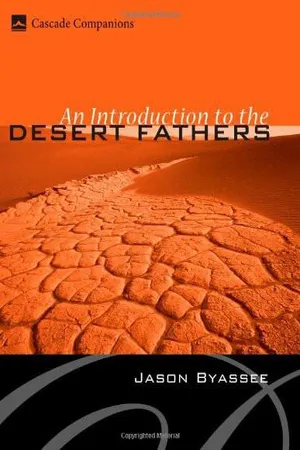
The desert fathers wanted to get away from a church co-opted by empire and a Christian faith grown cold and listless. They retreated to the desert to do battle against demons and against their own worst desires. They had no intention of being famous; yet ironically their Sayings have inspired millions of imitators over the centuries. This guide is meant to accompany a reading of the Sayings of the Desert Fathers, in hopes that readers with lives quite different than those third- and fourth-century dwellers of the Egyptian desert might nevertheless come to imitate their lives of poverty, chastity, and obedience; and more importantly, that readers might grow more imaginative and passionate in their following of the same Lord.
- 130 pages
- English
- ePUB (mobile friendly)
- Available on iOS & Android
eBook - ePub
An Introduction to the Desert Fathers
About this book
Information
Topic
Theology & ReligionSubtopic
Christian ChurchIntroduction
o We all have mental images of the desert, images honed by popular culture. The desert as a wild, uncultivated place where only the strong survive: cacti, various reptiles, the odd cowboy.
That image has a degree of truth in some places. Just as often, we have successfully cultivated the desert. Arizona could never have become the retirement mecca that it is without air conditioning and technological advances in procuring water—the latter with some political controversy. The southern United States generally could not have grown so precipitously in population without similar advances. We like the harsh beauty of the desert, viewed comfortably from an air-conditioned room some sixty degrees cooler than it is outside, with critters kept at bay. Though we may still dress up like cowboys, the reality is not so romantic as the carefully crafted Hollywood image.
In the ancient Christian world, the desert also became a city—but not like Mesa or Tucson. It became a city of those fleeing a church grown soft in collusion with the powerful Roman Empire, trying to live out the risky vision of discipleship glimpsed in the gospels. The description grew up in which these were “white martyrs”: those whose martyrdom was not colored with the red of their blood but was a “death” nonetheless—of ascetic denial of comforts, sex, and worldly security. The “desert fathers,” as they came to be called, did combat not only with their bodies’ wants, but also with demons—demons often represented in terrifying bodily form, as in the famous exploits of St. Anthony. The desert fathers have long occupied a certain pride of place in Christian understanding, such that believers far from the desert and well removed from radical ascetic living champion these peculiar ascetics and, in some sense, made them their own.
All that is a bit romantic and far-fetched. The desert fathers often complained about far more mundane things like mere tedium or listlessness. Further, the romantic image of the previous paragraph suggests that the monks were primarily against certain things—the Roman world, their own bodies, the demons, and so on.1 Their self-understanding would have included not only an antagonistic posture but also, or even primarily, an affirming one: the pursuit of an unbridled life with God, in all its severe intimacy. This pursuit was not so individualistic as it often sounds. The monks did write down their exploits for others to read after all, else we wouldn’t have The Sayings of the Desert Fathers and other texts. Readers of these works become themselves a certain sort of “community” of those who find the monks worth reading for whatever reason. Further, the “desert became a city” to such a degree that monks often complained about the difficulty of finding the solitude they sought. It also made for opportunities for gracious service to others—as when the Cappadocian fathers turned what was once a desert into a city that provided hospital services and affordable housing—unheard of in the ancient world.2
Monastic communities have always avidly read the Sayings as guides to their own form of costly discipleship and hospitality. Yet their readership also includes those not personally committed to monastic asceticism, from communities whose traditions do not encourage monasticism as a form of Christian living. Mainline Protestant scholars once denigrated monasticism, as was the Reformers’ wont from the beginning. Yet mainline and evangelical Protestants are now turning to this literature to inform their own efforts at discipleship.3 Why?
One guess is the parallel between the political climate now and in the fourth century. We live in a time in which the church has been extraordinarily pliant in the hands of an imperial political regime that demands absolute allegiance. Christians unhappy with that dark alliance, and uninterested in trying to take over the wheel themselves and steer the church’s political commitments in another direction, may find solace in the Sayings. Another reason may simply be that anti-Catholic bias among Protestants has waned considerably in the last few generations. This may be for bad reasons—if we’re all consumers of religious feeling, what do our religious differences matter anyway? (We might as well attend to monasticism instead of to our own, say, Lutheranism, as we would decide on McDonalds instead of Hardees). All the same, the chastening of antagonism is something churches should celebrate. For good reason or ill, Christ is preached, and the church is closer to a demonstration of the “oneness” of which he spoke (John 17:21).
My own interest in monasticism is rather quotidian. While studying theology at Duke Divinity School, I imbibed a vision of radical discipleship embodied among Mennonites, especially John Howard Yoder, as transmitted by Stanley Hauerwas. If the church really is distinct from the world, both in its form of life and in its dramatic willingness to share communal goods (like money), where is such a church? As a Methodist learning my church heritage’s liturgical underpinnings, I was drawn to Catholic forms of liturgy. Where could one find an ecclesial space marked by liturgy done not just tastefully, but sacramentally—so that the presence of God was as palpable as it was in the liturgy about which the fathers and John Wesley speak?4
The answer for me was Mepkin Abbey—a Trappist monastery in Moncks Corner (no kidding!), South Carolina.5 The monks there knew their liturgy. The Liturgy of the Hours6 is the Catholic monastic worship and wisdom that has been handed on and elaborated through the centuries. They also boasted several trained musicians committed not to showing off but to leading worship. There is nothing more lovely than a plain, unaccompanied guitar helping dozens of monks to chant psalms. The worship in that space was as exquisite as any I could imagine. It made me love the psalms anew, and to want to memorize and chant Scripture and ancient prayers. It made me, in short, a better Protestant (!), if by that we mean someone committed to a love of Scripture and personal piety. A friend took a group of drug-troubled teenagers to another Trappist community once. After Lauds, a service of chanting psalms for an hour at 3:20 a.m., he overheard one student say to another, “Man, that was better than getting high.” Worship done right is its own form of intoxication.7
The liturgical space is breathtaking. It’s a bare room with white walls and wooden ceilings, but those ceilings are stories high, leaving ample space in which light and shadow can play, inviting the imagination toward prayer. The altar is a great stone slab in the middle of a circular apse, around which the monks gather for adoration during the Eucharistic liturgy. It looks like something you could sacrifice someone on—a not-inappropriate image for Catholic mass. The baptismal font is a similarly granite colored and massive structure, shaped like a diamond, set to bubble occasionally to remind us aurally of baptism. It needn’t do so, as monks and visitors alike are constantly touching it and crossing themselves to remember their baptism and give thanks. The monks face one another in their choir stalls, attentive more to the prayer books in front of them than to the people across the way. Those books are extraordinary—hand-written copies of the Psalter, done by monks from a sister abbey in Massachusetts, lovely in every letter. The silence in the space is beautiful, interrupted as it usually is only by the sound of baptismal water dripping off fingers or monks’ robes as they shuffle to their stalls. By contrast the bullfrogs and cicadas of low-country South Carolina roar to life outside, audible easily through the walls.
The liturgy is at times beautiful beyond words. The monks’ voices sound at once sad and exultant, as befits the psalms they sing. The Eucharistic liturgy occasionally approaches ballet in its beauty, as priests preside who wear the mass as comfortably as I do an old sweatshirt. My favorite moment is at once Catholic and Pentecostal: when the celebrant raises the host and chalice and says the words of institution, all those present who are ordained lift their hands; it is a glimpse of an undivided, sacramental and Pentecostal form of worship! Even the various prayers about and to Mary, on which Protestants occasionally must swallow hard, eventually wear down opposition by their beauty. One can see, even if fleetingly, how liturgy can suffice in place of worldly ambition, money, sex, and family.
These monks were also not dissimilar to the Anabaptist communities of nonviolence about which Yoder and Hauerwas write.8 They’re committed to nonviolence themselves, as all Catholic vowed priests and religious are. Mepkin’s prayers echo this commitment. On August 6 one year (the Feast of the Transfiguration), one brother prayed “for those transfigured this day in 1944 at Hiroshima,” in a startling overlay of images— one of angelic peace, one of demonic violence. Perhaps more important, the monks’ physical bearing exudes peace and reconciliation. Some are quite literally bowed slightly at the waste at all times, not just from age but from a constant habit of bowing toward Christ and one another in the liturgy. Worship should always mark us so dramatically. My wife, a Methodist preacher, tells of the monks’ posture in contrast to that of us visitors. During communion, for example, visitors stand in the circle around the altar as we are accustomed—arms crossed, posture slouched. The monks stand ready to bow, as they have countless times before.
These monks hardly live in the desert.9 Moncks Corner sits on the Ashley and Cooper Rivers as these two flow toward the harbor town of Charleston. My wife and I left the immaculate silence of the monastery one afternoon and were feasting on world-class crab cakes that night. Further, the “church” and the “world” are more intertwined in today’s monasticism. Mepkin Abbey seeks to serve scholars like me with a recently opened, state-of-the-art library, complete with the now-requisite Internet terminals. One day while there, I went to lunch expecting the normal fare of cheese and bread and was met by stacks of Papa John’s Pizza, on which the monks were happily munching.
The monastery has its characters. One, brother Joseph, is the “liturgical guestmaster,” as I call him, for he totters over and turns the pages of the library of prayer books, so bewildered guests can find their way. He joined Gethsemani Abbey in Bardstown, Kentucky, in 1944, when he was seventeen and had just graduated from high school. The love of God is quite physically chiseled into his face. Father Aelred, the guitarist whose voice angels envy, reminds me more of an athletic camp counselor than my stereotype of a cloistered monastic. His kind and wise hospitality to outsiders would shame any evangelical. Abbot Francis Kline was a Julliard-trained musician who presided both at organ and at table until his death in 2006 of cancer. His spirit of gentleness pervaded the place, and in truth, still does. Now his replacement as abbot, Brother Stan, will have to spend more time traveling and less worshipping, like any administrator. One hopes that will not dim the childlike blaze in his eyes. A “younger” monk—actually retirement-age (they get as high a proportion of second-career persons as mainline seminaries do these days) spent one career as an Alaskan king crab fisherman, the most dangerous profession in the world according to insurers. He says he won’t eat seafood now since he can tell the difference between fish frozen for months and fish right out of the Bering Sea—so good it intoxicates. He then retired with millions to a ranch in Arizona, on which the Hollywood movie Tombstone was filmed. He calls that film “the good mustaches against the bad mustaches.” Then he retired anew to Mepkin. He says he misses the movies.
I’ve gone on at length about Mepkin, a place I’ve only visited half a dozen times, to make clear that living, breathing communities att...
Table of contents
- An Introduction to the Desert Fathers
- Preface
- Introduction
- I. Progress in Perfection
- II. Quiet
- III. Compunction
- IV. Self-Control
- V. Lust
- VI. Possessing Nothing
- VII. Fortitude
- VIII. Nothing Done for Show
- IX. Nonjudgement
- X. Discretion
- XI. Sober Living
- XII. Unceasing Prayer
- XIII. Hospitality
- XIV. Obedience
- XV. Humility
- XVI. Patience
- XVII. Charity
- XVIII. Visions
- Bibliography
Trusted by 375,005 students
Access to over 1.5 million titles for a fair monthly price.
Study more efficiently using our study tools.
Frequently asked questions
Yes, you can cancel anytime from the Subscription tab in your account settings on the Perlego website. Your subscription will stay active until the end of your current billing period. Learn how to cancel your subscription
No, books cannot be downloaded as external files, such as PDFs, for use outside of Perlego. However, you can download books within the Perlego app for offline reading on mobile or tablet. Learn how to download books offline
Perlego offers two plans: Essential and Complete
- Essential is ideal for learners and professionals who enjoy exploring a wide range of subjects. Access the Essential Library with 800,000+ trusted titles and best-sellers across business, personal growth, and the humanities. Includes unlimited reading time and Standard Read Aloud voice.
- Complete: Perfect for advanced learners and researchers needing full, unrestricted access. Unlock 1.5M+ books across hundreds of subjects, including academic and specialized titles. The Complete Plan also includes advanced features like Premium Read Aloud and Research Assistant.
We are an online textbook subscription service, where you can get access to an entire online library for less than the price of a single book per month. With over 1.5 million books across 990+ topics, we’ve got you covered! Learn about our mission
Look out for the read-aloud symbol on your next book to see if you can listen to it. The read-aloud tool reads text aloud for you, highlighting the text as it is being read. You can pause it, speed it up and slow it down. Learn more about Read Aloud
Yes! You can use the Perlego app on both iOS and Android devices to read anytime, anywhere — even offline. Perfect for commutes or when you’re on the go.
Please note we cannot support devices running on iOS 13 and Android 7 or earlier. Learn more about using the app
Please note we cannot support devices running on iOS 13 and Android 7 or earlier. Learn more about using the app
Yes, you can access An Introduction to the Desert Fathers by Jason Byassee in PDF and/or ePUB format, as well as other popular books in Theology & Religion & Christian Church. We have over 1.5 million books available in our catalogue for you to explore.