eBook - ePub
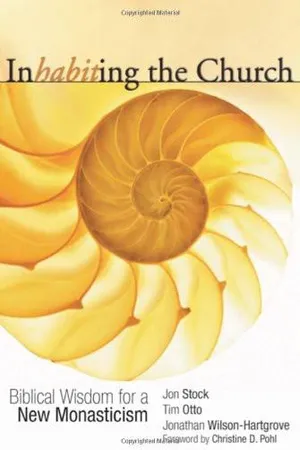
Inhabiting the Church
Biblical Wisdom for a New Monasticism
- 140 pages
- English
- ePUB (mobile friendly)
- Available on iOS & Android
eBook - ePub
Inhabiting the Church
Biblical Wisdom for a New Monasticism
About this book
If the church is more than just a building, what could it mean to live in it--to inhabit it as a way of life? From their location in new monastic communities, Otto, Stock, and Wilson-Hartgrove ask what the church can learn from St. Benedict's vows of conversion, obedience, and stability about how to live as the people of God in the world. In storytelling and serious engagement with Scripture, old wisdom breathes life into a new monasticism. But, like all monastic wisdom, these reflections are not just for monks. They speak directly to the challenge of being the church in America today and the good news Christ offers for the whole world.
Information
Topic
Theology & ReligionSubtopic
Christian Church1
Vows
On the Legitimacy of Vows
Historically, monastic vows have taken a beating since the Reformation. My Protestant heritage takes a dim view of any type of discipline that would seem to embrace legalism or justification by works, that would undercut the concept of the priesthood of all believers, or that would call Christians to a practice that may violate the principle of sola scriptura.
In America in an era when even marriage vows are often only taken seriously at the moment and may be cast aside if we are failing at self-actualization, the suspicion of monastic vows is even greater. Much is made of how we are shaped by late capitalism and by our market-driven economy, and those are legitimate issues of concern. We are trained to consume. We have been taught that true freedom is the freedom of consumer choice; it is the freedom to seek new alternatives that fulfill our immediate felt needs. Disney taught us as children that the greatest good is to follow our dreams, and that it is legitimate to betray our communities or to abandon our teammates in order to realize our dreams.1 Madison Avenue has taught us that we’ve got to conform to the right body type and keep up with the latest fashions in order to find love and acceptance. Wall Street has instructed us that our own economic security is tied up with our continued consumption. The entire system is built upon the necessity of an autonomous self who is able to re-create itself at a moment’s notice.2
I am a free-church Protestant born in the Western United States where we don’t like anyone telling us what to do. Groups of Christians who make vows together and keep them are a tremendous threat to our way of life. But the Protestant in me forces me to ask: is the making of vows biblical? The purpose of this chapter is to allow the ancient text invade our time and space and give consideration to the biblical witness regarding the making and keeping of vows or promises.
In conducting biblical investigation, it is always important to keep in mind just how big of a difference there is between a twenty-first century Oregonian and the ancient near east. In fact, one finds vows not only in the Bible, but in the inscriptions and literatures of virtually all peoples in the ancient Mediterranean—from Babylonians and Assyrians to Greek and Romans. Why was the vow so prevalent in these societies? They shared a number of basic characteristics and values. Most important for our purposes, they were all honor–shame societies and their populations lived predominantly in villages (that is, in close, face-to-face contact). The making of a vow was the public engagement of a person’s honor. If he or she did not keep the vow, the community held that person accountable—the one making the vow opened herself or himself up to public loss of honor.3 As classical monasticism developed—both in Europe and Egypt—the monks, nuns, and friars were also living in face-to-face communities to which they were accountable. As we read these ancient texts, it is essential that we not lose this element of face-to-face. We must ask whether or not any of the vows discussed in this book can be actually practiced without a similar social construction. In a day and age that offers us internet “church” and a plethora of virtual communities—we must be wary of divorcing the following texts from their contemporary social structure. If vows are applicable for new monasticism, they can only be such in a setting where face-to-face encounter is a daily reality. I suspect that vows, ultimately, are only as true as the life together that they represent. If new monasticism has any parallel with these ancient societies it is, that despite individualistic Western life, they live in close proximity and are daily accountable to one another.
Biblical and Theological Considerations
This essay is most certainly not a work of academic theology, but any essay of this nature is bound to be rife with theological presuppositions. I want to start by mentioning a few presuppositions that are key to the argument of this chapter:
1. Jesus is the God-bearer; this means that what we can know of God, we see in Jesus: “he who sees me sees him who sent me” (John 12:45).
2. As followers of Jesus, we are called to bear witness to the character of God. We are called to be holy as God is holy. We are called to be perfect as our heavenly Father is perfect. The religious temptation is to take these biblical calls to holiness and perfection and replace them with our own visions of “holiness” or “perfection” (usually some type of culture-bound moral code which, upon accomplishment, guarantees our personal salvation). It is God, in God’s own being and agency, who gives definition to a Christian understanding of “holiness” or “perfection.”4
3. It is a primary task of the people of God to discern who God is and what God is doing and then to bear witness to this God for the sake of the world.
This is not to say that speaking of God is unproblematic—we are human and quite limited in our ability to utter anything about God. “As ministers we ought to speak of God. We are human, however, and so cannot speak of God. We ought therefore to recognized both our obligation and our inability and by that very recognition give God the glory. This is our perplexity.”5 Again, as noted above, the key to our recognizing God is God’s activity in the world. We can only speak of God in relation to his agency, and we are very dependent upon metaphors. For example, to call God a faithful spouse to Israel is merely to employ a metaphor, but a metaphor that is grounded in the steadfast action of Yahweh.
Old Testament Considerations
1. Israel offers substantial testimony that Yahweh is a God who makes promises and creates covenants.6
Yahweh is a covenanting God. The family narratives of Genesis 12–50 lay the foundation of Yahweh’s covenantal vision for creating community.
Now the Lord said to Abram, “Go from your country and your kindred and your father’s house to the land that I will show you. And I will make you a great nation, and I will bless you and make your name great, so that you will be a blessing. I will bless those who bless you, and him who curses you I will curse; and by you all the families of the earth shall bless themselves. . . .Then the Lord appeared to Abram, and said ‘to your descendants I will give this land. . . .”
(Gen 12:1–3; 12:7)
(Gen 12:1–3; 12:7)
The creation of a community that will be a blessing to all the families of the earth requires people and a place to begin; Yahweh comes to Abram and promises both. This promise is reiterated in Genesis 13:14–17 after Abram and Lot separate (Lot setting up his tent near Sodom). Yahweh’s intent in calling Abraham is nothing short of the “re-forming of creation, the transforming of the nations.”7 Genesis 1–11 unfolds a story of a world gone awry. With the covenantal call of Abram, Yahweh begins setting things right.
In Genesis 15, Abram becomes anxious over his lack of an heir, noting that Eliezer of Damascus, a slave in his house, will become heir. Yahweh promises “this man will not be your heir; your own son shall be your heir” (Gen 15:4). Yahweh takes Abram outside and says to him, “Look toward heaven, and number the stars, if you are able to number them. . . . So shall your descendants be” (Gen 15:5). Abram believes Yahweh, and it is reckoned to him as righteousness (Gen 15:6). Yet, Abram wants assurance of Yahweh’s promise. Yahweh responds by instructing Abram to cut in two a heifer, a female goat, and a ram, laying the halves over against each other, along with a slaughtered turtledove and a pigeon. Abram falls into a deep sleep, during which he is given a foretelling of the slavery in Egypt and the liberation back into the Promised Land.
When the sun had gone down and it was dark, behold a smoking fire pot and a flaming torch passed between these pieces. On that day the Lord made a covenant with Abram, saying, “To your descendants I give this land, from the river of Egypt to the great river, the river Euphrates, the land of the Kenites, the Kenizzites, the Kadmointes, the Hittites, the Perizzites, the Rephaim, the Amorites, the Canaanites, the Girgashites and the Jebusites. (Gen 15:17–20)
Here, in a scene similar to that of Jeremiah 34:18 (another reference to an animal divided in half), a covenant is ratified as those who are party to t...
Table of contents
- Inhabiting the Church
- Foreword
- Introduction
- 1 Vows
- 2 Conversion
- 3 Obedience
- 4 Stability
- Conclusion
- Abbreviations
- Bibliography
Trusted by 375,005 students
Access to over 1.5 million titles for a fair monthly price.
Study more efficiently using our study tools.
Frequently asked questions
Yes, you can cancel anytime from the Subscription tab in your account settings on the Perlego website. Your subscription will stay active until the end of your current billing period. Learn how to cancel your subscription
No, books cannot be downloaded as external files, such as PDFs, for use outside of Perlego. However, you can download books within the Perlego app for offline reading on mobile or tablet. Learn how to download books offline
Perlego offers two plans: Essential and Complete
- Essential is ideal for learners and professionals who enjoy exploring a wide range of subjects. Access the Essential Library with 800,000+ trusted titles and best-sellers across business, personal growth, and the humanities. Includes unlimited reading time and Standard Read Aloud voice.
- Complete: Perfect for advanced learners and researchers needing full, unrestricted access. Unlock 1.5M+ books across hundreds of subjects, including academic and specialized titles. The Complete Plan also includes advanced features like Premium Read Aloud and Research Assistant.
We are an online textbook subscription service, where you can get access to an entire online library for less than the price of a single book per month. With over 1.5 million books across 990+ topics, we’ve got you covered! Learn about our mission
Look out for the read-aloud symbol on your next book to see if you can listen to it. The read-aloud tool reads text aloud for you, highlighting the text as it is being read. You can pause it, speed it up and slow it down. Learn more about Read Aloud
Yes! You can use the Perlego app on both iOS and Android devices to read anytime, anywhere — even offline. Perfect for commutes or when you’re on the go.
Please note we cannot support devices running on iOS 13 and Android 7 or earlier. Learn more about using the app
Please note we cannot support devices running on iOS 13 and Android 7 or earlier. Learn more about using the app
Yes, you can access Inhabiting the Church by Jon R. Stock,Tim Otto,Jonathan Wilson-Hartgrove in PDF and/or ePUB format, as well as other popular books in Theology & Religion & Christian Church. We have over 1.5 million books available in our catalogue for you to explore.