- 102 pages
- English
- ePUB (mobile friendly)
- Available on iOS & Android
eBook - ePub
About this book
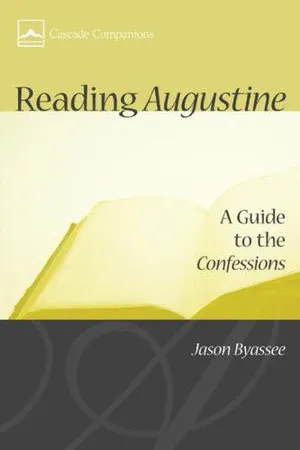
The Confessions of St. Augustine is one of the few Christian classics that is still widely read in the secular academy. Yet, oddly enough, it is not often read in the manner Augustine appears to have intended and in which the church read it for centuries: as a model of conversion, devotion, friendship, and the love of God. This book is a companion for any reader of the Confessions--whether in an academic, ecclesial, or devotional context--informed by the latest scholarship yet always directed toward pushing the reader, with Augustine, toward God.
Information
Topic
Theology & ReligionSubtopic
Christian TheologyChapter One:
Book 1
T here is a great irony in the Confessions not often commented upon: that a Christian convinced that “pride,” that is, undue self-attention at the expense of attention to God, is the worst of sins should tell us such intimate details of his personal life.1 Critics of Augustine suggest that modern western culture’s obsession with selfish introspection—that is, combing the depths of oneself while neglecting others in the world outside—can be traced to Augustine.2 On this account there is a short step from Augustine’s Confessions to books by the same title on today’s bookshelves with subtitles like “confessions of a video vixen”; “confessions of an economic hit man”; and “confessions of an ugly step-sister”! Here “confession” is made as salacious as possible for the sake of self-aggrandizement and economic gain. How is Augustine’s work different?
Augustine’s answer might be that his Confessions slowly move from attention to himself to attention to God—he is rarely self-referential in the work’s final books.3 In fact, Augustine is surprisingly reticent in providing information about his own life at all. If one were to string together what we learn of his life altogether, Confessions might only include one book rather than thirteen.4 In fact, the bulk of Confessions is not about Augustine at all, but about God, or to God, in the form of prayer. Like the best autobiographers in the history of the church, Augustine does not seek attention to himself for his own sake, but rather he seeks to provide a model by which his readers will see their lives as similarly driven by providence to return from the loneliness of sin to the community with God and others that is divine grace.5 Besides, what sort of autobiography works so hard to detail the author’s embarrassing mistakes? In the ancient world especially someone of enough means to write about oneself would take pains to present one’s achievements and hide one’s missteps.
Theologian Charles Matthews goes a step further to argue that Confessions is a sort of anti-autobiography.6 From his first words Augustine is concerned not with himself, but with God. Augustine narrates his life here as a series of false steps in self-assertion—the desire to make a place for himself in a world that respects only power, self-amusement, wealth, and family status. He makes no mean effort toward accumulation of those things, and precisely so drifts farther away from the God in whose presence life is most fully lived. His is no life at all then—only after the fact of his conversion can he narrate his missteps as false attempts to flee a God he cannot escape. This is also no autobiography because Augustine cannot even remember his own beginning. He has to look for evidence for what infants are like from others. He just as certainly cannot see his own end, as none of us can. In fact, for the Christian bishop now looking retrospectively over his life as he writes, no one can see their end until the End, in which God gathers all things to himself, judges, and appropriates everything to its eternal place. In the meantime Augustine remains “scattered,” in a place of “disintegration,” until God gathers him and us all up and becomes all in all (Chadwick 24).7 Augustine can give no account of his life that does not look away from himself and toward that eschatological horizon when he will receive his true self—and neither can we, as Confessions makes clear.
Augustine is fully aware of the presumption not only in writing his own life’s story, but in trying to address God properly at all. We are mere creatures, God is an unchanging and infinitely good creator—what words can the former properly apply to the latter? Yet as creatures of a good God we have been gifted by the desire to pray and praise. In that gift we can see a mirror image of the one whom we seek, without whom we are unendingly restless, in whom we have our fullest joy (3). Augustine here wrestles with what philosophers call “epistemology”—the question of how we know what we know. For him, our desire to praise is key to our knowledge about anything. For our knowledge runs aground as it seeks after God:
Who then are you, my God? . . . Most high, utterly good, utterly powerful, most omnipotent, most merciful and most just, deeply hidden yet most intimately present, perfection of both beauty and strength, stable and incomprehensible, immutable and yet changing all things, never new, never old, making everything new . . . .” (5)
Language itself creaks under the strain, and must resort to paradox to show that this one cannot properly be spoken about. Yet language itself stretches toward the one who is all wisdom and delight, and in our very failed efforts to speak of God we can see something of his grace. Throughout Confessions knowledge and love are twins, reflecting in us creatures the Wisdom and Love that are the Son and Holy Spirit within the life of God. Our attempts to know God, or anything else, are indelibly triune, if only in fits and starts. When we properly love and know God we catch a glimpse insofar as creatures can of the Mystery of the divine life. Our very desire to praise rightly is a hint at the nature of the One we desire. Fortunately for us we can do more than strain intellectually and morally after such glimpses—for the One we strain to see becomes incarnate among us, giving us far more than mere hints.
There is much we could focus upon in this and every book, and much we must leave behind. Another key theme in this first book is that of education. Since this series is aimed at those who have invested a great deal of time and money in their own educations, it should prove worthy of our attention. Augustine is clearly unimpressed with his early educational experiences. Not only was the teaching poor, and often accompanied by beatings, its goal was clearly the acquisition of “deceitful riches,” rather than any love of learning for its own sake (11). Like any child he loved to play, and remembers his disciplinarians as hypocrites for refusing to let the children do so, while “playing” their own games with impunity (12).8 He remembers with disdain the meticulous attention paid to proper grammar and phrasing, all the while reciting licentious actions of pagan gods without shame (20). In a moment of dark humor, Augustine muses that a student would be ridiculed for mispronouncing the “h” in homo (Latin for “human”), while he could hate another human being with no questions asked (21). For the converted and consecrated bishop looking back on his life, both the form and content of his early education were intolerably antithetical to the love for Christ that now guides his life.
For Reflection
. To what extent does Confessions seem to be an autobiography?
. How, and to what degree, can we know1
. This book leads us to ask about our own educations. How were their form (the way we were taught) and content (what we were taught) helpful or a hindrance to our returning from the prodigal’s far country to our father’s house?9
. In our day as in Augustine’s, an expensive education is crucial to a lucrative career. For Augustine it is clear that this pursuit of social and economic advance was a detriment to his nascent spiritual life. How have you experienced anything similar?
1 James J. O’Donnell, Augustine: Confessions, 3 vols. (Oxford: Clarendon, 1992) 1:xlii.
2 The charge that Augustine paved the way for the modern, interiorly obsessed self (or even invented it) is common in Augustine scholarship. Its most sophisticated proponent may be Charles Taylor in his Sources of the Self: The Making of Modern Identity (Cambridge: Harvard University Press, 1989).
3 Ibid., xlix.
4 Serge Lancel, St. Augustine, trans. Antonia Nevill (London: SCM, 2002) 211.
5 A modern parallel would be the autobiographical work of Frederick Buechner; among others see his Telling Secrets (San Francisco: HarperSanFrancisco, 1991). Though it may be that Buechner remains mostly in the orbit of self-examination and never quite reaches for contemplation of the divine mystery that Augustine achieves in Confessions books X–XIII.
6 See his “Book One: The Presumptuousness of Autobiography and the Paradoxes of Beginning,” in A Reader’s Companion to Augustine’s Confessions, ed. Kim Paffenroth and Robert Kennedy (Louisville: Westminster John Knox, 2003) 7–23.
7 This study guide will use the translation by Henry Chadwick: Confessions, World’s Classics (Oxford: Oxford University Press, 1992). Subsequent references to Chadwick will be parenthetical.
8 Rowan Williams brilliantly discusses the theological and moral seriousness of childhood playing in his Lost Icons (Edinburgh: T. & T. Clark, 2000).
9 For example, I write as one whose education cost my family and others’ some quarter of a million dollars (mostly in the form of scholarships), which has bought me the privilege of writing books like these, and being addressed as “reverend” and “doctor.”
Chapter Two:
Book II
For whom does Augustine write these Confessions? He is surely not informing God of anything God does not already know. Therefore he can only be writing for us: “that I and any of my readers may reflect on the great depth from which we have to cr...
Table of contents
- Start—Reading Augustine
- Preface
- Introduction
- Chapter One: Book I
- Chapter Two: Book II
- Chapter Three: Book III
- Chapter Four: Book IV
- Chapter Five: Book V
- Chapter Six: Book VI
- Chapter Seven: Book VII
- Chapter Eight: Book VIII
- Chapter Nine: Book IX
- Chapter Ten: Book X
- Chapter Eleven: Book XI
- Chapter Twelve: Books XII–XIII
- Glossary
Trusted by 375,005 students
Access to over 1.5 million titles for a fair monthly price.
Study more efficiently using our study tools.
Frequently asked questions
Yes, you can cancel anytime from the Subscription tab in your account settings on the Perlego website. Your subscription will stay active until the end of your current billing period. Learn how to cancel your subscription
No, books cannot be downloaded as external files, such as PDFs, for use outside of Perlego. However, you can download books within the Perlego app for offline reading on mobile or tablet. Learn how to download books offline
Perlego offers two plans: Essential and Complete
- Essential is ideal for learners and professionals who enjoy exploring a wide range of subjects. Access the Essential Library with 800,000+ trusted titles and best-sellers across business, personal growth, and the humanities. Includes unlimited reading time and Standard Read Aloud voice.
- Complete: Perfect for advanced learners and researchers needing full, unrestricted access. Unlock 1.5M+ books across hundreds of subjects, including academic and specialized titles. The Complete Plan also includes advanced features like Premium Read Aloud and Research Assistant.
We are an online textbook subscription service, where you can get access to an entire online library for less than the price of a single book per month. With over 1.5 million books across 990+ topics, we’ve got you covered! Learn about our mission
Look out for the read-aloud symbol on your next book to see if you can listen to it. The read-aloud tool reads text aloud for you, highlighting the text as it is being read. You can pause it, speed it up and slow it down. Learn more about Read Aloud
Yes! You can use the Perlego app on both iOS and Android devices to read anytime, anywhere — even offline. Perfect for commutes or when you’re on the go.
Please note we cannot support devices running on iOS 13 and Android 7 or earlier. Learn more about using the app
Please note we cannot support devices running on iOS 13 and Android 7 or earlier. Learn more about using the app
Yes, you can access Reading Augustine by Jason Byassee in PDF and/or ePUB format, as well as other popular books in Theology & Religion & Christian Theology. We have over 1.5 million books available in our catalogue for you to explore.