eBook - ePub
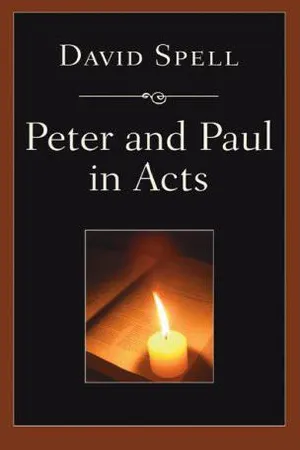
Peter and Paul in Acts: A Comparison of Their Ministries
A Study in New Testament Apostolic Ministry
- 218 pages
- English
- ePUB (mobile friendly)
- Available on iOS & Android
eBook - ePub
Peter and Paul in Acts: A Comparison of Their Ministries
A Study in New Testament Apostolic Ministry
About this book
Acts is arguably the most exciting book in the New Testament. It covers the tumultuous early years of Christianity and narrates the growth of the church throughout the Roman Empire. Luke tells this story by focusing primarily on two men, Peter and Paul. This book examines their apostolic ministries as they are revealed within the pages of The Acts of the Apostles.
Their apostolic ministries are examined in the context of several different components: Leadership, Evangelism and Church Planting, Miracle Working and Healing, and Mystical or Supernatural Experiences. These categories are shown to detail particular aspects of each man's apostleship work. These categories provide a convenient way to compare and contrast the type of ministry that each apostle performed, as described by Luke.
Spell also devotes a chapter each to Luke's literary method and the relationship of Peter and Paul as seen in their letters. These two chapters lay important groundwork for examining the apostles. This book will provide the reader with valuable insights from Scripture that they can apply to their own lives and ministry. By looking at how Peter and Paul conducted their ministries in the first century, we can be more effective in the twenty-first.
Information
PART ONE
1 / The Book of Acts in Critical Perspective
Critical Issues Associated With Acts
Because Acts is going to be the foundation for this study, it is important that some of the historical/critical issues that are associated with the book be discussed. This material may be more appropriate for the scholar as opposed to the average lay person. However, it is important for the lay reader to understand those areas in which Acts has been attacked and how it has withstood these attacks. An understanding of the critical issues associated with Acts will carry over into the rest of the New Testament as well.
Acts is the only book in the New Testament that is devoted to the history of the early church and its value as a source for early church history continues to generate discussion and debate among scholars.10 This debate does not diminish the importance of the book for New Testament study. Foakes-Jackson acknowledges the importance of Acts when he says, “Without it, had we even the rest of the New Testament, the origin of the Christian church would be a subject for ingenious conjecture.”11
The first group of scholars that will be discussed are those who consider Acts as having little, if any, historical significance. These are generally regarded as being liberal in their view of the Scriptures. F. C. Baur and the “Tübingen School” are examples of this type of thought.12 While Baur himself never completely rejected all of Acts, believing that some of the material may have been inspired by genuine traditions, he laid the groundwork for his followers, Albert Schwegler and Eduard Zeller, who did.13 They dated Acts in the 110–150 AD period and according to Hemer, “there is no room in these writers for any connection with authentic traditions deriving from a companion of Paul.”14 Baur and his followers attempted to apply Hegelian philosophy to Christian history in order to understand how the early church developed. In so doing, the Tübingen School became “a historical-critical approach to the Bible that completely ignored the divine element in it.”15
One of the main ideas that Baur and his followers subscribed to was that Acts was written in an effort to reconcile Petrine and Pauline theology. It was believed that there had been a split between Peter and Paul while they were living and that Acts was written in an effort to heal this rift between their followers.16 Baur based this on 1 Corinthians 1:12, where Paul described one of the problems in the Corinthian church. Some were aligning themselves with Christ, others with Cephas, others with Apollos, and still others with Paul.17 It will be demonstrated in chapter 2 that the New Testament does not give any concrete evidence of a long-term conflict between Peter and Paul, nor does it provide the basis for the “two churches” or “two missions” that some scholars describe.
While Baur and his followers lived about 150 years ago, their influence is still felt in some circles today.18 There are contemporary scholars who do not accept Acts as an accurate account of early church history and seem to have been influenced by Baur and his followers. One modern scholar who exemplifies this is Gerhard Krodel. In one of his commentaries on Acts, he states that Acts is neither chronological, nor historically accurate, and is what he refers to as an example of “biblical history which proclaims the mighty acts of God.”19 By relegating it to “biblical history,” it does not matter to Krodel if Acts is accurate historically or not.20 Krodel also seems to accept Baur’s premise that Luke wrote to heal rifts between the followers of Peter and Paul.21
A Pauline scholar who acknowledges the value of the Tübingen School is Samuel Sandmel. He believes that Baur and his students were “on the threshold of the correct solution,” in how to treat Acts.22 While agreeing with most of the their conclusions regarding Acts, Sandmel thinks that the Tübingen scholars’ biggest mistake was in their attempt to force their findings into a Hegelian framework.23
Unlike many Pauline scholars who only focus on Pauline traditions, Sandmel also discusses Petrine tradition in Acts. He believes that the only valid Petrine tradition in the New Testament is that which Paul wrote in Corinthians and Galatians.24 As a scholar who holds to the Tübingen ideals, Sandmel believes that Luke’s Peter is created as “the hammer with which one blunts the sharp edge of Pauline doctrine.”25
J. Christiaan Beker is another modern scholar who appears to have been influenced by the Tübingen School. He says that Acts is composed of “a mixture of oral reports, memories, and legends . . .”26 Beker believes that Luke’s Paul is presented in a way that shows continuity with the original apostles and he is shown working hard to maintain a harmonious relationship with them.27 In Beker’s view, the Paul we see in Acts is a product of Luke’s creativity.28
Another contemporary scholar who holds to the Tübingen idea that Acts was written to reconcile Peter and Paul is Michael Goulder. He says, “Acts is in fact a doubtful asset, for it was Luke who invented the united virginal church theory, and Acts is his steady attempt to paper over all the cracks.”29 Goulder goes to great lengths in his book to establish the fact that the two very different missions of Peter and Paul played a significant role in the development of the church.30
Many modern scholars have attempted to find some middle ground concerning Acts. One example of this is Marion Soards. While he does not accept Acts as a primary source for establishing a chronology for Paul’s life, he does believe that the book has value as a secondary source. Soards says that Acts, “may be used cautiously as a supplement to the primary materials when it is not in conflict with the letters.”31 He believes that it is important that both sources be used, Paul’s letters and Acts, when attempting to develop a chronology of Paul’s life and ministry.32
Johannes Munck also acknowledges that both Acts and Paul’s letters are important if one wants to gain a clear picture of the early church, especially where Paul was concerned. However, Munck does believe that Paul’s letters hold more weight than Acts even though he argues that in many places Acts is a valid primary source for information on the early church.33 In arguing strongly against the Tübingen point-of-view of Acts, Munck says,
Freed from the load of tradition, [Acts] gives us a much clearer picture of primitive Christianity, and that its presentation of Jewish Christianity does not open between Paul and Jerusalem the deep chasms that the Tübingen School took for granted . . .34
C. K. Barrett is another scholar who appears to occupy this middle ground concerning Acts. While Barrett accepts much of Acts as a valid source for how the early church developed, he is much more critical in the way he examines Luke’s presentation of Paul. Barrett concludes that Luke’s Paul is so different from the Paul that one sees in his own letters, that Luke resorted to “degrees of fictitiousness.”35 Barrett believes that if the author of Acts were actually a personal companion and admirer of Paul his presentation of him would be more consistent with the Paul who wrote the letters.36
The speeches that are put in the mouths of Peter and Paul are another area in which Barrett ...
Table of contents
- Title Page
- Acknowledgements
- Introduction
- Part One
- Part Two
- Bibliography
Trusted by 375,005 students
Access to over 1.5 million titles for a fair monthly price.
Study more efficiently using our study tools.
Frequently asked questions
Yes, you can cancel anytime from the Subscription tab in your account settings on the Perlego website. Your subscription will stay active until the end of your current billing period. Learn how to cancel your subscription
No, books cannot be downloaded as external files, such as PDFs, for use outside of Perlego. However, you can download books within the Perlego app for offline reading on mobile or tablet. Learn how to download books offline
Perlego offers two plans: Essential and Complete
- Essential is ideal for learners and professionals who enjoy exploring a wide range of subjects. Access the Essential Library with 800,000+ trusted titles and best-sellers across business, personal growth, and the humanities. Includes unlimited reading time and Standard Read Aloud voice.
- Complete: Perfect for advanced learners and researchers needing full, unrestricted access. Unlock 1.5M+ books across hundreds of subjects, including academic and specialized titles. The Complete Plan also includes advanced features like Premium Read Aloud and Research Assistant.
We are an online textbook subscription service, where you can get access to an entire online library for less than the price of a single book per month. With over 1.5 million books across 990+ topics, we’ve got you covered! Learn about our mission
Look out for the read-aloud symbol on your next book to see if you can listen to it. The read-aloud tool reads text aloud for you, highlighting the text as it is being read. You can pause it, speed it up and slow it down. Learn more about Read Aloud
Yes! You can use the Perlego app on both iOS and Android devices to read anytime, anywhere — even offline. Perfect for commutes or when you’re on the go.
Please note we cannot support devices running on iOS 13 and Android 7 or earlier. Learn more about using the app
Please note we cannot support devices running on iOS 13 and Android 7 or earlier. Learn more about using the app
Yes, you can access Peter and Paul in Acts: A Comparison of Their Ministries by David Spell in PDF and/or ePUB format, as well as other popular books in Theology & Religion & Biblical Criticism & Interpretation. We have over 1.5 million books available in our catalogue for you to explore.