- 158 pages
- English
- ePUB (mobile friendly)
- Available on iOS & Android
eBook - ePub
About this book
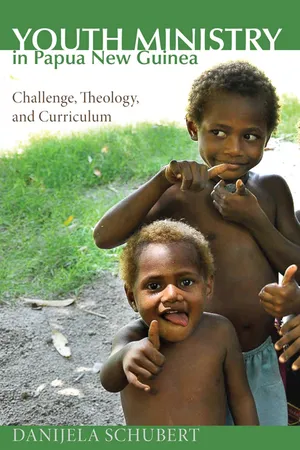
Papua New Guinea is experiencing changes that grow in significance and accelerate in pace. Although the majority of its population are still subsistence farmers, the postmodern world is fast making an impact. That means that, at the same time, they are strongly influenced by firmly ingrained tradition where animism is binding and a pervasive element as well as Western media with its consumerism and worldview. The most impacted are youth who are caught between the traditional and postmodern culture. In a country that is Christian by constitution, pastors are looked upon with high esteem. They need to find a way to bridge the gap, to make sense of the world youth are living in, and find a meaningful way forward. Although this book is aimed at pastors and youth workers in PNG, other sectors can benefit from the research--politicians, educators, health workers, clergy--especially if they are coming from a different culture, be that from PNG or another country.
Information
Topic
Theology & ReligionSubtopic
Christian ChurchPart 1
Youth Ministry Challenge in PNG
Chapter 1
Context
To understand the message of the Bible, one needs to understand the context in which the Bible was written: where, why, and to whom it was written. This is now the commonly accepted view of understanding its content. Similarly, to decide how to transmit its message, one needs to understand the context—to whom and where it is to be passed on—and then to decide how to do that. Chapter 1 describes the context of the PNG society based on the area in which a citizen might live. Whether a person grew up or lives in a village or the city, an island or the Highlands, will have a great impact on their worldview, habits, language, and even personal characteristics.
Papua New Guinea is a country just south of the equator, about 150 kilometers north of the tip of Australia, between the Bismarck and Coral Seas in the South Pacific Ocean. On its western side, it has a land border of 820 kilometers with Indonesia, which occupies the other half of the island of New Guinea. It is the largest country in the South Pacific, except for Australia. PNG has over six hundred islands, but the main landmass, referred to as mainland, is on New Guinea. PNG occupies an area of 462,840 square kilometers, of which 9,980 is water. Its coastline is 5,152 kilometers.
PNG is divided administratively into twenty-two provinces.1 These divisions are more than administrative—for example, there is no road suitable for vehicles connecting the two neighboring provinces Central and Milne Bay. Although PNG has over 19,600 kilometers of roads, only 686 kilometers are sealed. Similarly, out of 571 airports, only twenty-one have sealed runways.2 The climate, although tropical, shows great diversity between provinces. A stark example is the annual rainfall. Milne Bay region, for example, receives over 5,000 millimeters of rain annually, and the delta region of Fly River, close to 6,000 millimeters, while Port Moresby, although situated in between the two, only receives about 1,150 millimeters annually.3 About 98 percent of the people are Melanesian, other groups include Polynesian, Micronesian, Chinese, and European. Politically, the divisions are Papuans, Highlanders, New Guineans, and Islanders.4 For a country that is comparable in size to California, the population of just over six million people (2012 estimate) makes it sparsely populated. However, although statistically not densely populated, in some cities and households the population is very dense: there could be twenty people sleeping in a two-bedroom house in the city.
Even though PNG is by constitution a Christian country, it is at the same time an independent and free country, with other religions, like Islam, Buddhism, and Baha’i, present in small numbers. When meeting another person on the street, it is safe to assume that the other is a Christian from one of the predominant denominations. The main religion is Catholic, followed by Lutherans. In the 2000 census, approximately 10 percent of the population have declared themselves Seventh-day Adventists, although church data reports only half as many members.5
PNG boasts an abundance of natural resources, but people are its greatest asset. The variety of cultures, all expressed in unique traditions, art, war preparations (now mostly reenacted), dances, and songs are a real treasure. More than eight hundred different spoken languages are evidence of this diversity. Other great natural resources are rich coral seas abundant in marine life, virgin rain forests in which new species of flora and fauna are still being discovered, an abundance of fresh water from rains, lakes, and rivers, a variety of habitats, gold (one of the finest in the world), liquefied natural gas, and many more. People grow up in these diverse places. They are divided into four contexts in this book: villages, cities, islands, and highlands. The following describes how these contexts influence the worldview of its inhabitants.
Village
Over 80 percent of the population of PNG lives in a village setting. Most of them are subsistence farmers. Life would be very different in a village situated on a small atoll island as compared with the highlands of PNG. For example, an island village would rely on fish, coconut, cassava, banana, breadfruit, sweet potato, and sago for food, building houses, and even clothing. Formal employment is not prevalent.6 On the other hand, a village in the highlands would rely on sweet potato as the main source of food, but sometimes also English potato, a variety of beans, cabbage, carrots, onions, and other vegetables, bananas, and other fruit, which can be harvested two to three times a year. It is possible to find employment, at least seasonally, in the large coffee plantations, but some cash income could come from the sale of homegrown food crops not used for family consumption.7 Cash in the village is scarce and used for purchasing medicine, clothing, and food from the local store, like rice, tinned fish, biscuits, and noodles. Travel expenses and school fees are also paid from the same source. For garden-grown foods a barter system is still used in many villages. Coastal villagers can exchange fish for fruits and sweet potato from the inland villagers.8
In the village, the whole community is involved in raising children. Uncles, aunties, cousins and grandparents are all included. While children are young, mothers feed and bathe them, but older siblings or aunties would spend much time with the child, allowing the mother to perform other duties like gardening, cooking, or even working. Such jobs as changing nappies, feeding, or bathing the baby would be the sole domain of women. When boys reach puberty, they are separated from their mothers and spend significant time with their fathers and other males in the village without mixing with women.
Each village would have a men’s house where women are not allowed. In villages women also have their house apart from the home, where they stay while menstruating, and no men would enter that place. Village homes are made from bush materials and need regular repairs. They are characterized by small sleeping quarters, soil or sometimes wooden floors, and scarcely any furniture. A traditional village house in the highlands is a thatched-roof building with just one room and an open fireplace in the middle. Some have a small window, and smoke rises from the thatched roof when the fire is burning. Walls are made of wood or woven pitpit leaves. The whole family sleeps inside around the fire place, including the family dog. Those who can afford it use commercial materials to build their homes, as they are more durable. Those houses have roofs and outside walls made of tin. It appears that the lower the altitude where villages are situated, the more often houses are built on stilts, to allow air circulation during the day while it is hot, although some houses in the islands, where it is the hottest, are not built on stilts. The space underneath the stilt houses is where children play and families gather for meals and rest, while at night they sleep inside the house.
Traditionally, girls spend time with their grandmothers, mothers, and aunties, while boys do the same with their grandfathers, fathers, and uncles. From them they learn about life, acquire skills, and prepare for adulthood. Girls learn how to cook, grow food in the gardens, clean the house, raise children, and make bilums (string bags) and mats, while boys learn how to clear an area for gardening, how to fight, how to make a house, and how to hunt. If the village is near water, they will also learn how to make a boat and acquire the skills necessary for fishing. The village boys also learn how to use sorcery, which is perceived as beneficial for daily living.9
City
The cities of PNG are growing and the country is becoming increasingly urbanized. The influx of people coming from villages to the cities is constant and growing, but immigration is another factor in this growth. Immigrants are from Australia, Sri Lanka, India, China, Philippines, Indonesia, Solomon Islands, and other countries. Increasing opportunities for financial benefit is the main reason for this growth. The two biggest cities are the nation’s capital, Port Moresby, and Lae, in Morobe province. Although Port Moresby has more than double the population, Lae has far greater port activity.10 Other urban areas are much smaller, generally not exceeding the population of thirty thousand.11
The coastal cities, like Port Moresby, have a different style of accommodation. There are suburbs, like Koki and Hanuabada, that are entirely built on stilts above the sea. Their inhabitants rely fully on their income from formal employment to sustain their families. They have no arable land, so they cannot grow any food. They have to buy it all. They have to pay for electricity, education, and clothing. All of that is more expensive in the city than inland. Port Moresby is the most expensive city in PNG, however, it also has the most employment and education opportunities. Another style of accommodation in other parts of the city is either single-house or multiple-apartment dwellings. Those that live in single-house dwellings could make small gardens from which to grow food; however, fresh fruits and vegetables come to Port Moresby from the surrounding areas or highlands. Due to transport costs the prices are significantly higher.
In the city, parents and their children live in a home often shared with other relatives. One room may be given to one family consisting of father, mother, and two or more children, while another room is used by another blood-related family. They may use one kitchen for all. Fathers, and increasingly mothers, too, are out of home, busy with work in formal or informal employment, and there is no wider community to look after children who are left alone. Those that can afford to pay the fees send their children to kindergartens and schools. On any day in downtown Port Moresby, one can see those whose parents cannot afford school fees begging in the streets, sitting and doing nothing, or getting into mischief. Similar to Western societies, children are left to fend for themselves, or as Chap Clark puts it, they have been “systemically abandoned.”12 Many who come from villages to the city to find a better life end up being unemployed with no shelter or food. Some turn to crime and violence and harm the rest of the society. They are given the name raskols. Often they operate as gangs similar to t...
Table of contents
- Title Page
- Acknowledgments
- Introduction
- Part 1: Youth Ministry Challenge in PNG
- Chapter 1: Context
- Chapter 2: Psychosocial Development
- Chapter 3: Influences and Ecology
- Part 2: Youth Ministry as Practical Theology in the SDA Context
- Chapter 4: Biblical Call of Adoption and Practical Theology
- Chapter 5: Youth Ministry History in the SDA Church
- Chapter 6: Anticipated Trends
- Part 3: Curriculum for Introduction to Youth Ministry Course
- Chapter 7: Course Goals and Learning Outcomes
- Chapter 8: Elements of the Curriculum
- Summary and Conclusion
- Appendix A: Selected Bibliography for Introduction to Youth Ministry Course
- Appendix B: Sample Lesson Studies
- Bibliography
Trusted by 375,005 students
Access to over 1.5 million titles for a fair monthly price.
Study more efficiently using our study tools.
Frequently asked questions
Yes, you can cancel anytime from the Subscription tab in your account settings on the Perlego website. Your subscription will stay active until the end of your current billing period. Learn how to cancel your subscription
No, books cannot be downloaded as external files, such as PDFs, for use outside of Perlego. However, you can download books within the Perlego app for offline reading on mobile or tablet. Learn how to download books offline
Perlego offers two plans: Essential and Complete
- Essential is ideal for learners and professionals who enjoy exploring a wide range of subjects. Access the Essential Library with 800,000+ trusted titles and best-sellers across business, personal growth, and the humanities. Includes unlimited reading time and Standard Read Aloud voice.
- Complete: Perfect for advanced learners and researchers needing full, unrestricted access. Unlock 1.5M+ books across hundreds of subjects, including academic and specialized titles. The Complete Plan also includes advanced features like Premium Read Aloud and Research Assistant.
We are an online textbook subscription service, where you can get access to an entire online library for less than the price of a single book per month. With over 1.5 million books across 990+ topics, we’ve got you covered! Learn about our mission
Look out for the read-aloud symbol on your next book to see if you can listen to it. The read-aloud tool reads text aloud for you, highlighting the text as it is being read. You can pause it, speed it up and slow it down. Learn more about Read Aloud
Yes! You can use the Perlego app on both iOS and Android devices to read anytime, anywhere — even offline. Perfect for commutes or when you’re on the go.
Please note we cannot support devices running on iOS 13 and Android 7 or earlier. Learn more about using the app
Please note we cannot support devices running on iOS 13 and Android 7 or earlier. Learn more about using the app
Yes, you can access Youth Ministry in Papua New Guinea by Danijela Schubert in PDF and/or ePUB format, as well as other popular books in Theology & Religion & Christian Church. We have over 1.5 million books available in our catalogue for you to explore.