eBook - ePub
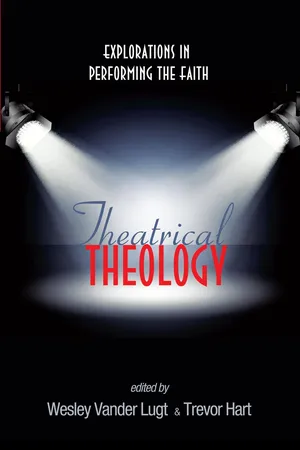
Theatrical Theology
Explorations in Performing the Faith
- 298 pages
- English
- ePUB (mobile friendly)
- Available on iOS & Android
eBook - ePub
Theatrical Theology
Explorations in Performing the Faith
About this book
Theology is inherently theatrical, rooted in God's performance on the world stage and oriented toward faith seeking performative understanding in the theatre of everyday life. Following Hans Urs von Balthasar's magisterial, five-volume Theo-Drama, a growing number of theologians and pastors have been engaging more widely with theatre and drama, producing what has been recognized as a "theatrical turn" in theology. This volume includes thirteen essays from theologians and pastors who have contributed in distinct ways to this theatrical turn and who desire to deepen interdisciplinary dialogue between theology and theatre. The result is an unprecedented collection of essays that embodies and advances theatrical theology for the purpose of enriching theological reflection and edifying the church.
Information
Topic
Theology & ReligionSubtopic
Christian Theology1
At Play in the Theodrama of the Lord
The Triune God of the Gospel
The Dramatic Essence of Christianity: Gospel Theatre as Trinitarian Work
John Calvin could well lay claim to the title “patron saint of theatrical theology” inasmuch as he makes frequent reference to the world (i.e., the heavens and the earth) as the theatrum gloriae: a theater in which to behold God’s glory.1 The focus of Calvin’s theater is consistently on nature, or what we might call the history of creation, rather than on grace and the history of redemption. A further problem is that sinners “wickedly defraud God of his glory” and “cannot by contemplating the universe infer that he is Father.”2 Stated differently, and more provocatively: at least in Calvin, theatrical theology has little to do with the gospel, or the triune God.
The situation is quite different in the Fourth Gospel, where what is being played out in the theater of the world is precisely God’s love for the world, which the “world” rejects. John’s Gospel is a courtroom drama where, on one level, Jesus’ identity is on trial, more specifically, his theologically revolutionary claim to be “one” with the Father (John 10:30). (On another level, however, it is the reader’s ability to read the signs and make correct judgments that is on trial.) The whole of John’s narrative structure alternates between accounts of Jesus’ deeds and discourses, two types of signs—evidence!—that he is who he says he is. What Jesus says and does in the Fourth Gospel is, on his own account, the climax and fulfillment of a longstanding divine project that defines both his life and his ministry: “Jesus came into Galilee, proclaiming the gospel of God” (Mark 1:14).3 In the Fourth Gospel, the drama arises from seeing how people respond to Jesus’ words (John 3:34; 6:63) and to Jesus himself as the Word of God made flesh (John 1:14). It is precisely as the incarnate Word that Jesus not only proclaims but also enacts the “gospel of God.” Indeed, Jesus is the gospel of God—God’s great saving word/deed on the stage of world history—and hence the reason why the essence of Christianity is inherently dramatic: “in Christ God was reconciling the world to himself” (2 Cor 5:19).
If a theology oriented to the theater of redemptive operations (rather than creation alone) needed a proof text, John 5:19–20 could well fit the bill insofar as it is all about “seeing” and “showing” the wonderful works of God the Father and the Son: “Jesus said to them, ‘Truly, truly, I say to you, the Son can do nothing of his own accord, but only what he sees the Father doing; for whatever the Father does, the Son does likewise. For the Father loves the Son, and shows him all that he himself is doing; and greater works than these will he show him, that you may marvel.’” The context of the passage is itself dramatic, occurring at a key moment in the millennia-long evangelical oikonomia of divine mercy that, according to Augustine, begins with the mark God puts on Cain (Gen 4:15). The immediate context concerns Jesus’ healing an invalid on the Sabbath (John 5:9), a miracle that prompted Jewish opposition (John 5:16) and Jesus’ retort “My Father is working until now, and I am working” (John 5:17). Jesus’ answer made the Jews all the more determined to kill him “because not only was he breaking the Sabbath, but he was even calling God his own Father, making himself equal with God” (John 5:18): high drama indeed!
It is against this backdrop that Jesus makes the comments that serve as a lens through which the present essay seeks to discern how “deep” the theatrical qualifier goes. My question concerns the triune theodrama of redemption, and whether it pertains to history only or stems from a plot conceived in eternity. On the surface, Jesus is defending his actions by claiming that, in healing on the Sabbath, he is simply doing what God is always doing (i.e., giving life). The repeated emphasis on doing and showing speaks directly to the theatrical nature of Christian theology, as does the emphasis on seeing.
Jesus’ comments in John 5 comprise a brief summary of the drama of redemption, at the bottom of which (so to speak) we find the doctrine of the Trinity. Jesus’ works are ingredients in a single overarching work that comes to a climax on the cross.4 The Johannine Christ conceives of his life in terms of a single project, as evidenced in his prayer to the Father, “I glorified you on earth having accomplished the work that you gave me to do” (John 17:4) and by his last words, “It is finished” (John 19:30). Redemption is a theatrical work, something Jesus does in the theater of the world for the world’s salvation and the glory of God.
In doing theatrical theology it is important to remember that “theatrical” is a qualifier, not the main subject. Theologians ought not elevate theatre studies to the rank of queen of the sciences; my appeal to the language of theatre and drama is strictly ministerial and heuristic. The substance of redemption is indeed dramatic inasmuch as it concerns what the triune God has done on the stage of world history: theodrama. It is important, however, to recognize the limits of the theatrical analogy. For example, a critic might ask what the Christian theodrama represents, assuming that drama always represents something “more real” than the actors and actions themselves. However, if Jesus is God made flesh, whom or what does he represent?5 It is just here that our passage may she...
Table of contents
- Title Page
- Contributors
- Introduction
- 1. At Play in the Theodrama of the Lord: The Triune God of the Gospel - Kevin J. Vanhoozer
- 2. Beyond Theatre and Incarnation - Trevor Hart
- 3. The Intractable Sense of an Ending: Gethsemane's Prayer on the Tragic Stage - Ivan Patricio Khovacs
- 4. Raising a Tempest: Brookian Theatre as an Analogy for Providence - Timothy Gorringe
- 5. In Praise of Empty Churches - Shannon Craigo-Snell
- 6. Play It Again - Kierkegaard's Repetition as Philosophy and Drama - George Pattison
- 7. The Play of Christian Life: When Wisdom Calls to Wisdom - Jim Fodor
- 8. Doing God’s Story: Theatre, Christian Initiation, and Being Human Together - Todd E. Johnson
- 9. “And That’s True Too”: Revelation, Drama, and the Shape of Christian Ethics - David S. Cunningham
- 10. Eucharistic Drama: Rehearsal for a Revolution - Marilyn McCord Adams
- 11. Holy Theatre: Enfleshing the Word - Richard Carter and Samuel Wells
- 12. The Church as a Theatre of the Oppressed: The Promise of Transformational Theatre for a Youth-Led Urban Revolution - Peter Goodwin Heltzel
- 13. Theatre as a Source of Religious Insight and Revelation - David Brown
Trusted by 375,005 students
Access to over 1.5 million titles for a fair monthly price.
Study more efficiently using our study tools.
Frequently asked questions
Yes, you can cancel anytime from the Subscription tab in your account settings on the Perlego website. Your subscription will stay active until the end of your current billing period. Learn how to cancel your subscription
No, books cannot be downloaded as external files, such as PDFs, for use outside of Perlego. However, you can download books within the Perlego app for offline reading on mobile or tablet. Learn how to download books offline
Perlego offers two plans: Essential and Complete
- Essential is ideal for learners and professionals who enjoy exploring a wide range of subjects. Access the Essential Library with 800,000+ trusted titles and best-sellers across business, personal growth, and the humanities. Includes unlimited reading time and Standard Read Aloud voice.
- Complete: Perfect for advanced learners and researchers needing full, unrestricted access. Unlock 1.5M+ books across hundreds of subjects, including academic and specialized titles. The Complete Plan also includes advanced features like Premium Read Aloud and Research Assistant.
We are an online textbook subscription service, where you can get access to an entire online library for less than the price of a single book per month. With over 1.5 million books across 990+ topics, we’ve got you covered! Learn about our mission
Look out for the read-aloud symbol on your next book to see if you can listen to it. The read-aloud tool reads text aloud for you, highlighting the text as it is being read. You can pause it, speed it up and slow it down. Learn more about Read Aloud
Yes! You can use the Perlego app on both iOS and Android devices to read anytime, anywhere — even offline. Perfect for commutes or when you’re on the go.
Please note we cannot support devices running on iOS 13 and Android 7 or earlier. Learn more about using the app
Please note we cannot support devices running on iOS 13 and Android 7 or earlier. Learn more about using the app
Yes, you can access Theatrical Theology by Wesley Vander Lugt,Trevor Hart, Vander Lugt, Hart in PDF and/or ePUB format, as well as other popular books in Theology & Religion & Christian Theology. We have over 1.5 million books available in our catalogue for you to explore.