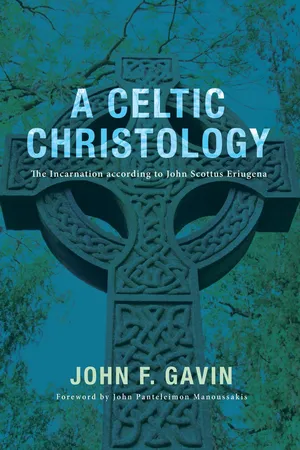
- 178 pages
- English
- ePUB (mobile friendly)
- Available on iOS & Android
eBook - ePub
About this book
John Scottus Eriugena, the brilliant and controversial Irishman in the court of Charles the Bald (823-877), the grandson of Charlemagne, drew upon both the Latin and Greek patristic traditions in order to present a bold and original Christian vision. A philosopher, theologian, translator, poet, and mystic, he may be considered the ideal Carolingian Renaissance man. This volume examines his understanding of the Incarnation, the enfleshment of the Word. On the one hand, Eriugena's Christology creatively appropriates traditional categories in order to explain God's philanthropia in creating, sustaining, and restoring the cosmos. On the other hand, it also provides a guide for the believer's mystical participation in the life of Jesus and return to divine union. This brilliant intellectual from the so-called "Dark Ages" offers much to inspire, and perhaps even to startle, contemporary theologians, philosophers, and believers who ponder the mystery of the God-made-flesh.
Information
Topic
Theology & ReligionSubtopic
Christian Theology1
Being Human, Being Flesh
Eriugena declares that the Word “was made fully man, subsisting in flesh, soul and mind.”49 Yet before considering the significance of the Incarnation in his thought, we must carefully qualify what the Word assumed in becoming flesh. Since flesh, as this chapter will show, designates a particular state of the human body after the fall, to say that the Word became incarnate means that God actually entered into humanity’s world of suffering and death.
This chapter follows the fall of humanity into the tragic state of material existence. First, it examines the reasons behind humanity’s creation. Second, it considers humanity’s embodied state in paradise, that is, the pre-lapsarian spiritual body. Finally, it takes up the problem of the fleshly state after the fall. The journey of this chapter, therefore, takes a tragic course that concludes in a world of suffering, instability, and decay. Yet the flesh also contains the hope of restoration and elevation in the Incarnation of the Word. “Where man reaches the end of his Fall, there begins his return.”50
Before proceeding, it should be noted that Eriugena’s allegorical reading of the Scriptures, particularly his reading of Genesis, often challenges modern sensibilities. Like the ancient exegetes before him, he understood the hermeneutical difficulties in explaining the creation story with its disturbing anthropomorphisms, repetitions, and inconsistencies. Though the resources of the historical-critical method were obviously not available to him, he did overcome these obstacles through an allegorical interpretation of the narrative that sought to penetrate the deeper mysteries of humanity’s tragic circumstances and hunger for liberation. The text of God’s Word remained ever his guide, since even its problems inspired contemplation of the mysteries of the fall and redemption. Perhaps Leon Kass’s words regarding the reading of Genesis—and the reading of the Scriptures in general—will open the contemporary reader to the possibilities of the Irishman’s exegesis: “We may be disappointed in the [scriptural] text’s lack of clarity, but we are at the same time grateful that the account leaves mysterious what cannot help but be mysterious. In this sense, at least, we believe that the text tells the truth: we already suspect that there is no way for us human beings to visualize clearly or to understand fully the awesome coming into being of the world. We begin to trust the text.”51
The Reasons for Creation
The Glory of God
Why did God create and what is humanity’s vocation within the divine plan? In general, Eriugena gives three reasons for God’s creative act. First, he states that “all things were created out of nothing in order that the breadth and bounty of divine goodness might be manifested and praised through the things which he made.”52 Things come to be for God’s greater glory. In the act of creation, God “makes” and reveals himself, since he moves from the darkness of non-being—the incomprehensible and transcendent divinity—into the light of intelligible being in things that he makes.
This creative act also demands intelligent beings that may know and praise God. God’s greater glory comes from the free response of angels and men:
If the divine Goodness had remained alone in itself, at rest and without action, it perhaps would not have created an occasion for its praise. But now [the divine Goodness], pouring itself out into all visible and invisible things, and existing as all things and in all things, turns the rational and intellectual creature toward knowledge of itself. Thus, God made everything in order to show every rational and intellectual creature the innumerable and beautiful species of the rest of creation as material for his praise. He did this that there might not be any creature that does not, either through itself or in itself or through another, praise the Supreme Good.53
Intellectual creatures—angels and men—glorify God by knowing God’s self-manifestation in creation and by praising him through that knowledge.
Divine Fecundity
A second general reason for creation comes from the very notion of divine Goodness: Goodness itself is inherently fecund.54 God emerges from the impregnability of divine non-being through an act of natural generosity and love: “The Highest Good, which is a subsisting Good from itself and in itself, must not abstain from the creation (conditio) of goods, which are good neither from themselves nor in themselves, but from the Good itself and in the Good itself. For this reason he created existing things from non-existence, lest he be reproached for jealousy by holding himself back from the establishment (substitutio) of those things that he was able to establish (substituere).”55 This divine abundance that pours forth into creation does not imply an unwilled act, but rather it reveals God’s free outflowing generosity and majesty.56
Love
God creates because God is love: “It is right, therefore, that God is said to be love, because he is the cause of all love, and he is diffused through all things, and he gathers all things into one, and it turns back to him in an ineffable return. He encloses the loving motions of the whole of creation in himself. Also, the diffusion itself of the divine nature into all things, which are in the divine nature and come from it, is called the love of all things.”57 Since creation is a theophany of the divine—God “makes” himself, that is, he comes to be known in what he creates—it comes “to be...
Table of contents
- Title Page
- Foreword
- Acknowledgements
- Abbreviations
- Introduction
- Chapter 1: Being Human, Being Flesh
- Chapter 2: Jesus Christ
- Chapter 3: Cur Deus Homo?
- Chapter 4: The Foundations of Participatory Christology
- Chapter 5: The Mystical Appropriation of the Life of Jesus
- Conclusion
- Bibliography
Trusted by 375,005 students
Access to over 1.5 million titles for a fair monthly price.
Study more efficiently using our study tools.
Frequently asked questions
Yes, you can cancel anytime from the Subscription tab in your account settings on the Perlego website. Your subscription will stay active until the end of your current billing period. Learn how to cancel your subscription
No, books cannot be downloaded as external files, such as PDFs, for use outside of Perlego. However, you can download books within the Perlego app for offline reading on mobile or tablet. Learn how to download books offline
Perlego offers two plans: Essential and Complete
- Essential is ideal for learners and professionals who enjoy exploring a wide range of subjects. Access the Essential Library with 800,000+ trusted titles and best-sellers across business, personal growth, and the humanities. Includes unlimited reading time and Standard Read Aloud voice.
- Complete: Perfect for advanced learners and researchers needing full, unrestricted access. Unlock 1.5M+ books across hundreds of subjects, including academic and specialized titles. The Complete Plan also includes advanced features like Premium Read Aloud and Research Assistant.
We are an online textbook subscription service, where you can get access to an entire online library for less than the price of a single book per month. With over 1.5 million books across 990+ topics, we’ve got you covered! Learn about our mission
Look out for the read-aloud symbol on your next book to see if you can listen to it. The read-aloud tool reads text aloud for you, highlighting the text as it is being read. You can pause it, speed it up and slow it down. Learn more about Read Aloud
Yes! You can use the Perlego app on both iOS and Android devices to read anytime, anywhere — even offline. Perfect for commutes or when you’re on the go.
Please note we cannot support devices running on iOS 13 and Android 7 or earlier. Learn more about using the app
Please note we cannot support devices running on iOS 13 and Android 7 or earlier. Learn more about using the app
Yes, you can access A Celtic Christology by John F. Gavin in PDF and/or ePUB format, as well as other popular books in Theology & Religion & Christian Theology. We have over 1.5 million books available in our catalogue for you to explore.