eBook - ePub
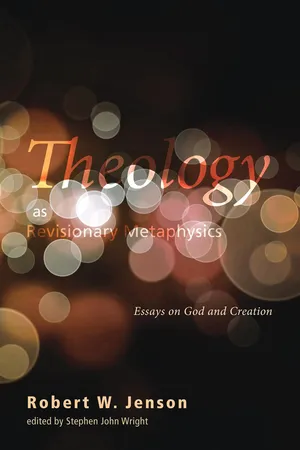
Theology as Revisionary Metaphysics
Essays on God and Creation
- 242 pages
- English
- ePUB (mobile friendly)
- Available on iOS & Android
eBook - ePub
Theology as Revisionary Metaphysics
Essays on God and Creation
About this book
Modern Protestant theology has tended to shun metaphysics. The philosophical underpinnings of our theological traditions have cracked under the weight of modern scrutiny. Robert Jenson is a theologian who has embraced the critique of inherited metaphysics, but who then finds contained within the gospel itself the basis for further and more specific critiques: the story of Jesus of Nazareth. Jenson argues that the appropriate response of theology to the contemporary situation is not to reject metaphysics, but to develop new and more radical metaphysical proposals. For several decades now, he has been pursuing a theological program of "revisionary metaphysics"--an attempt to speak about the gospel in a society more and more characterized by epistemological disquiet. Gathered together in this volume is a collection of his proposals for theology laboring under this task of revisionary metaphysics.
Information
Topic
Teologia e religioneSubtopic
Metafisica filosoficaGod
8
The Hidden and Triune God (2000)
The following article is a first and perhaps still too programmatic attempt to respond to a friend’s21 urgent suggestion. I should, he said, think harder about the relation between the biblical God’s triunity, of which I had written much, and his hiddenness, about which I had written little and in explicit context of his triunity even less.
Martin Luther is of course the master exponent of God’s hiddenness, and will be a chief interlocutor. The theme, moreover, is especially dominant in the tract that of all his writing I have most read and reread, the De servo arbitrio. At each new reading or reflection I have said to myself, “This about God’s impenetrable hiddenness is really great stuff! And moreover, it surely must somehow be true.” But I have not known—or perhaps wanted to know—where to go from there.22
The problem about God, I have insofar long agreed with Luther, is not his metaphysical distance from us. After all, mere distance, however great and metaphysical, could not hide him but could only attenuate his visibility, and such a distancing of our view of God might very well only clarify the picture. Rather, God is hidden, and our problem with him is constituted precisely by the character and importunity of his presence.
In De servo arbitrio, God’s hiding presence is instanced at two locations. The first23 is his very present rule of his creation. If God were off in the metaphysical spaces, we might in some moods complain of this, but the situation would have the advantage that we could construe buffering mediations between God and this world with its evils. But if God rules in his creation as its present Lord, the fact of even one tortured child must indeed mask his visage and that most horridly. Readers will recall Luther’s famous dictum, that if we consider God’s rule of his creation, and judge by any available standard, we must conclude “either that God is not or that he is wicked,” aut malum aut nullum esse Deum.24 I have always thought Ivan Karamazov a notable disciple of Luther, who simply chose the one horn of Luther’s dilemma.
Another location25 is christological. If the Antiochenes and many neo-Protestants were right about the relation between the person of Jesus and God the Son, if the Son were one subject and the Suffering Servant another, who works with the Son or points to him or is in whatever such prepositional relation to him, then Jesus’ rejection and suffering on the cross—or Israel’s rejection and suffering in Babylon and the ruins of Jerusalem—would not need to trouble our picture of divine power and bliss. But if in any straightforward sense of the copula the figure up there on the cross just is God the Son, or Israel in Exile just is the first-born whom the Lord called from Egypt, then the face without form or comeliness, from which we can but turn our own faces, is God’s own.
A third location occurs in the Commentary on Galatians—not so great a favorite of mine but of course required reading. There Luther says that faith itself is a hiding of God in the soul.26 Faith, he there says, is a very peculiar sort of perception, not so much a light in the heart as a darkness, within which Christ is present as was God in the darkness over Sinai. Faith is precisely the hidden indwelling of Christ; indeed it is God hiding himself from us by entering that most obscure of locations, our own hearts.
All this I have thought right from my first encounter with it. But I have not sufficiently tried to make it a systematic part of my own interpretation of God.
At most I have used Luther’s insights therapeutically, to ward off a bowdlerized apophaticism which has recently been popular. That God is unknowable must not be construed to mean that he is but vaguely glimpsed through clouds of metaphysical distance, so that we are compelled—and at liberty—to devise namings and metaphors guided by our religious needs. It means on the contrary that we are stuck with the names and descriptions the biblical narrative contingently enforces, which seem designed always to offend somebody; it means that their syntax is hidden from us, so that we cannot identify synonyms or make translations. It means that we have no standpoint from which to relativize them and project more soothing visions.
Luther’s famous “theology of the cross” has more or less the opposite force from that given it by many who recite the phrase: his point is that the vision of God-crucified crucifies us, and precisely in our religious needs and seekings at their most compelling and most innocent. I have used Luther’s evocation of God’s hiddenness to debunk pop-Feuerbach, and think the weapon good for the purpose; but using so powerful a theologoumenon only in this way is indeed shooting mosquitoes with an elephant gun.
So why have I not gone after bigger game? My thinking has been moved above all by the conviction that the doctrine of the Trinity is both the great specificum and the great task of Christian theology; and the attempt to integrate serious trinitarianism with Luther-style discourse about God’s hiddenness opens a very daunting can of worms.
According to classic trinitarianism, Father, Son, and Spirit are distinct identities as and only as poles of the relations between them. The Father begets the Son and breathes the Spirit, and just and only so there is the Father; and just and only so there is the one God. So the classical doctrine. And I want to go on to say: the Spirit liberates the Father and the Son for each other, and just and only so there is the Spirit; and just and only so there is God. And, the Son reconciles the Father and the Spirit, and just and only so there is the Son; and just and only so there is God. Is hiding yet another such relation or web of relations? If it is, how does it fit with the others?
Or is hiddenness a simple predicate of the one God, like omnipotence or omniscience? To be sure, in my own development of doctrine, there are no “simple” predicates of the one God. Attributes supposed to be true of the one God are properly predicated of the life lived between Jesus the Son and the One he called Father, in the Spirit of their freedom, so that a divine predicate is properly construed only when the different role of each divine identity in this aspect of their mutual life is told. To speak of omniscience, the Father sees himself and his works in the Son, with the creative freedom of the Spirit, and so we can say that the one God is omniscient. If now we want hiddenness to be a predicate of God, does then the Son’s hiddenness on the cross hide God the Father from himself? Or to speak of omnipotence, the Spirit frees the Father to originate from nothing by works he lays upon the Son. Do the evils in creation cloud the Father’s intent or the Spirit’s joy?
Or is hiddenness a divine reality in some other fashion altogether? Let me instance two major theological enterprises which do, each in a way unique to itself, integrate hiddenness and triunity.
A major stream of Orthodox theology, going back to Gregory Palamas,27 adapts some language of the Cappadocians and distinguishes three modes of being in God: the triune identities or persons, the one life constituted in the perichoresis of their “energies,” and God’s “natural entity,” his “ousia” or “physis.” Systematically, this theology posits a third mode of deity, a “divine ousia,” in order to say that while God takes us to share in the mutual life of the three, so fully that our participation can even be called “deification,” there remains a depth in which God is non-participable, which is epistemically to say, unknowable even apophatically, which is finally to say, “hidden.” Here the hiddenness of God is a depth in which he is inalienably closed to us.
For the very different other instance, Karl Barth notoriously made a dialectic of revealedness and hiddenness the very root of trinitarian doctrine. “We arrive,” wrote Barth, “at the doctrine of the Trinity by no other way than by” a conceptual analysis of the revelation—that is to say unhiding—of God in Christ.28 Barth then makes two runs at such analysis, the second the more serious.29 This begins with the maxim that “revelation means in the Bible the self-unveiling to humanity of the God who essentially cannot be unveiled to humanity.”30 Nevertheless, unveiling happens, that is, God occurs as other than his inviolably hidden selfhood.
Since unveiling in fact happens, there must be in God the possibility that it happens, there must be in God a Bedingung der Möglichkeit of this reality of God as other than God; and so we k...
Table of contents
- Title Page
- Acknowledgments
- Abbreviations
- Story
- God
- Creation
- Culture
- Bibliography
Trusted by 375,005 students
Access to over 1.5 million titles for a fair monthly price.
Study more efficiently using our study tools.
Frequently asked questions
Yes, you can cancel anytime from the Subscription tab in your account settings on the Perlego website. Your subscription will stay active until the end of your current billing period. Learn how to cancel your subscription
No, books cannot be downloaded as external files, such as PDFs, for use outside of Perlego. However, you can download books within the Perlego app for offline reading on mobile or tablet. Learn how to download books offline
Perlego offers two plans: Essential and Complete
- Essential is ideal for learners and professionals who enjoy exploring a wide range of subjects. Access the Essential Library with 800,000+ trusted titles and best-sellers across business, personal growth, and the humanities. Includes unlimited reading time and Standard Read Aloud voice.
- Complete: Perfect for advanced learners and researchers needing full, unrestricted access. Unlock 1.5M+ books across hundreds of subjects, including academic and specialized titles. The Complete Plan also includes advanced features like Premium Read Aloud and Research Assistant.
We are an online textbook subscription service, where you can get access to an entire online library for less than the price of a single book per month. With over 1.5 million books across 990+ topics, we’ve got you covered! Learn about our mission
Look out for the read-aloud symbol on your next book to see if you can listen to it. The read-aloud tool reads text aloud for you, highlighting the text as it is being read. You can pause it, speed it up and slow it down. Learn more about Read Aloud
Yes! You can use the Perlego app on both iOS and Android devices to read anytime, anywhere — even offline. Perfect for commutes or when you’re on the go.
Please note we cannot support devices running on iOS 13 and Android 7 or earlier. Learn more about using the app
Please note we cannot support devices running on iOS 13 and Android 7 or earlier. Learn more about using the app
Yes, you can access Theology as Revisionary Metaphysics by Robert W. Jenson, Stephen John Wright, Wright in PDF and/or ePUB format, as well as other popular books in Teologia e religione & Metafisica filosofica. We have over 1.5 million books available in our catalogue for you to explore.