- 112 pages
- English
- ePUB (mobile friendly)
- Available on iOS & Android
eBook - ePub
About this book
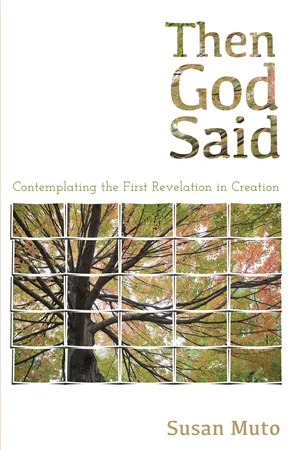
Then God Said teaches us to open our eyes and behold the gifts of creation that unfold before us in all their splendor. We abide in awe before the generative forces of the universe. We delight in the splendor of created things and thank God for this outpouring of gifts from the beginning of time. Each chapter of Then God Said invites us to contemplate the first revelation in creation--from water and sky to cattle and creeping things. We ponder, page by page, the power of the Father, the presence of the Son, and the productivity of the Holy Spirit. We behold anew the majesty of this planet and the merciful dispensation of the Divine under which we live day by day. We celebrate the beauty of the earth and the sheer majesty of each minute trace of the transcendent. Readers are encouraged to find the footprints of love that move the sun, the moon, and all the stars. Creation not only reminds us of God's glory; it offers us a sacramental understanding of all that we see, hear, touch, taste, and smell, thereby increasing our ecological sensitivity and our commitment to foster respectful stewardship over all that we survey.
Information
Topic
Theology & ReligionSubtopic
Biblical StudiesPart One
Animals Beloved by God
That Bow Before God’s Face
1.
Birds
Ps 50:10–11. For every wild animal of the forest is mine, the cattle on a thousand hills. I know all the birds of the air, and all that moves in the field is mine.
Matt 6:26. Look at the birds of the air; they neither sow nor reap nor gather into barns, and yet your heavenly Father feeds them.

At one moment or another all of us have probably dreamt of what it would be like to soar free as a bird in the blue sky, flitting from branch to branch, not as random creatures in an indifferent cosmos but as spirits known intimately by our Creator, who feeds us season by season and guides our migratory flights.
Picture any bird—from a red-breasted robin to an American eagle—and the first word that comes to mind is freedom. The second a predator approaches, wings arch, spread, flap and this beautifully formed creature flies away.
Birds display a remarkable diversity within the unity of flight. They flit like sandpipers with the ebb and flow of the sea. They coo like doves announcing the dawn of a new day and squawk like crows disturbing our peace. They announce with excited chirps the shift from winter to spring and migrate over distances that defy the imagination.
Homing pigeons carry messages from senders to recipients, who may not have access to any other means of communication. Birds are plain as sparrows and as rainbow-hued as rare rain forest parrots. Some are seen as bearers of good omens like white pigeons; others as harbingers of death and destruction like buzzards and vultures.
As any bird watcher may be inclined to conclude, they are living books the Creator may use to teach us lessons we are not likely to forget. Birds of prey can symbolize impending, indeed ominous, signs of divine judgment (Hos 8:1). None of us want to be doomed creatures who fall to their death in the “snare of the fowler” (Ps 91:4). How much better it is to “fly away and be at rest” (Ps 55:6), to live the worry-free existence of winged wonders who neither sow nor reap (Luke 12:24). Birds trust in the daily bread supplied by Providence (Ps 147:9) and so ought we. Isn’t it ironic that they build nests wherever they are while so many of us humans are homeless (Luke 9:58)? Under their wings we find a symbol of divine protection (Ps 63:7) from malevolent spirits and a place where we can pause a while and restore our strength.
Birds teach us lessons about fidelity. Some, like ospreys, mate for life. From others, we learn the meaning of nurturing as when a mother bird, at risk to herself, feeds and protects her young. No matter how far away we roam, birds teach us that homecoming is always a reachable goal. In Aesop’s fable, The Stork and the Farmer, the stork argues that it should be set free to go home and take care of its parents in their old age, and the farmer agrees. By contrast, the seeming indifference of ostriches to their offspring is an unacceptable model for good parent-child relationships (Lam 4:3).
Birds convey many messages, ranging from picking at a carcass and chasing away its competitors to reminding us what it means to protect our young and spread seeds in fertile soil. Their examples of loyalty evoke our admiration, their beauty our awe, and so we pray: “Lord, let me live as fully and freely as possible in fidelity to your call until that day when my soul, on wings of dawn, flies through the cage of time to its homecoming in eternity.”
2.
Colts
Zech 9:9. Rejoice greatly, O daughter Zion! Shout aloud, O daughter Jerusalem! Lo, your king comes to you, triumphant and victorious is he, humble and riding on a donkey, on a colt, the foal of a donkey.
John 12:14–5. Jesus found a young donkey and sat on it; as it is written: ‘Do not be afraid, daughter of Zion. Look, your king is coming, sitting on a donkey’s colt!’
“You jackass!” has always been a pejorative expletive and yet the lowly colt has played a significant role in salvation history and in the progress of humanity. This low-maintenance beast of burden provided a means of transportation for poor people, tackled treacherous terrains, and earned a reputation for being worth its weight in gold. Everyone knows that mules and donkeys and colts can be stubborn creatures, at times adamantly refusing to move without the application of the whip, but their reliability and resilience are unquestionable.
Lowly as it was the donkey was destined to become in scriptural lore a mount of nobility. It was the animal of choice that would transport Mary, heavy with child, to Bethlehem. In nativity productions, Joseph gently guides the mule carrying the mother of our Lord and Savior. Its breath and body warm the stable where she gave birth. At other times, donkeys bore a great deal of abuse, being whipped senseless and accused of being dumb, but nothing could be farther from the truth. This sure-footed creature not only mastered dizzying trails like those that carry tourists deep into the Grand Canyon but also became a sign of an impending ascension to power as when David mounted Solomon on his own mule (I Kgs 1:33).
Similarly, Jesus orchestrated his triumphal entry into Jerusalem not on a majestic war horse but on a lowly mule, regarded in that scene as a symbol of kingship and peace (Matt 21:2). Neither swaying palm branches nor loud hosannas could break this beast’s steady pace through the cobblestone streets of Jerusalem. Imagine, if this colt could talk, what a story it would tell! Just as Jesus raised up the donkey’s dignity at the time of his birth and shortly before his death, so he wants to lift up the likes of us. It is not the mule’s stubbornness we are to emulate but the patience with which it accepts and carries the weight placed on it. Revealed in this ordinary beast is a knack for efficiency that might arouse our envy. That the Lord himself rode on it conveys the truth that he often chooses the nothings of this world to do his will.
Once upon a time there was an old monk who had a scripture quote for whatever happened in the monastery—a habit the younger monks wanted him to break. The abbot agreed with them and chastised the erstwhile biblical expert to kneel in perfect silence in the middle of the refectory during meals. He accepted his punishment with docility, but one day the beast of burden became untethered and ran toward the dining area braying at the top of its lungs. The monks jumped up in an attempt to r...
Table of contents
- Title Page
- Prologue
- Part One: Animals Beloved by God—That Bow Before God's Face
- Part Two: Fruits, Vegetables, Flowers, and Minerals Manifesting the Most High
- Part Three: Things Invested with Transcendent Meaning
- Part Four: Places in Nature Pointing to God
- Epilogue
Trusted by 375,005 students
Access to over 1.5 million titles for a fair monthly price.
Study more efficiently using our study tools.
Frequently asked questions
Yes, you can cancel anytime from the Subscription tab in your account settings on the Perlego website. Your subscription will stay active until the end of your current billing period. Learn how to cancel your subscription
No, books cannot be downloaded as external files, such as PDFs, for use outside of Perlego. However, you can download books within the Perlego app for offline reading on mobile or tablet. Learn how to download books offline
Perlego offers two plans: Essential and Complete
- Essential is ideal for learners and professionals who enjoy exploring a wide range of subjects. Access the Essential Library with 800,000+ trusted titles and best-sellers across business, personal growth, and the humanities. Includes unlimited reading time and Standard Read Aloud voice.
- Complete: Perfect for advanced learners and researchers needing full, unrestricted access. Unlock 1.5M+ books across hundreds of subjects, including academic and specialized titles. The Complete Plan also includes advanced features like Premium Read Aloud and Research Assistant.
We are an online textbook subscription service, where you can get access to an entire online library for less than the price of a single book per month. With over 1.5 million books across 990+ topics, we’ve got you covered! Learn about our mission
Look out for the read-aloud symbol on your next book to see if you can listen to it. The read-aloud tool reads text aloud for you, highlighting the text as it is being read. You can pause it, speed it up and slow it down. Learn more about Read Aloud
Yes! You can use the Perlego app on both iOS and Android devices to read anytime, anywhere — even offline. Perfect for commutes or when you’re on the go.
Please note we cannot support devices running on iOS 13 and Android 7 or earlier. Learn more about using the app
Please note we cannot support devices running on iOS 13 and Android 7 or earlier. Learn more about using the app
Yes, you can access Then God Said by Susan Muto in PDF and/or ePUB format, as well as other popular books in Theology & Religion & Biblical Studies. We have over 1.5 million books available in our catalogue for you to explore.