- 142 pages
- English
- ePUB (mobile friendly)
- Available on iOS & Android
eBook - ePub
About this book
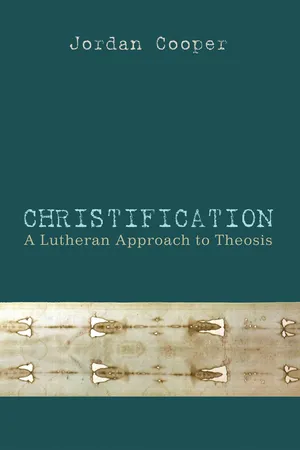
The doctrine of theosis has enjoyed a recent resurgence among varied theological traditions across the realms of historical, dogmatic, and exegetical theology. In Christification: A Lutheran Approach to Theosis, Jordan Cooper evaluates this teaching from a Lutheran perspective. He examines the teachings of the church fathers, the New Testament, and the Lutheran Confessional tradition in conversation with recent scholarship on theosis. Cooper proposes that the participationist soteriology of the early fathers expressed in terms of theosis is compatible with Luther's doctrine of forensic justification. The historic Lutheran tradition, Scripture, and the patristic sources do not limit soteriological discussions to legal terminology, but instead offer a multifaceted doctrine of salvation that encapsulates both participatory and forensic motifs. This is compared and contrasted with the development of the doctrine of deification in the Eastern tradition arising from the thought of Pseudo-Dionysius. Cooper argues that the doctrine of the earliest fathers--such as Irenaeus, Athanasius, and Justin--is primarily a Christological and economic reality defined as "Christification." This model of theosis is placed in contradistinction to later Neoplatonic forms of deification.
Information
Topic
Theology & ReligionSubtopic
Christian Church1
Defining Theosis
Theosis is a multifaceted doctrine with a variety of formulations; thus, it is a difficult concept to define. Most well known is the Athanasian proclamation that “God became man so that man might become god.”1 This statement summarizes the patristic teaching on the subject and establishes a basis on which all further dialogue on the topic expounds. This statement, however, is subject to a variety of interpretations. It could be misread to support the pagan notion of apotheosis, wherein one becomes a unique divine entity among a pantheon of gods. A more precise definition will aid in proceeding with the present work. Though no definition completely captures all the implications and subtleties of this teaching, Norman Russel’s explanation of deification is perhaps the most comprehensive:
Theosis is our restoration as persons to integrity and wholeness by participation in Christ through the Holy Spirit, in a process which is initiated in this world through our life of ecclesial communion and moral striving and finds ultimate fulfillment in our union with the Father—all within the broad context of the divine economy.2
While the Lutheran tradition has placed soteriology primarily in the realm of event rather than process, the Eastern tradition proclaims deification, its central soteriological category, as a process.
Salvation as Process in Orthodox and Lutheran Theology
Notions of salvation as event and process need not be pitted against one another. Justification, in Lutheran (and Pauline) theology, is an event of the past and present, in which God’s eschatological verdict of “righteous” is placed on his people in advance. This occurs through the alien righteousness of Christ received by faith.3 As will be demonstrated below, the Lutheran Confessions are also willing to speak of a soteric process by which union with God is increased and the believer progresses in holiness. This is the context in which theosis is to be placed.
Such a distinction between event and process is not foreign to Orthodox theology either. In his popular handbook on the Orthodox Church, Anthony Coniaris distinguishes between justification and sanctification. He defines justification as the understanding that “we have been saved from sin and death through baptism, which is our personal Golgotha.”4 In Coniaris’ perspective, justification is the beginning of the Christian life—salvation spoken of in the past tense. Justification is received by faith, which is “the humble acceptance of God’s gracious gift. It is the hand that takes the blessing. It receives what God gives, not as something we deserve, but as a gift of His grace.”5 Good works do not cause justification, but are “a grateful response, a feeble attempt on our part to show appreciation to God for what He has done for us.”6 This is distinguished from sanctification, which is the understanding that “we are being saved daily as we repent of our sins and continue to walk with Jesus yielding our will to Him in humble obedience.”7 Like Luther, Coniaris speaks of conversion and repentance as a daily reality. The great saints “were not converted once. Nor did they repent just once. Their life was a daily conversion and a constant repentance.”8 If Coniaris is representative of Orthodox theology in this regard, there are many convergences between Lutheran and Orthodox soteriology. For both, salvation can be spoken of in the past tense in relation to justification. This occurs through faith and baptism, wherein God creates life from death and gives the forgiveness of sins due to the work of Christ at Golgotha. Works then serve as the result of God’s grace, in thankfulness for what God has done in Christ. Theosis is then placed alongside of justification as a compatible soteriological motif. It flows from justification and involves a process of growth.
The difference, then, between the two traditions is not over whether salvation is an event or a process, but over which aspect of redemption is primary. Orthodox theology, especially since Lossky’s critique of Western theology, has emphasized salvation as a process.9 The doctrine of justification has received little to no treatment in major orthodox dogmatic works. Lutheran theology emphasizes salvation as an event—as justification. Though some may claim this to be merely the outgrowth of medieval debates or as an overreaction to Semipelagianism, there are important theological reasons for this prioritization. In justification, one receives the benefits of Christ: namely, the forgiveness of sins and the righteousness of Christ. God’s eschatological verdict is placed upon the sinner in the present, resulting in the justification of the ungodly. This work is perfect in the present life, and assures the eternal salvation of God’s people. Growth is always incomplete; the Christian will always remain simul iustus et peccator because he or she simultaneously exists in eschatological life and the present Adamic age. The Christian is a citizen of both this age and the age to come. One progresses toward union with God as eschatological life moves toward the believer, and the old Adam is put to death. If the focus were on salvation as a process—in terms of sanctification or deification—one’s assurance would be misplaced. It is always the perfect act of God, rather than the imperfect and continual, which gives the assurance of salvation and which then serves as the basis for theosis.
Becoming God
The notion of “becoming god” falls deaf on Western ears. It likely brings up images of ancient hero cults in which a great figure, emperor, or pharaoh was said to become a divine figure. Or perhaps the Mormon conception of divinization comes to mind, under which a man can genuinely become a god, not merely through participation but in essence. Such misconceptions need to be clarified before proceeding. A distinction, which the fathers were careful to make, must be drawn between theosis and apotheosis.10 Apotheosis is the notion that a human can become a divine entity—that a complete ontological transformation takes place wherein humanity is transcended and becomes god by nature. This would displace the Trinitarian God and result in pantheism. Andrew Louth writes that:
Here is perhaps a good place to clear up a misconception about deification, namely, that it involves the transformation of our human nature into something other than human, some kind of apotheosis that removes our humanity: to quote some frequently quoted words, “If the aim of the Christian is to cease to be ‘human, all too human,’ it would be a natural corollary in Christology to regard the humanity of our Lord as a problem r...
Table of contents
- Title Page
- Abbreviations
- Introduction
- 1. Defining Theosis
- 2. Theosis in the Lutheran Tradition
- 3. Theosis in Holy Scripture
- 4. Theosis as Christification in Early Patristic Sources
- 5. The Neoplatonic Approach to Deification
- Bibliography
Trusted by 375,005 students
Access to over 1.5 million titles for a fair monthly price.
Study more efficiently using our study tools.
Frequently asked questions
Yes, you can cancel anytime from the Subscription tab in your account settings on the Perlego website. Your subscription will stay active until the end of your current billing period. Learn how to cancel your subscription
No, books cannot be downloaded as external files, such as PDFs, for use outside of Perlego. However, you can download books within the Perlego app for offline reading on mobile or tablet. Learn how to download books offline
Perlego offers two plans: Essential and Complete
- Essential is ideal for learners and professionals who enjoy exploring a wide range of subjects. Access the Essential Library with 800,000+ trusted titles and best-sellers across business, personal growth, and the humanities. Includes unlimited reading time and Standard Read Aloud voice.
- Complete: Perfect for advanced learners and researchers needing full, unrestricted access. Unlock 1.5M+ books across hundreds of subjects, including academic and specialized titles. The Complete Plan also includes advanced features like Premium Read Aloud and Research Assistant.
We are an online textbook subscription service, where you can get access to an entire online library for less than the price of a single book per month. With over 1.5 million books across 990+ topics, we’ve got you covered! Learn about our mission
Look out for the read-aloud symbol on your next book to see if you can listen to it. The read-aloud tool reads text aloud for you, highlighting the text as it is being read. You can pause it, speed it up and slow it down. Learn more about Read Aloud
Yes! You can use the Perlego app on both iOS and Android devices to read anytime, anywhere — even offline. Perfect for commutes or when you’re on the go.
Please note we cannot support devices running on iOS 13 and Android 7 or earlier. Learn more about using the app
Please note we cannot support devices running on iOS 13 and Android 7 or earlier. Learn more about using the app
Yes, you can access Christification by Jordan Cooper in PDF and/or ePUB format, as well as other popular books in Theology & Religion & Christian Church. We have over 1.5 million books available in our catalogue for you to explore.