eBook - ePub
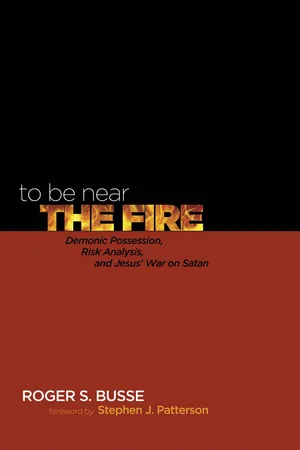
To Be Near the Fire
Demonic Possession, Risk Analysis, and Jesus’ War on Satan
- 196 pages
- English
- ePUB (mobile friendly)
- Available on iOS & Android
eBook - ePub
About this book
Virtually all scholars agree that Jesus did one very risky thing: he exorcised demons. Exorcism was an illicit activity in the Roman world, so why would Jesus risk condemnation, arrest, and even death for the sake of the demon-possessed? Some point to his compassion. Roger Busse, a thirty-nine-year veteran of risk analysis and a graduate of Harvard Divinity School, has another answer from the world in which he lives: risk assessment. People engage in risky ventures only when not doing so would pose even greater risks. What was the greater risk for Jesus? He believed that his land and home, then suffering under foreign occupation, was filled with demons. He believed that if he did not drive them off, all might be lost and the forces of darkness might win out, leaving only the kingdom of Satan. Given this context, Busse reassesses the gospel traditions. Using risk analysis, Busse provides a new approach that recovers the specific charismatic practices, sayings, and parables that the exorcist Jesus' employed in his deliberate and dangerous strategy to drive Satan from the land and reestablish the kingdom of God. To Be Near the Fire offers a new portrait of Jesus and the origins of Christianity.
Information
1
Introduction
Demonic Possession, Risk Analysis, and Jesus’ War on Satan
“To be near Jesus is dangerous. It offers no prospect of earthly happiness, but involves the fire of tribulation and the test of suffering. But, it must indeed be born in upon every one who, yielding to fear, turns away from the call of Jesus, that he excludes himself from the Kingdom of God.”
—Joachim Jeremias1
Is this correct? Was it dangerous to be near Jesus, and if so, why? Did the young Jewish Galilean peasant and exorcist, Yeshua ben Yosef, embrace the “fire of tribulation,” reject earthy happiness, and demand the same of those who, having witnessed his expulsion of demons, chose to respond to his proclamation? What perilous risks did he perceive that would have led him to demand such a radical response? Can these risks be recovered from their historical context, and if so, how? What were the perilous risks of his generation, and how did he confront them, even at risk to his own life? What do they tell us about his undisputed confrontation with demonic possession and the religious elite, as well as his death?
These are questions that have plagued me for over thirty years, because risk is something I deal with every day. Now I manage a $1.5 billion community bank, but ten years ago I worked at the highest levels of risk evaluation and analysis in a multibillion-dollar organization, analyzing all types of perilous risks, quantitative and qualitative.2 During those years, I developed and employed proven methodologies for evaluating and mitigating risks, presenting countless seminars to all levels of risk managers and leaders. This included working with nonprofit and religious organizations, as well as speaking on the subject at Harvard Divinity School. Analyzing risk and evaluating historical countermeasures to peril have permeated my thinking.
Many years ago, I thought I had risked everything. I left my career so that I could attend Harvard Divinity School in search of a deeper understanding of risk and historical resistance to evil, even at one’s own peril. It was there that I read about Jesus of Nazareth and Paul of Tarsus—people who risked everything. Only then did I begin to understand the human drive to neutralize risk, and that certain analytical methods were useful in uncovering consistent patterns of risk response, regardless of culture or time. I eventually finished my studies at Harvard, and thanks to the support of my advisor, Helmut Koester, I was armed with a new understanding of how to apply my skills to New Testament studies.
As a result, risk analysis of the New Testament has become my lifelong passion. I have applied various risk methodologies to interpreting the New Testament, leading me to believe that a specific application of risk analysis uncovers a fascinating, detectable pattern of conflict between Jesus and his opponents, particularly in his confrontations with them over demonic possession, pollution of the land, and imperialism. These findings suggest that there is a core tradition surrounding Jesus’ activity that is reliable and recoverable through risk analysis.
Let me describe a framework for researching the New Testament from a risk analysis perspective. First, I take the Gospels, particularly the Gospel of Mark, holistically. I do so because there are several indisputable historical facts that virtually all scholars accept. They provide a “wisp of history”3 that even the most ardent critics embrace, and it is important to note that subsequent practices of the community in which the memory of Jesus is preserved confirm aspects of his risk actions, including the practice of exorcising demonic possession. As Helmut Koester states,
Historians are therefore treading on very thin ice if they try to recover the historical person of Jesus through a critical analysis of the sayings tradition. A person of past history can only be understood if the extant sources reveal the traditions to which such a person belongs as well as the subsequent structures, practices, and institutions of a community in which the memory of this person is preserved.4
Second, Jesus’ risk practices can be correlated using our methodology. In fact, there is a direct connection between practice and ritual instituted by Jesus himself—which, as we shall see, should include his own ritual practice related to exorcisms, particularly among the exorcists he trained, who later made up the first post-Easter community.
When aggregated, these historical facts provide a general historical context that confirms that there was a significant risk conflict between Jesus and his opponents. In my experience, the presence of risk conflict between competing or embattled parties universally points to historical conflict that a rigorous analysis of context can successfully unravel, even in documents that layer and obscure the original conflict. This is particularly true when the conflict includes historical elements that are internally awkward for one of the parties, and would be omitted if possible. If we take such a core set of facts, introduce a proven risk methodology, and then use it as a basis on which to reevaluate these traditions as they are reflected in the Gospel of Mark, what new findings might be suggested? Furthermore, what are the implications as to their meaning? I will use these facts as a common ground to begin the risk analysis and then let findings fall where they may. So what are these facts?
The historical facts accepted by virtually all scholars can be divided into context and conflict. With regard to context, there is no disputing that first-century Palestine was occupied by brutal and corrupt Roman rulers. The Jewish aristocracy and religious elite of Jerusalem were Roman collaborators. They participated in this brutality and accepted Roman rule as the will of God. Resistance to this rule was tantamount to blasphemy, a rejection of the order divinely set forth. Unlike the wealthy aristocracy, Jesus was a poor, reclusive, and dispossessed Galilean peasant, Jewish ecstatic, and exorcist. For Jesus, his exorcisms evidenced that the land was possessed by demons and spirits introduced by Satan, whose activity and power had been augmented by the invasion of pagan, foreign imperialists and their supporters. Jesus left Galilee to become a disciple of John the Baptist. John rejected the Jerusalem elite, calling them “vipers” (Matt 3:7), that is, those possessed by Satan. At baptism, Jesus had an ecstatic experience and was possessed by the Spirit given by God. Jesus was then able to command demons and angels at will, for which he was feared. The Jerusalem elite murdered John, leading Jesus to flee to the Galilee. Jesus then began an assault on Satan, exorcising demons and spirits by his Spirit, which he called the “finger of God” (Luke 11:20). He recruited and trained other men to be exorcists. For Jesus and others who witnessed them (in experiential encounters), these exorcisms had meaning. Jesus announced that God was coming as king (or was already becoming present), and that he would claim his people, his children, in the powerful and transformative intervention of the kingdom, leading to the general resurrection and judgment of the apostate. The rule of Satan was ending.
The context of conflict then becomes clearer based on other undisputed contextual facts. Exorcists were well-known, but Romans considered them to be charlatans. Indeed, exorcism was considered to be demonic dark magic, was illegal under Roman law, and was punishable by death as a capital crime. Jesus was therefore an outlaw under Roman law, not just an annoyance. Worse, to associate demons with Rome and the elite amounted to sedition. Thus, the Jerusalem elite accused Jesus of being a seditious magician, possessed by Beelzebul. His family also rejected him and publicly accused him of being mad—that is, possessed. So it was that Jesus and the Jerusalem elite, together with their supporters, were in perilous conflict.
With this context established, we can assess risk responses to crises that are expressed in Jesus’ conflict with his opponents, which included Satan.5 The response to dire conflict in the perception of dangerous risks is historically consistent. Indeed, the human response to risk has not changed in millennia, only the source of those risks and the types of countermeasures we employ to cancel them out.6 In the world of first-century Palestine—a world widely believed to be filled with onerous spirits, demons, and unmitigated evil that caused pain, sickness, and death—the ultimate countermeasure was exorcism, or expulsion of those forces. Those who could control or command the spirits were revered by the afflicted as more powerful than evil, or alternately, were feared, hated, and often killed by those who were threatened by powers they considered subversive. We may arrogantly believe that we are different from our ancient ancestors, but we are anything but different when it comes to our fear and the response countermeasures we take to annihilate perilous risks that we perceive as real and present. We want fearful risks ended and will use whatever means necessary. In short, our response is to react with effective countermeasures. So, when perilous risks arise, human responses can be evaluated objectively and historically. To explain this, let me set the stage by providing the basic tenets of risk analysis so that we may apply them to this context.
Effective risk analysis, when applied to uncovering perilous risks and conflict, is generally framed in two methodological categories. The first is quantitative risk analysis, based on numbers, ratios, trends, and statistics. This method, which is associated with traditional mathematical due diligence, is obviously not fruitfully applied to the New Testament except in terms of word counts to help determine authorship. The second methodology is qualitative risk analysis. I believe this method has real value in analyzing the New Testament context outlined above and for evaluating the implications of this historical conflict.
Qualitative risk analysis generally follows a standard evaluative pattern that is iterative. To begin with, there is a perception of what those in the industry call “perilous risk,” or danger of imminent, serious material harm, which is thought to be a real threat to the stability or survival of an entity under analysis. This threat is usually an assault on the entity’s religious, social, economic, or political environment(s). Qualitative risk analysis assesses both the scope of those threats and the entity’s vulnerability, then evaluates the effectiveness of potential measures employed to cancel them out. If they are successful, these countermeasures are usually patterned, replicated, or embellished by the entity, thereby attracting other adherents and standard practices. However, when countermeasures fail, devastation, catastrophe, or even physical harm or death can ensue.
Where there are two conflicting entities, additional criteria come into play that are particularly applicable to studies of the New Testament. When two entities in a common historical context perceive one another as a perilous risk, the countermeasures each employs to cancel the other o...
Table of contents
- Title Page
- Foreword - Stephen J. Patterson
- 1. Introduction: Demonic Possession, Risk Analysis, and Jesus' War on Satan
- 2. Roman Imperialism, Occupied Palestine, and Perilous Risk: Qualitative Risk Analysis and Contemporary Sources
- 3. Palestinian Judaism and Ecstatic Activity: Demonic Activity and Possession
- 4. The Beelzebul Controversy: Countermeasures to Perilous Risk
- 5. Reconstructing the Conflict of Perilous Risks
- 6. Disarming the Strong Man: Jesus' Attack on Satan and Demonic Imperialism
- 7. The Risk Context of the Controversy Dialogues: The Collision of Countermeasures to Perilous Risk
- 8. Jesus’ Exorcisms and the Risk Context of His Mashal
- 9. Confirming Findings: Perilous Risk, Jesus to Paul
- 10. Qualitative Risk Analysis and Faith
- 11. Summary
- Bibliography
Trusted by 375,005 students
Access to over 1.5 million titles for a fair monthly price.
Study more efficiently using our study tools.
Frequently asked questions
Yes, you can cancel anytime from the Subscription tab in your account settings on the Perlego website. Your subscription will stay active until the end of your current billing period. Learn how to cancel your subscription
No, books cannot be downloaded as external files, such as PDFs, for use outside of Perlego. However, you can download books within the Perlego app for offline reading on mobile or tablet. Learn how to download books offline
Perlego offers two plans: Essential and Complete
- Essential is ideal for learners and professionals who enjoy exploring a wide range of subjects. Access the Essential Library with 800,000+ trusted titles and best-sellers across business, personal growth, and the humanities. Includes unlimited reading time and Standard Read Aloud voice.
- Complete: Perfect for advanced learners and researchers needing full, unrestricted access. Unlock 1.5M+ books across hundreds of subjects, including academic and specialized titles. The Complete Plan also includes advanced features like Premium Read Aloud and Research Assistant.
We are an online textbook subscription service, where you can get access to an entire online library for less than the price of a single book per month. With over 1.5 million books across 990+ topics, we’ve got you covered! Learn about our mission
Look out for the read-aloud symbol on your next book to see if you can listen to it. The read-aloud tool reads text aloud for you, highlighting the text as it is being read. You can pause it, speed it up and slow it down. Learn more about Read Aloud
Yes! You can use the Perlego app on both iOS and Android devices to read anytime, anywhere — even offline. Perfect for commutes or when you’re on the go.
Please note we cannot support devices running on iOS 13 and Android 7 or earlier. Learn more about using the app
Please note we cannot support devices running on iOS 13 and Android 7 or earlier. Learn more about using the app
Yes, you can access To Be Near the Fire by Roger S. Busse in PDF and/or ePUB format, as well as other popular books in Teologia e religione & Critica e interpretazione biblica. We have over 1.5 million books available in our catalogue for you to explore.