- 140 pages
- English
- ePUB (mobile friendly)
- Available on iOS & Android
eBook - ePub
About this book
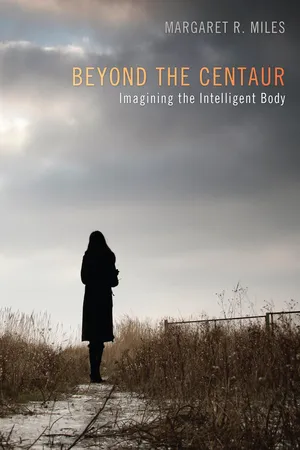
Beyond the Centaur questions the accuracy and usefulness of the virtually unquestioned ancient consensus that persons are composed of unequally valued, hierarchically stacked antagonistic components, usually soul or mind and body. Part I explores the gradual historical development of this notion of person. Part II consists of a thought experiment, examining an understanding of persons, not as stacked components, but as intelligent bodies--one entity. It explores how a new understanding of persons can affect in important and fruitful ways how we live: how we move, feel, think, believe, and die.
Information
Subtopic
Esprit et corps en philosophiePart One
From Stacked Components to the Intelligent Body
1
Introduction
Philosophy and theology are only as good as the anthropology they assume. The idea of “person” we have inherited in the West assumes that persons consist of two (or more) assembled, stuck together, hierarchically arranged components, usually body and mind or soul. Other components, such as spirit, may be added; we’re not very clear about these parts and their roles. A “silent thought,”1 namely, that persons consist of two entities, directs our physical movements, our feelings, our thoughts, how we believe, and how we approach death.
If instead we conceptualized ourselves as intelligent bodies—indivisible, not analyzable into parts, one entity—how might we experience our lives differently? In this book I will undertake the difficult (because seldom practiced and lacking models) exercise of thinking as an intelligent body rather than as a rational mind. To think with the intelligent body is to reunite rational thought, traditionally assigned to mind, and emotion, traditionally assigned to body. Beyond the Centaur is not an argument but an exploration, an exercise.2 Its goal is to provoke other thought experiments in imagining intelligent bodies.
I
For many centuries it has seemed self-evident to philosophers and theologians that persons are made up of components; until recently it has also seemed indisputable to most that mind or soul must rule the ensemble, “mastering” the recalcitrant body. In Part One, I sketch with a broad brush the gradual development of the idea of persons as components from the pre-Socratics to Descartes, the first author in which the distinction explicitly became a separation.
Presently, however, not everyone stacks our assumed components in the same way. Toward the end of the twentieth century, a number of theologians championed the “absent body,” endeavoring to rescue body from its bad press in historical Christianity.3 And contemporary neurophysiologists and some philosophers consider mind an epiphenomenon of body, dependent on body for its physical operations as well as its perspective. Turning the traditional idea of person upside down, they place body in the commanding position; soul receives orders from body. While Plato said, “The body is the prison-house of the soul,”4 Antonio Damasio writes, “the brain is the body’s captive audience.”5 “Biological drives, body states, and emotions [are] an indispensable foundation for rationality,” he writes.6 Not only is rationality the “helpless victim” of body; feelings and emotions also depend on body, and “emotion is integral to the process of reasoning and decision-making.”7 However, theologians, neurophysiologists, and philosophers all seem to take for granted that persons are two things, at least two things.
Given this remarkable consensus across centuries, I was intrigued and fascinated to find a philosopher who argues that we are irreducibly one thing—an intelligent body that cannot be dissected or analyzed into parts. Maxine Sheets-Johnstone—contemporary philosopher, dancer, evolutionary biologist, phenomenologist, and developmental psychologist—understands human persons as being on a continuum of human and nonhuman animals, intelligent bodies all. Moreover, thinking of persons as intelligent bodies challenges the gender assumptions that have organized Western societies, in which men are associated with rational thought and women with body and emotion. If the dissection of persons into mind/soul and body doesn’t work, neither do traditional gender arrangements nor the socialization that renders gendered social arrangements “natural.” In Part II, I explore suggestions and practices that presume another model, namely, that we are “one thing,” an intelligent body.
Rational thought, the activity of the allegedly detachable soul/mind, is a difficult and laborious learned activity, a skill developed under historical conditions that cannot be discussed fully here. Picture Rodin’s sculpture The Thinker: The thinker’s body is tense and cramped, struggling to produce rational thought. From this immense physical effort, humans developed—gradually, over centuries—the ability to isolate rationality and to plot its operation: logic. No longer was thinking the result of physical effort; we humans learned to think with our rational minds, with our minds only, assigning emotion to body and excluding body and emotion from the activity of thinking. We call this “objectivity” and we are very proud of its accomplishment. It took centuries, but we did it! Now we find it “natural.” As the song says, “It’s second nature to me now, like breathing out and breathing in . . .” Nevertheless, it is not natural but learned behavior.
When I retired from a teaching career I trained as a hospice volunteer. Having examined conceptions of bodies for many years, I wanted to be with actual bodies—not presently the warm, milky-smelling bodies of my little children, but the bodies of persons in their last months, weeks, or days of life. I wanted to hear life stories, to warm cold hands, and to rub lotion into dry feet. The criterion for a patient qualifying for hospice care was her doctor’s best guess that she would live no longer than six months. Yet I found that patients could not be considered “dying people.” They were, rather, living people who wanted to live each day as fully and richly as possible. My task was to find the activities that would enable that particular richness for that patient on that day. Hospice volunteering taught me something both intimate and concrete about intelligent living/dying bodies like my own. Neither mind in isolation nor body in isolation is a trustworthy and fruitful source of understanding and living; the reality of human persons is intelligent bodies.
II
Why did historical authors speak so consistently of body and soul as opposing entities? The answer, no doubt, is endlessly co...
Table of contents
- Title Page
- Preface
- Acknowledgments
- Part One: From Stacked Components to the Intelligent Body
- Part Two: The Life of Intelligent Bodies
- Epilogue
- Bibliography
Trusted by 375,005 students
Access to over 1.5 million titles for a fair monthly price.
Study more efficiently using our study tools.
Frequently asked questions
Yes, you can cancel anytime from the Subscription tab in your account settings on the Perlego website. Your subscription will stay active until the end of your current billing period. Learn how to cancel your subscription
No, books cannot be downloaded as external files, such as PDFs, for use outside of Perlego. However, you can download books within the Perlego app for offline reading on mobile or tablet. Learn how to download books offline
Perlego offers two plans: Essential and Complete
- Essential is ideal for learners and professionals who enjoy exploring a wide range of subjects. Access the Essential Library with 800,000+ trusted titles and best-sellers across business, personal growth, and the humanities. Includes unlimited reading time and Standard Read Aloud voice.
- Complete: Perfect for advanced learners and researchers needing full, unrestricted access. Unlock 1.5M+ books across hundreds of subjects, including academic and specialized titles. The Complete Plan also includes advanced features like Premium Read Aloud and Research Assistant.
We are an online textbook subscription service, where you can get access to an entire online library for less than the price of a single book per month. With over 1.5 million books across 990+ topics, we’ve got you covered! Learn about our mission
Look out for the read-aloud symbol on your next book to see if you can listen to it. The read-aloud tool reads text aloud for you, highlighting the text as it is being read. You can pause it, speed it up and slow it down. Learn more about Read Aloud
Yes! You can use the Perlego app on both iOS and Android devices to read anytime, anywhere — even offline. Perfect for commutes or when you’re on the go.
Please note we cannot support devices running on iOS 13 and Android 7 or earlier. Learn more about using the app
Please note we cannot support devices running on iOS 13 and Android 7 or earlier. Learn more about using the app
Yes, you can access Beyond the Centaur by Margaret R. Miles in PDF and/or ePUB format, as well as other popular books in Théologie et religion & Esprit et corps en philosophie. We have over 1.5 million books available in our catalogue for you to explore.