eBook - ePub
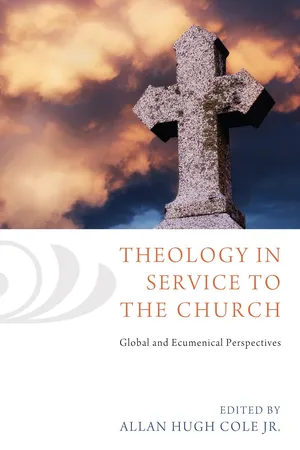
Theology in Service to the Church
Global and Ecumenical Perspectives
- 242 pages
- English
- ePUB (mobile friendly)
- Available on iOS & Android
eBook - ePub
About this book
As a global religion with growing numbers of expressions, Christianity calls for deepening relationships across traditions while also formulating collaborative visions. A thriving church will require Christians from various traditions and on varying trajectories to become familiar with one another, appreciate one another, and work in common service to God in Jesus Christ.
In this book, a group of thirteen distinguished scholars from around the world and representing a range of Orthodox, Catholic, and Protestant perspectives demonstrate how theological reflection and broad-based ecumenical conversations may serve the church. Reflecting on numerous salient matters facing the global church, these scholars model what may be accomplished in ecumenical conversations that recognize the gifts that come with unity across diversity among those who seek to be faithful to Jesus Christ.
Information
Topic
Theology & ReligionSubtopic
ReligionConstructive and Public Theology
5
Knowing Our Place(s)
The Ecclesial Role(s) of the Theologian
When I attend academic conferences and find myself in the company of theologians and scholars of religion from a variety of different traditions, I usually feel at home and quite relaxed. Much more relaxed, in fact, than I commonly am when speaking in an exclusively Catholic context, even if it were a roomful of Catholic theologians. One would think, I suppose, that the opposite would be true, and that the fact that Catholics among Catholics or Methodists among Methodists could take so much more for granted about the history, traditions, and doctrines they share would mean a more accepting and fruitful context for dialogue. And yet I do not find it to be so. In my own Catholic tradition, apparently, this problem goes to the very top. I was once told on pretty good authority that in the early years of his pontificate John Paul II would host an annual seminar at Castel Gandolfo, his summer residence, where he would sit down and roll up his sleeves to engage the other participants as equals in academic debate. Those invited were always world-renowned scholars, but no Catholics were allowed.
It may be that dialogue within one tradition takes a lot for granted and therefore is focused only on the exploration of differences, whereas ecumenical dialogue takes differences for granted and seeks common ground. It may, on the other hand, be that different ecclesiologies coexist within one tradition, usually unthematized but there nonetheless, and in consequence the dialogue is perhaps not always about what it seems on the surface to be about. Or, again, it might just be that theologians among themselves practice a kind of professional insouciance which, in church circles, they must exchange for at least the appearance of pastoral earnestness. Maybe we are comfortable together because there is no altar call at the American Academy of Religion.
The distinction that first comes to mind when we think about Protestant and Catholic understandings of the role of the theologian has to do with the idea of “vocation,” which Edward P. Hahnenberg has so recently written on in extraordinary fashion.87 The role of theologian is evidently a “calling” in the Protestant sense, and indeed one to which you can be ordained in more than a few traditions. Compared to this, the Catholic tradition is distinctly odd, or at least very different. Traditionally Catholics have unfortunately tended to reserve the term vocation for those called to or entering into ordained ministry or religious life. Any relationship between these vocations and the role of theologian is quite accidental and, frankly, not highly correlated. Theologians in the Catholic tradition these days, unlike a generation or two ago, may or may not be ordained, and the majority are not. Bishops, however, who may or may not be good theologians or indeed know very much theology at all, are the official teachers of the faith, and theologians qua theologians have no connection whatsoever to the charism of teaching with authority in the Church. Practically, at any rate, that is the case, though the fact that in the medieval church the magisterium was primarily located in theologians might suggest that looking at the question theologically we could come to another conclusion. But for the present the ecclesial understanding of what theologians do is nicely captured in a remark I recall but cannot reference from a book I read long ago, which declared that there are only two ways that Catholics can do theology: with a canonical mission or as a hobby. In other words, theology is done as an officially approved aide to the bishops or as a purely private pursuit of no ecclesial consequence. The relationship of the non-canonically-missioned theologians to the teaching of the Church would be approximately that of the philatelist to the Postal Service.
So when one begins to think about the roles of theologians vis-à-vis the Church in the categories of vocation or calling, it is almost inevitable that any further taxonomizing will take the form of identifying their roles relative to the Church or tradition to which they adhere. One need not necessarily jump to the categories of faithful or unfaithful, professing or dissenting, pastoral or critical, whether relative to ecclesial or biblical fundamentalism, though there are undoubtedly some who do and it is difficult to employ such terms without at least seeming to be judgmental about one or another alternative. So I will use somewhat less current terms for three different possible relationships theologians might have to the formation of sound teaching, if only to undercut the potential for identifying one or another as more or less valuable. The terms I will use and briefly outline here are insiders, liminals, and aliens. But be warned; while I think terms like these are better terms for avoiding the either-or judgmentalism of the usual pairings, I believe that they too must give way in the end to a more holistic vision of the theological task, which I will explore in the second half of the paper.
It would be a mistake to assume that insiders are necessarily conservative voices. Insiders see their work primarily in relationship to the Church, but whether they are conservative or liberal will depend pretty much on which of Antonio Gramsci’s two classes of intellectuals they exemplify. Are they under the impression that their work stands somehow above or outside social and political contexts, or do they see themselves as marked by, even representative of, particular social groups or classes? Are they, in Gramsci’s categories, traditional or organic intellectuals?88 The key to distinguishing theologians in this way is not ideological so much as political. What are their relationships to the forces of production, as Walter Benjamin might ask, and indeed did in his essay exploring the role of the writer in a revolutionary society.89 Nor, of course, should one assume that insiders are somehow more conventional or less moral than others; or less conventional or more moral. It is simply that insider theologians conceive of their professional responsibility in terms of apologetics, broadly understood. They are either traditional intellectuals, who mostly do not recognize or may even reject the role of context and history in the way theology is done, or they are organic intellectuals who understand quite consciously that their work is expressive of a relationship to the church conceived institutionally.90 But, conservative or liberal, they work in close relationship to the forces of production, to the Church as institution, and are therefore—honorably and sometimes quite critically—somehow or other negotiating the relationship between faith and the institution in such a way as to satisfy the powers behind the forces of production. Some are comfortable with this position, some less so, but all of them are realists about the powers that be.
Liminals, as the word suggests, are those individuals who work on the threshold between the Church and the secular world, or perhaps between the church and other major world religions. These too might in principle appear in both more “progressive” and more “traditional” guises. However, in the present-day more conservative ethos of institutional Catholicism the traditional liminals become indistinguishable from insiders, and disappear from sight. In any guise, liminals are driven by a more hortatory and less coolly rational rhetorical style. They may seem more choleric, where the insider is inclined to be phlegmatic, though frankly both have their choleric and phlegmatic moments when things seem to be going in the wrong direction. They may be thought more foolhardy, in danger of throwing out the baby with the bathwater, though they would probably defend themselves by saying that the baby has already gone off to join an ashram and the bathwater is cold and uninviting. They are more anxious and perhaps, in the end, more puritanical. They expect more from the Church and when it does not come, they forgive less. But they bring an edge to theological debate that complements the solidity of insider theology. They too are organic intellectuals, but their self-understanding is more proletarian than the first groups. They identify with “the Christian masses,” however tec...
Table of contents
- Title Page
- Contributors
- Preface
- Acknowledgments
- Historical, Doctrinal, and Philosophical Theology
- Constructive and Public Theology
- Pastoral Theology
- Bibliography
Trusted by 375,005 students
Access to over 1.5 million titles for a fair monthly price.
Study more efficiently using our study tools.
Frequently asked questions
Yes, you can cancel anytime from the Subscription tab in your account settings on the Perlego website. Your subscription will stay active until the end of your current billing period. Learn how to cancel your subscription
No, books cannot be downloaded as external files, such as PDFs, for use outside of Perlego. However, you can download books within the Perlego app for offline reading on mobile or tablet. Learn how to download books offline
Perlego offers two plans: Essential and Complete
- Essential is ideal for learners and professionals who enjoy exploring a wide range of subjects. Access the Essential Library with 800,000+ trusted titles and best-sellers across business, personal growth, and the humanities. Includes unlimited reading time and Standard Read Aloud voice.
- Complete: Perfect for advanced learners and researchers needing full, unrestricted access. Unlock 1.5M+ books across hundreds of subjects, including academic and specialized titles. The Complete Plan also includes advanced features like Premium Read Aloud and Research Assistant.
We are an online textbook subscription service, where you can get access to an entire online library for less than the price of a single book per month. With over 1.5 million books across 990+ topics, we’ve got you covered! Learn about our mission
Look out for the read-aloud symbol on your next book to see if you can listen to it. The read-aloud tool reads text aloud for you, highlighting the text as it is being read. You can pause it, speed it up and slow it down. Learn more about Read Aloud
Yes! You can use the Perlego app on both iOS and Android devices to read anytime, anywhere — even offline. Perfect for commutes or when you’re on the go.
Please note we cannot support devices running on iOS 13 and Android 7 or earlier. Learn more about using the app
Please note we cannot support devices running on iOS 13 and Android 7 or earlier. Learn more about using the app
Yes, you can access Theology in Service to the Church by Allan Hugh Cole Jr., Cole in PDF and/or ePUB format, as well as other popular books in Theology & Religion & Religion. We have over 1.5 million books available in our catalogue for you to explore.