- 152 pages
- English
- ePUB (mobile friendly)
- Available on iOS & Android
eBook - ePub
About this book
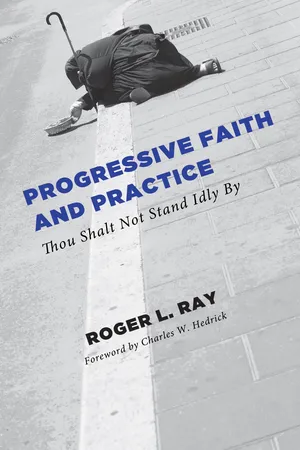
Holocaust survivor and Nobel Prize winner Elie Wiesel has said that there is a new commandment: "Thou shalt not stand idly by." This book articulates a progressive faith that represents a true marriage of the academic work of the modern biblical critical movement and the historical Jesus work of the Jesus Seminar applied within the life of an active parish. Setting aside the magic and superstition found in much of traditional religious life and affirming an evidence-based approach to faith, author Roger Ray strives to apply Wiesel's injunction to actively respond to the injustice, violence, and discrimination in the world. In concrete terms, Ray describes what progressives can embrace intellectually and morally, and how those convictions can be lived out in a faith community.
Information
Topic
Teologia e religioneSubtopic
Teologia cristiana1
Evidence-Based Faith
I wish to propose for the reader’s favorable consideration a doctrine which may, I fear, appear wildly paradoxical and subversive. The doctrine in question is this: that it is undesirable to believe a proposition when there is no ground whatever for supposing it is true. I must of course admit that if such an opinion became common it would completely transform our social life and our political system.1
—Bertrand Russell
There is a new wave of reason sweeping across America, Britain, Europe, Australia, South America, the Middle East and Africa. There is a new wave of reason where superstition had a firm hold.2
—Richard Dawkins
“The room is filled with four foot tall Skrinchen,” my philosophy professor asserted. “They are,” Dr. Jim Spicer told his freshman students, “invisible and without mass and they are visible only to me.” Dr. Spicer introduced me at the age of eighteen to the concept of an a priori truth claim that could not be verified by any external evidence nor be subjected to any sort of test. Though there was no way to prove that the room was not full of Skrinchen, there was also no particular reason to believe that he was telling the truth.Still, I knew that I would be foolish to believe that I was surrounded by these invisible beings. It would take me another decade to have the courage to apply this same conclusion to what I had been told by my Sunday school teachers about angels, demons, a talking snake, and so much more. After years of trying to teach philosophy and religion to my own college students, I recognize the difficulty in trying to explain how a story can convey important life principles while not being either literally or historically factual.
We believe much of what we believe because our family, community, church, or nation have passed along those beliefs, and we would be out of sync with our world if we did not also go along. In matters such as putting the fork on the left hand side of the plate, shaking hands with our right hands, or standing for the national anthem, it is just easier to go along than to demand a persuasive explanation. But when it comes to being told that, for example, being a homosexual is a sin worthy of eternal punishment, or that women cannot be leaders in faith communities, or that you must belong to one certain sect of one certain religion or risk becoming anathema to the Almighty Creator of the universe, then some critical thinking is called for.
The famous philosophical maxim known as Occam’s Razor is often mistakenly used to imply that the simplest answer is likely to be the right answer. What Occam’s Razor actually says is that the solution requiring the fewest number of unverifiable assumptions is the most likely answer.3 So, if I ask you if the room is full of Skrinchen and you consider that there is no detectable evidence for the presence of Skrinchen except for some facetious philosophy professor who asks you to assume that he is telling you the truth, then the most obvious logical conclusion is that there are no Skrinchen present. While you could be wrong, there is no good reason to assume that you are not right.
This becomes rather more complex, however, when authority figures, your parents, and your friends and classmates are all fairly united in telling you that there are Skrinchen in the room. Then you have to be more resolved in your application of critical thinking to avoid falling in line with the generally shared faith in Skrinchen.
Of course, belief or disbelief in the existence of Skrinchen does not affect how you will live. Assertions about heaven and hell, a final judgment, the nature of salvation, the definition of sin—these do matter. In fact, they may matter more than anything else in life and yet, for the most part, there is not much evidence to substantiate these supernatural claims, and attempts at giving evidence generally do not stand up to critical analysis.
A pastor I know told me about a friend of his who had visited a medium when he was a member of the Allied forces occupying Germany shortly after WWII. The medium had channeled the young soldier’s deceased father. The spirit allegedly told the soldier about the existence of a half-brother, even revealing the sibling’s name and address. The soldier contacted the man and discovered that what the spirit had told him through the medium was true. “How,” my friend asked me, “can you explain that if there is no life after death?”
So I asked, “What did the medium tell him on his second visit?” “Well,” he replied, “he never went back again.” “Really,” I asked, “for a few dollars he got to speak to his deceased father, discovered a previously unknown brother, and he never went back again?” I’m not saying that paranormal events never take place. I can no more say that there are no angels or demons than I can prove that there are no Skrinchen hiding behind every tree and rock, but if a truth claim is not repeatable or testable then we cannot rationally draw any conclusions from these reported angel sightings, ESP experiences, or visions. The events may be very powerful or even life-changing for the individual, but a private experience remains just that—private. Maybe they are accurately describing an event or maybe their memories become embellished in the retelling. As neurologists have reported in their research about memory, repeated retelling of a story often erases actual memories, and all that a person can remember is their elaborately embellished accounts. They are not lying about the memory; they are giving an honest account of their memory, but their memory itself has become a fictional account.4
This, of course, was the problem that Paul, the author and inspiration of much of the New Testament, faced when he sought to convert the people he encountered to the version of faith that was so important to him. He never met Jesus of Nazareth in the flesh; he had to rely on his visions. Only those who were willing to suspend critical thinking could fully accept what he had to say. He had no more evidence to offer that Jesus was raised from the dead than Clement, the popular first-century bishop of Rome, had for his insistence that the phoenix lived for five hundred years and then was reborn from the decayed remains.
Like Paul, Clement tried to add weight to his claim by saying that the newly born phoenix would carry the bones of the recently deceased phoenix to a temple in Egypt where priests recorded the arrival of the bird with the bones and nest of his predecessor on the five hundredth anniversary of the previous phoenix. Of course, there never was such a magical bird, but Clement had news of it from sources he trusted and—this may be the more important part—he believed it because he wanted to believe it.
If you want to believe that God wrote the Bible or that you have a literal soul that lives forever (even if trees, birds, and bees don’t), then you can find reasons that support your belief—I prayed that it wouldn’t rain on our picnic and it didn’t rain . . . Thank you Jesus! . . . Too bad about all of those prayers for the end of the civil war in Syria. Perhaps God was too busy defending picnics from rain?
While it is impossible to be free of the prejudice of preference, still, we can strive to be as objective as possible in our application of critical thinking. One of the hazards faced by progressive religious people is that once we are set at liberty from the constraints of old creedal claims, some find themselves falling headlong into seemingly more attractive and less destructive truth claims that are just as dependent upon untestable assumptions as the religion from which they escaped.
It was bad theology that led to the Crusades, to the divine right of kings, inquisitions, and sectarian religious wars, some of which were fought on battlefields, but many more divided families at the dinner table. There is good theology and there is bad theology. Critical thinking does matter. Sloppy thinking leads to uncertain results. Novices who have rejected the formal religion of their youth will often cobble together a more savory concoction that they will call Buddhism or Native American spirituality, much of which they made up last week after watching a really good movie, but—to call upon Occam’s Razor once more—if they are trading one truckload of irrational assumptions for a new and more exotic-sounding truckload of irrational assumptions, the implications are likely to be equally unsavory.
Our preference for good manners, getting along well with others, and desire to avoid conflict, often lead us to a nearly sacramental love of false equivalents. I would invite anyone who says, “Everyone’s religion is a private choice,” or simply “To each his or her own,” to take the time to visit their local shelter for victims of domestic violence or for teen “runaways.” In my experience, a huge portion of the teen “runaway” population did not run away; they were kicked out of their family home because the religion of their parents kept them from accepting homosexuality, even if the homosexual in question was their own son or daughter. The misogyny that lies at the root of a great deal of domestic violence can be traced directly to the pulpits that influence the abusers. Mental health professionals have been trying to point out the connection between teen suicide and homophobic religious teachings for years.5 Sloppy thinking doesn’t just lead to unnecessary feelings of guilt and fear, but there is actually a casualty count and therefore, at the risk of alienating some for appearing to be impolite and lacking in diplomacy skills, I emphatically push for my peers in the religious world to be as rigorous in their scholarship and their critical thinking as is humanly possible.
The media has largely fallen prey in the past generation to a belief in false equivalents that compels them to appear to be neutral in almost every case, giving equal time to both sides of any issue. Sometimes the sides are just not equal. Note that when almost any television news outlet talks about global climate change, they will give almost equal time to those who deny climate change as they give to those who warn against the human behaviors causing climate change. Among climate scientists, there is more tha...
Table of contents
- Title Page
- Foreword - Charles W. Hedrick
- Acknowledgments
- Introduction
- 1. Evidence-Based Faith
- 2. What Do Progressives Mean When We Say “God”?
- 3. What is Scripture to Progressives?
- 4. Which Jesus Do We Hold Most Dear?
- 5. What Are the Religions of the World to Us?
- 6. What Is Church, Synagogue, Mosque, or Temple to Us Now?
- 7. What Do We Do When We Gather as a Community?
- 8. Shall We Still Pray?
- 9. What Should We Teach Our Children About Religion?
- 10. What Is So? So What? So?
- 11. What Answers Does Progressive Faith Offer to the Big Questions?
- 12. Holy Water, Sacred Land
- 13. Just War Theory in a Nuclear World
- 14. The Justice System and Our Prison Nation
- 15. Our Preference for the Poor
- 16. What Is in the Crystal Ball?
- Bibliography
Trusted by 375,005 students
Access to over 1.5 million titles for a fair monthly price.
Study more efficiently using our study tools.
Frequently asked questions
Yes, you can cancel anytime from the Subscription tab in your account settings on the Perlego website. Your subscription will stay active until the end of your current billing period. Learn how to cancel your subscription
No, books cannot be downloaded as external files, such as PDFs, for use outside of Perlego. However, you can download books within the Perlego app for offline reading on mobile or tablet. Learn how to download books offline
Perlego offers two plans: Essential and Complete
- Essential is ideal for learners and professionals who enjoy exploring a wide range of subjects. Access the Essential Library with 800,000+ trusted titles and best-sellers across business, personal growth, and the humanities. Includes unlimited reading time and Standard Read Aloud voice.
- Complete: Perfect for advanced learners and researchers needing full, unrestricted access. Unlock 1.5M+ books across hundreds of subjects, including academic and specialized titles. The Complete Plan also includes advanced features like Premium Read Aloud and Research Assistant.
We are an online textbook subscription service, where you can get access to an entire online library for less than the price of a single book per month. With over 1.5 million books across 990+ topics, we’ve got you covered! Learn about our mission
Look out for the read-aloud symbol on your next book to see if you can listen to it. The read-aloud tool reads text aloud for you, highlighting the text as it is being read. You can pause it, speed it up and slow it down. Learn more about Read Aloud
Yes! You can use the Perlego app on both iOS and Android devices to read anytime, anywhere — even offline. Perfect for commutes or when you’re on the go.
Please note we cannot support devices running on iOS 13 and Android 7 or earlier. Learn more about using the app
Please note we cannot support devices running on iOS 13 and Android 7 or earlier. Learn more about using the app
Yes, you can access Progressive Faith and Practice by Roger Lee Ray in PDF and/or ePUB format, as well as other popular books in Teologia e religione & Teologia cristiana. We have over 1.5 million books available in our catalogue for you to explore.