- 226 pages
- English
- ePUB (mobile friendly)
- Available on iOS & Android
eBook - ePub
About this book
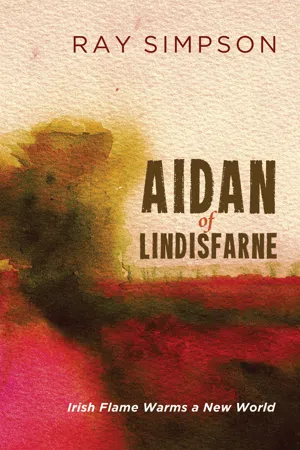
Seventh-century Ireland is becoming a land of saints, scholars, and spiritual foster mothers as well as warriors. The boy Aidan, a descendant of Saint Brigid, is formed by all of these as well as by a pilgrimage, aborted by an Arab uprising, on which he meets a follower of the Prophet Muhammad. He is transferred to Iona, the mother-house of Saint Columba's family of monasteries, where his character is forged. Aidan becomes guest-master to challenging visitors, one of whom conducts a mysterious affair, suffers a midlife crisis, and develops friendships with royal Saxon exiles at the Dunadd court, the seat of the "real" King Arthur. Iona commissions Aidan to evangelize the original WASPs: the White, Anglo-Saxon Pagan invaders of Britain. Aidan offers a radically different approach to that of the Roman missionaries. His gentle grassroots gospel-sharing through friendship, his villages of God that model God's kingdom, his introduction of spiritual foster-mothers such as Hilda to the English, his soul friendships and heartbreaks with successive saintly and power-hungry kings, and his near-death foresight into the future take us inside the heroic spiritual formation of a person and a people in a story that has contemporary significance. Even Aidan's name, Flame, tells a story of its own
Information
Topic
Theology & ReligionSubtopic
Christian TheologyPart One
Kindling Fires
Ireland and the Early Years
chapter 1
The Boy
597 Birth and naming
It was 9 June 597. Cara gazed into a tributary of the mighty river Shannon that nourished half of Ireland. She was heavy with child, heavy, too lest her progeny be edged aside by the Ui Neills from the north. Her people once proudly strutted across Connaught’s stage. They defeated Columba’s clan at the battle of Cum Druine, but ever since the Ui Neills had pushed her clan to the margins. This was hard for a mother who dreamed great things for her offspring. She and her husband Lugar knew what they would name the child. Finn if it was a boy; if it was a girl, Fiona would be her name.
Shortly after darkness fell her eyes bulged in astonishment. The water had turned bright red. Looking up she saw a pillar of fire stab awake the night. Never before, nor ever again, would she see its like. The fiery cloud divided into two. The larger part zoomed off towards the coast, taking what seemed like some awesome presence with it. The smaller part became the shape of a finger. The finger moved towards her, pointing, she swore it, at the very babe in her womb. A bird flew overhead.
Cara cried out. Birth pangs seized her. The nurse came running from the house. There was painful struggle. A boy’s head popped out. The nurse carried him away. Lugar came, but to their surprise cries still came from the womb. There was another struggle. A finger popped out. It did not clutch. It pointed upward.
They had no name for a child they did not expect. Next day, as they discussed what to call him, a relative arrived, breathless, with solemn news. Blessed Columba was dead. He had died across the sea on Iona Isle in the early hours of dark. “The whole sky of Alba and Ireland was lit up with fire” said he, “as his holy soul was escorted to the other world.” Then it was that Cara knew the meaning of that flaming sky. Then, too, she knew what they must name their second twin—Little Flame—Aidan in their tongue.
* * *
The Prophecy
I baptize you “Little Flame,” the priest said, “in the name of the Father, the Son and the Holy Spirit. A flame goes where it wills. At times it burns low or peters out. Maybe this child will at times wish to die away. But a flame can blaze up, race, crackle; it can ignite and spread far. A flame takes many colors, many forms. It is never still, it dances, and others catch fire wherever it goes. You will be hidden at first, little one, as others flare up, but you are a spark from heaven. From you fires will be lit that one day will circle the world.”
Aidan’s mother told her child what that prophetic priest had spoken over him. The significance of his name impinged upon him noiselessly, seamlessly. Throughout his childhood flames danced before his eyes—but in such different ways. There was the flame that flickered, there were the legendary fires lit by Patrick and Brigid, there were flames of passion and battlefield, and there was another flame.
* * *
His parents owned a farmstead at the foot of Crag Liath, near to the great Shannon crossing at Killaloe. Here the fields were lush. They grew barley, and kept hens, sheep and goats. They had serfs to help the family maintain the farm, and a man who made barrels and buckets from wood. On Sundays they gathered everyone into the cart. Their two biggest work horses would pant and pull them up to the top of the crag, where the chief had his fort. An aged priest gave them Holy Communion, and a blacksmith made knives and shoes for the horses. The serfs wore woolen cloaks over linen tunics. Aidan’s family did, too, but theirs were brightly colored. When Aidan was six he felt uncomfortable wearing these clothes. He stopped wearing these when he was with the serfs. Finn put his hand to the practical things that made up farm life. He learned to milk cows, make things out of wood and dig the soil. He grew freckles and had the gift of the gab.
The twins had an elder sister, Fionnula. She was tall and fair-haired, useful to her mother and attractive to boys, but very much her own person. Once she was led round their paddock on the horse. “I want a ride too,” Aidan piped up. “You are too young, little one, but your time will come,” his father assured him. A tear dropped from Aidan’s cheek. “Why don’t you give the horse a treat?” said his father, feeling pity for him. They fetched a chunk of honeycomb from the kitchen, Aidan held out a flat hand, and the horse swept it into its mouth with relish. A fiery tingle swept through Aidan as the horse licked his hand. That began a life-long love of horses. However, being the second twin, and the youngest, Aidan felt he was a Number Two person. He assumed it was natural for others to take the lead, and so he held back.
Aidan’s father was lithe and caring. He worked hard on the farm and loved to row his boat on the river. When Aidan was seven Lugar paid for an excellent woman to become his foster mother. It was normal in Ireland, and according to the law, that parents of good standing made such a contract. The foster parent often came from a family with royal connections, and could introduce the child to the knowledge and social skills of a wider world. Some children lived with the foster parent, but most, like Aidan, made regular visits. As the Christian Faith had spread, holy and wise women who had made vows to Christ were prized as foster mothers. Such was Wise Dara, a widow. She was quite short, with swept back gray hair, a large wrinkle in her forehead. She had a bright smile, knowing eyes and wore a shawl intertwined with purples, greens and browns. She knew about many things. That first year she helped Aidan to think about what he did, and about his name, Little Flame.
One day Aidan rushed through her room, not noticing what was in it. He trod on the eggs Dara had carefully placed there. Dara did not scold him, but asked him gently if he would clear up the mess. “I have a suggestion,” she then said. “Would you bring me one egg from your home each time you visit me, until the number of eggs we have lost is made up?” She taught him one of the sayings about three things that the Irish loved to learn: Three things will get you into trouble—stealing, violence and lying; three things will bring you life—eggs, child-birth and prayer. She taught Aidan to think before he fell asleep about things he had spoiled because he had rushed. She wanted him to become mindful.
Dara understood that Aidan was insecure. That is why she talked to him about the meaning of his name. She told him of the fire lit by holy Patrick, who first brought the news of Christ to their tribes north of the Shannon. The pagan High King of all Ireland had gathered his people on the Great Hill of Tara to celebrate the Spring Equinox. Opposite, on the Hill of Slane, Patrick lit a fire to celebrate the resurrection of Christ. “If you do not put this fire out today,” the king’s Druid declared, “the fire of this new religion will burn for ever in our land.” The king sent his warriors to arrest Patrick and his fellow Christians, but all they could see were deer running down the hill. Patrick did not scorn the sun. He called Christ the True, Uncreated Sun; the sun He had created was His precious gift. Dara suggested that Aidan was a ray of light from the sun. She wanted him to grow in confidence as a child of Light.
“I’ve noticed you spend your time with people who are nice to you,” Dara said one day. “Isn’t that natural?” Aidan said. “It depends what you mean by ‘natural’ ,” Dara replied. “Suppose one day you find yourself in a place where no one welcomes you?” “What could I do about it?” Aidan asked. “Well, for a start, you could look out for someone who looks unhappy and chat with them. To make a friend, be a friend.” Dara taught him a triad: “The three elements of friendship: respect, understanding and a loving heart.” “Why don’t you look out for someone tomorrow who looks unhappy” she suggested. Dara planted a seed that day that turned into a life-long practice of Aidan—taking the first step in befriending another.
* * *
Aidan’s father was a descendant of the famous saint Brigid of Kildare. People spoke of her as the midwife who brought Christ to birth in Ireland and they imagined her as the midwife of Mary, mother of God’s Son. Often in the kitchen they told stories about her just as, before Ireland became Christian, people told stories about their great goddess Brigid. Sometimes they mixed the two together. They imagined that Brigid took fire from God’s sun, and this danced inside her heart. From the fire of her hearth she wrought healing medicines, from the fire in her head she created poetry and writing, and from the fire of her heart compassion spread throughout Ireland in acts of mercy and hospitality to the poor. One thing was for sure, her large monastery for men and women at Kildare, in the central plain of Ireland, still drew many people, and night and day its sisters replenished its ever-burning fire.
604
In 604 it was decided that the twins were old enough to make their first big journey, and they would visit their relatives in Kildare for the Beltane festival. The family piled their satchels of clothes and food on to their carriage, and the horse cantered its way eastwards across the esker ridge. At last they were welcomed by their cousins. Their boy Cormac and his sister Dacey played with the twins. In Kildare the best horses in Ireland race on the curragh. The elders had declared the curragh would for ever be land where horses and people were free to roam. They did this out of respect for Brigid. As soon as possible the children sped to the curragh’s vast expanse of green. Horses raced such as Aidan had never seen before. His heart raced inside him:
When the horses race on the great Curragh
I want to shout Hurrah! Hurrah!
he bellowed, reveling in his first outburst of poetry. They chanted his little poem over and over again, marching round the edge of the curragh, causing heads to turn.
Cormac and Dacey told stories about Brigid when she was their age. She used to help her mother in the kitchen. She always laid a spare place at the meal table in case Christ came in the guise of a needy person. The next day they, too, laid a table with a spare place. Aidan would commend this custom throughout his life. Before they went to sleep Cormac and Dacey told Aidan and Finn that Brigid, when she heard Jesus’ words that we should always pray, asked herself how she could do this, even if it was night. As she lay down to sleep she stretched out her arms in the shape of a cross, so that even as she slept her arms would be in prayer. They tried to copy her, but their arms became tangled up!
The following day they took their seats early at the court of the king of Kildare. Various people spoke, animals and acrobats performed their tricks, and Tewdric the bard spoke thus:
Brigid, Virgin most fair
Brigid, Queen of Eire.
Where once warring rulers had their forts
Now your servants of Christ hold heavenly courts.
The glittering river Liffey—all this is your domain
The light-filled Curragh stretches to the plain.
Here love replaced hatred, blessings multiplied
Here you enthroned Christ, in valley and hillside.
The people made sure the poor were fed
There was mead of welcome in every homestead.
Strains of song pierced the air
Instead of boasting, now there was prayer.
The renown of your King sped like a star
To Britain and Gaul and lands afar
Ships bearing goods became a familiar sight
A land that was dark now filled up with light.
You reign for ever with the Great King
On your finger the royal bride’s ring.
Easy it is to grow proud and set
But we your children will not forget.
On and on the bard sang in the mead hall that night and Aidan’s wonderment at Brigid grew. The next evening they again took their seats early, since Gododdin, the Britons’ most famous bard was due to appear. His words would for ever be etched in Aidan’s memory:
I tell you a tale of Christ and pagan darkness,
Of great warriors and men of treachery.
Urien of Rheged, generous was he,
And has been since Adam.
He, wise ruler, Christ’s king
Had the most wide-ranging sword of the kings of the north.
Into our land poured hordes of Saxons
Like a pack of wolves chasing sheep.
Yet, if there’s an enemy on the hill
Urien will make him shudder.
If there’s an enemy in the hollow
Urien will pierce him through.
If there’s an enemy in the mountain
Urien will bruise him.
If there’s an enemy in the dyke
Urien will strike him down.
Aidan, son of Gabran, and all the thirteen kings joined Urien.
They goaded the Saxons to the Isle of Medcaut
Near to Bamburgh’s fort.
There they circled the enemy—poised for great victory.
But Tragedy! Tragedy!
Urien, king of the baptized world
Was struck down, not by the Saxon foe,
But by Morcant, one of the thirteen kings.
That Judas, thinking to take Urien’s place,
Forfeited the trust of defending troops
They fled in disarray.
The Saxons stayed, and now rule all Northum...
Table of contents
- Title Page
- Part One—Kindling Fires: Ireland and the Early Years
- Part Two—Testing Fires: Iona and the Middle Years
- Part Three—The Flame Spreads: The English and the Ripe Years
- Epilogue
- A Personal Reflection from the Author
- Historical Notes
- A Selection of Books by Ray Simpson
Trusted by 375,005 students
Access to over 1.5 million titles for a fair monthly price.
Study more efficiently using our study tools.
Frequently asked questions
Yes, you can cancel anytime from the Subscription tab in your account settings on the Perlego website. Your subscription will stay active until the end of your current billing period. Learn how to cancel your subscription
No, books cannot be downloaded as external files, such as PDFs, for use outside of Perlego. However, you can download books within the Perlego app for offline reading on mobile or tablet. Learn how to download books offline
Perlego offers two plans: Essential and Complete
- Essential is ideal for learners and professionals who enjoy exploring a wide range of subjects. Access the Essential Library with 800,000+ trusted titles and best-sellers across business, personal growth, and the humanities. Includes unlimited reading time and Standard Read Aloud voice.
- Complete: Perfect for advanced learners and researchers needing full, unrestricted access. Unlock 1.5M+ books across hundreds of subjects, including academic and specialized titles. The Complete Plan also includes advanced features like Premium Read Aloud and Research Assistant.
We are an online textbook subscription service, where you can get access to an entire online library for less than the price of a single book per month. With over 1.5 million books across 990+ topics, we’ve got you covered! Learn about our mission
Look out for the read-aloud symbol on your next book to see if you can listen to it. The read-aloud tool reads text aloud for you, highlighting the text as it is being read. You can pause it, speed it up and slow it down. Learn more about Read Aloud
Yes! You can use the Perlego app on both iOS and Android devices to read anytime, anywhere — even offline. Perfect for commutes or when you’re on the go.
Please note we cannot support devices running on iOS 13 and Android 7 or earlier. Learn more about using the app
Please note we cannot support devices running on iOS 13 and Android 7 or earlier. Learn more about using the app
Yes, you can access Aidan of Lindisfarne by Ray Simpson in PDF and/or ePUB format, as well as other popular books in Theology & Religion & Christian Theology. We have over 1.5 million books available in our catalogue for you to explore.