eBook - ePub
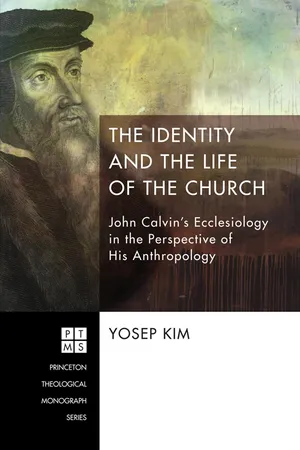
The Identity and the Life of the Church
John Calvin’s Ecclesiology in the Perspective of His Anthropology
- 228 pages
- English
- ePUB (mobile friendly)
- Available on iOS & Android
eBook - ePub
The Identity and the Life of the Church
John Calvin’s Ecclesiology in the Perspective of His Anthropology
About this book
This study of John Calvin's ecclesiology argues that Calvin's idea of the twofold identity of the Church--its spiritual identity as the body of Christ and its functional identity as the mother of all believers--is closely related to his understanding of Christian identity and life, which are initiated and maintained by the grace of the triune God. The anthropological basis of Calvin's idea of the Church has not been examined fully, even though Calvin presents the important concepts of his ecclesiology in light of his anthropological ideas. This study offers an overall evaluation for Calvin's ecclesiology, arguing that it is ultimately his pastoral concern for the Christian and the Church under affliction that both governs his theological understanding of the Church and shapes his proposals for establishing and sustaining the life of the Church in the world.
Information
Topic
Theology & ReligionSubtopic
World Historypart one
Calvin’s Anthropology
1
The Imago Dei in the Divine-Human Relationship
Introduction: Calvin’s Theological Anthropology
Calvin’s anthropology can be called a theological anthropology in the sense that he maintains that the knowledge of humanity is possible only through piety. In the opening chapter of the final Latin edition of the Institutes, Calvin states the importance of the knowledge of humanity in his theology by arguing that knowledge of humanity and knowledge of God are inseparably “joined by many bonds.” He then argues, “true and sound wisdom consists of the knowledge of God and of ourselves.”43 In the following section in the Institutes, Calvin emphasises that “piety” is a prerequisite for the knowledge of God. He thinks that any discussion about God would be meaningless if it did not consider His grace towards human race: “Man never achieves a clear knowledge of himself unless he has first looked upon God’s face.”44 Calvin defines piety as “reverence joined with love of God which the knowledge of his benefits induces,” and it depends on men’s recognition that “they owe everything to God, that they are nourished by his fatherly care, that he is the Author of their every good.”45 Therefore, an investigation of Calvin’s idea of the image of God is useful to understand his idea of humanity in the divine-human relationship. He states the image of God as the key to his theological anthropology at the beginning of the first edition of the Institutes: “In order for us to come to a sure knowledge of ourselves, we must first grasp the fact that Adam, parent of all, was created in the image and likeness of God.”46
With regard to the concept of the image of God in Calvin’s anthropology, I will use Grenz’s framework of the “structural” and “relational” aspects of the image of God in humanity: the “structural” aspects apply to “the very structure of human nature,” such as reason and the immortal soul, and the “relational” aspects refer to “a relationship between Creator and creature” and “what occurs as a consequence of the relationship.”47 This chapter investigates the theological focus of Calvin’s theological anthropology by examining Calvin’s discussion of the image of God according to the three stages which are implicitly supposed in his anthropology in the Institutes, namely creation, the fall, and restoration. That is because Calvin’s anthropological discussions appear in this order in the Institutes (1559): the original condition of humanity in creation is discussed in the Institutes, I.15; the human condition after the fall in the Institutes II.1–3; and the human condition in the course of regeneration in the Institutes III, 3–10. This investigation will show that although Calvin deals with the “structural” aspects of the image of God in some specific contexts, he focuses mainly on its “relational” aspects, in particular, the restoration of the image of God in humanity by grace from this teleological perspective.
The Image of God in Creation
The Two Aspects of the Imago Dei
Calvin’s idea of the image of God has been one of the most controversial topics among scholars.48 The controversy arises basically from the absence of any firm definition of this concept within Calvin’s writings themselves. According to Schreiner’s summary, two groups of studies have emerged: while some have commented on Calvin’s relational understanding of the imago Dei, such as “the right spiritual attitude,” “gratitude,” the role of either “reflecting God’s glory” and “mirroring God’s image,” others have pointed out his structural understanding of the image of God as found in “reason,” “immortality of the soul” and “human dignity.”49
The former group of studies has tended to argue that Calvin’s discussion of the image of God focuses mainly on the relationship between Christ and a Christian. Both Torrance and Niesel argue that Calvin discussed the image of God in order to explain Christ’s benefits for the salvation of humanity, who has been alienated from God and lost his original “orientation towards his Creator.”50 Likewise, Prins claims that the theological emphasis, concerning the relationship between the restored image of God and the original image of God in Adam, is more essential to Calvin’s thought than analysis of its nature from a mere anthropological perspective.51 This group has a tendency to systematise Calvin’s idea of the imago Dei from christological perspective.
The latter group of studies have complained that a systematic approach of the former group to Calvin’s idea of the imago Dei, focusing on the relationship between Christ and a Christian, tends to ignore the other dimensions of Calvin’s anthropology. Cairns argues that the relational and existential interpretation of Calvin’s understanding of the image of God “is n...
Table of contents
- Title Page
- Preface
- Abbreviations
- Introduction
- Part One: Calvin’s Anthropology
- Part Two: Calvin’s Ecclesiology
- Conclusion
- Bibliography
Trusted by 375,005 students
Access to over 1.5 million titles for a fair monthly price.
Study more efficiently using our study tools.
Frequently asked questions
Yes, you can cancel anytime from the Subscription tab in your account settings on the Perlego website. Your subscription will stay active until the end of your current billing period. Learn how to cancel your subscription
No, books cannot be downloaded as external files, such as PDFs, for use outside of Perlego. However, you can download books within the Perlego app for offline reading on mobile or tablet. Learn how to download books offline
Perlego offers two plans: Essential and Complete
- Essential is ideal for learners and professionals who enjoy exploring a wide range of subjects. Access the Essential Library with 800,000+ trusted titles and best-sellers across business, personal growth, and the humanities. Includes unlimited reading time and Standard Read Aloud voice.
- Complete: Perfect for advanced learners and researchers needing full, unrestricted access. Unlock 1.5M+ books across hundreds of subjects, including academic and specialized titles. The Complete Plan also includes advanced features like Premium Read Aloud and Research Assistant.
We are an online textbook subscription service, where you can get access to an entire online library for less than the price of a single book per month. With over 1.5 million books across 990+ topics, we’ve got you covered! Learn about our mission
Look out for the read-aloud symbol on your next book to see if you can listen to it. The read-aloud tool reads text aloud for you, highlighting the text as it is being read. You can pause it, speed it up and slow it down. Learn more about Read Aloud
Yes! You can use the Perlego app on both iOS and Android devices to read anytime, anywhere — even offline. Perfect for commutes or when you’re on the go.
Please note we cannot support devices running on iOS 13 and Android 7 or earlier. Learn more about using the app
Please note we cannot support devices running on iOS 13 and Android 7 or earlier. Learn more about using the app
Yes, you can access The Identity and the Life of the Church by Yosep Kim in PDF and/or ePUB format, as well as other popular books in Theology & Religion & World History. We have over 1.5 million books available in our catalogue for you to explore.