- 154 pages
- English
- ePUB (mobile friendly)
- Available on iOS & Android
eBook - ePub
About this book
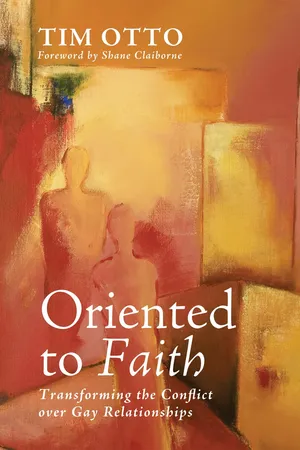
Rather than embracing the conflict around gay relationships as an opportunity for the church to talk honestly about human sexuality, Christians continue to hurt one another with the same tired arguments that divide us along predictable political battle lines. If the world is to "know that we are Christians by our love," the church needs to discover better ways to live out the deep unity we share in Christ as we engage with politics and our world.
In Oriented to Faith, Tim Otto tells the story of his struggle with being gay and what that taught him about the gospel. With an authentic and compelling personal voice, Tim invites us to explore how God is at work in the world, even amidst the most difficult circumstances, redeeming and transforming the church through this difficult debate. With gentle wisdom and compassionate insight, Tim invites all followers of Jesus to consider how we might work with God through these tensions so that all can be transformed by God's good news in and through Christ.
Information
Topic
Theology & ReligionSubtopic
Christian Theology1
Remembering Pain
“Tell me how much you know of the sufferings of others and I will tell you how much you have loved them.”
—Helmut Thielicke
When I was six years old, I accepted Jesus into my heart. My parents were missionaries in Uganda, East Africa, and I would stand my mother’s accordion case on end, open the family Bible on top of it, preach loud “sermons,” and recruit a parent, pet, or peer to listen. Waving my arms flamboyantly and conducting hymns, I loved playing “church.”
This was also the year I discovered the game “doctor.” When other missionary kids would sleep over, I realized I had more interest in the bodies of the boys I explored than those of girls. Even at age six, playing “doctor” made me feel intensely ashamed.
In this chapter I’ll try to relate what it was like to grow up gay. To understand homosexuality, in all its complexity, we must not speak in the abstract, but rather pay attention to particular people. As my mentor Jack taught me, paying attention to particular people might help us understand what God is doing here and now, among us.
Moreover, although same-sex attraction can be a helpful curriculum, it is important not to overlook the pain of growing up gay. An honest answer of how God is at work among us must take into account pain and difficulty. Of course I can’t speak for all LGBT people, but I hope my story will help illustrate the kind of painful history that needs to be remembered.
Choice
As far as I can tell, I never consciously decided to be gay. The desires I experienced in myself shocked and shamed me. I didn’t lie in bed as a six-year-old and wonder rebelliously, “How can I mess with my parents? Maybe I’ll get a tattoo. No, too painful. Maybe I’ll join a rock and roll band. And do what, play mom’s accordion? I know . . . I’ll be homosexual!”
When I was eight, the dictator Idi Amin kicked my family out of Uganda, and we returned to the United States. When I first came back, I knew I was attracted to boys, but I didn’t have a name for it. I didn’t think about it too much.
When I started school in California, I was called all kinds of names. Some names I could dismiss. Once I learned what the f-word meant, I thought about how “mother f-er” is inaccurate. “Well actually, I don’t do that,” I thought. But fourth-graders have amazingly good “gaydar.” I got called names like “sissy,” “faggot,” “homo,” “gay,” and “queer” all the time. I began to realize, “Oh, those words actually apply to me.” And so my peers taught me the words with which I would hate myself.
If there was any way I could have chosen differently, I would have. After having gone to fifteen schools by the time I was in the sixth grade (my parents, as missionaries, moved around a lot), I desperately wanted to fit in. I was uncoordinated, bookish, lonely, and beginning to develop pimples; the last thing I wanted was another way of being different.
A Life Paragraph
As I grew older I began to research sex and homosexuality by secretly reading the Christian books my parents had about sex. When I turned thirteen my parents bought me James Dobson’s book Preparing for Adolescence. I devoured the book, and found its one short paragraph on homosexuality under the heading, “Questions of Fear.” Question number nine is: “Wouldn’t it be awful if I became a homosexual?” The book goes on to explain:
A homosexual is someone who is not attracted to the opposite sex, but who is attracted to the same sex. It’s a boy’s interest in boys or a girl’s interest in girls. Homosexuality is an abnormal desire that reflects deep problems, but it doesn’t happen very often and it’s not likely to happen to you.1
After the questions the chapter concludes this way:
Your sexual development is a normal event that is being controlled inside your body. It will work out all right, so you can just relax and let it happen. . . . If you can learn to channel your sexual impulses the way God intended, this part of your nature can be one of the most fascinating and wonderful aspects of your life, perhaps contributing to a successful and happy marriage in the years ahead.2
While some people have a “life verse,” I adopted those last sentences as my “life paragraph.”
I hoped my attraction to boys would be overcome if I channeled my sexual impulses “the way God intended.” I wasn’t sure what that all meant, but at least it meant “choosing” to be attracted to girls as much as I could. In junior high I found myself vaguely attracted to a smart, articulate, athletic girl named Elaine. She often wore a beret and dressed like a guy. I prayed my affection for her would grow, and that somehow she might be interested in me. Later I realized I was interested in her because she was the most masculine girl I knew. In college Elaine came out as a lesbian.
In junior high, I got beaten up regularly because I was “queer.” Each day I contemplated three separate ways home from school, and each one had its share of bullies who would taunt and tease me, then beat me up. As the end of the school day approached, nausea and dread filled my stomach as I played Russian roulette route home.
Thankfully my family moved again when I began high school. Though the bullying and name calling stopped, it continued in my head.
After an innocent thought like, “Ken has such beautiful green eyes,” I would think, “Tim, you are such a sick faggot.” When I was honest with myself, the word “handsome” seemed inadequate to describe some of the guys in high school. They were achingly beautiful to me—both proof of God’s existence and of my own stench, weighing me down with shame and guilt.
In the early 1980s, there was very little awareness of LGBT students. I didn’t imagine there were any other students in my small-town high school who were struggling with similar feelings. It was rumored that the drama teacher was a “dyke,” but that was said with scathing contempt. Gay jokes were a constant part of joking between guys. As Brad East puts it, “To be gay was the worst thing possible. To call another guy gay was the worst insult possible.”3
I remember driving with my friend, Richard, by a restaurant that was rumored to have a gay chef. Richard seemed to have everything going for him. He was good-looking and artistic, he ran track, drove a hot car, and dated a beautiful girl. Richard repeated the rumor about the gay chef and told me, “If I ever meet a homo I think I’ll either run away or try to kill him.”
Knowing Richard to be a better person than that, I still find it strange that he said what he did. But it reflected well the deep anxiety about homosexuality in that small town.
Knowing how my friends felt, and assuming I knew what my parents would think, I never told anyone I was attracted to guys. I tried as hard as I could to act straight and cover up any evidence of being gay. I wore flannel shirts and tried to learn a sport (tennis). I went on some dates with women, thinking if I went through the motions the feelings might follow. But the “fake it till ya make it” strategy never ended up working.
I believed if anyone knew I was attracted to guys, he or she would despise me. Believing I was fundamentally loathsome, I settled for what I unconsciously thought would be a substitute for love: admiration. I got good grades, won speech contests, and got elected junior class president and then student body president.
But the admiration I earned turned out to be shallow. As I stood in front of hundreds of students at pep rallies and games, I wished I could be with just one guy who knew all about me and loved me anyway.
Living the Victorious Christian Life
When I began applying to colleges, I told myself if I could be around more committed, loving Christians my life would be better, so I decided to go to a Christian college in southern California. My parents moved back to Uganda, and I drove down the I-5 freeway until I found the turn-off to my new life.
At first I thought Christian college was heaven, but I was still trying to achieve admiration through good grades. I had little time for friendships and didn’t have the courage to tell others about my attraction to guys. The sunny campus culture dictated that being a good Christian meant living the “victorious Christian life.”
Shame
For the summer, I fled the strip-malled, white, sterile, “courtesy capital of the world” for the streets of San Francisco. I knew some missionaries, Steve and Laura Reed, who worked with Salvadoran immigrants, and I joined Laura to work as a para...
Table of contents
- Title Page
- Foreword - Shane Claiborne
- Preface
- Introduction
- Chapter 1: Remembering Pain
- Chapter 2: Hitting the Jackpot
- Chapter 3: The Bundle of Life
- Chapter 4: The Kingdom Family
- Chapter 5: It’s the Economy, Stupid!
- Chapter 6: Gospel Economics
- Chapter 7: Sacrificial Power
- Chapter 8: Ekklesia: A Community of Blessing
- Chapter 9: Biblical Sexuality: An Occasion for Joy
- Chapter 10: Walking Humbly with God
- Chapter 11: A Humble FIRE
- Chapter 12: A Humble Biblicism
- Chapter 13: A Compassionate Traditionalism
- Chapter 14: A Committed Affirmation
- Chapter 15: “May All Be One”
- Chpater 16: Receiving the Kingdom
- Bibliography
- Online Resources
- Acknowledgments
- About the Author
Trusted by 375,005 students
Access to over 1.5 million titles for a fair monthly price.
Study more efficiently using our study tools.
Frequently asked questions
Yes, you can cancel anytime from the Subscription tab in your account settings on the Perlego website. Your subscription will stay active until the end of your current billing period. Learn how to cancel your subscription
No, books cannot be downloaded as external files, such as PDFs, for use outside of Perlego. However, you can download books within the Perlego app for offline reading on mobile or tablet. Learn how to download books offline
Perlego offers two plans: Essential and Complete
- Essential is ideal for learners and professionals who enjoy exploring a wide range of subjects. Access the Essential Library with 800,000+ trusted titles and best-sellers across business, personal growth, and the humanities. Includes unlimited reading time and Standard Read Aloud voice.
- Complete: Perfect for advanced learners and researchers needing full, unrestricted access. Unlock 1.5M+ books across hundreds of subjects, including academic and specialized titles. The Complete Plan also includes advanced features like Premium Read Aloud and Research Assistant.
We are an online textbook subscription service, where you can get access to an entire online library for less than the price of a single book per month. With over 1.5 million books across 990+ topics, we’ve got you covered! Learn about our mission
Look out for the read-aloud symbol on your next book to see if you can listen to it. The read-aloud tool reads text aloud for you, highlighting the text as it is being read. You can pause it, speed it up and slow it down. Learn more about Read Aloud
Yes! You can use the Perlego app on both iOS and Android devices to read anytime, anywhere — even offline. Perfect for commutes or when you’re on the go.
Please note we cannot support devices running on iOS 13 and Android 7 or earlier. Learn more about using the app
Please note we cannot support devices running on iOS 13 and Android 7 or earlier. Learn more about using the app
Yes, you can access Oriented to Faith by Tim Otto in PDF and/or ePUB format, as well as other popular books in Theology & Religion & Christian Theology. We have over 1.5 million books available in our catalogue for you to explore.