eBook - ePub
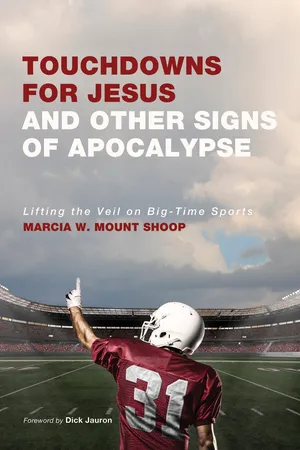
Touchdowns for Jesus and Other Signs of Apocalypse
Lifting the Veil on Big-Time Sports
- 134 pages
- English
- ePUB (mobile friendly)
- Available on iOS & Android
eBook - ePub
Touchdowns for Jesus and Other Signs of Apocalypse
Lifting the Veil on Big-Time Sports
About this book
Why do sports matter so much to so many people? And why should we care? Far from being a distraction or a trivial pastime, sports tell us deep truths about ourselves. Big-time sports are a particularly potent mirror for humanity--reflecting both our promising possibilities and our demonic distortions. Theologian (and football coach's wife) Marcia Mount Shoop invites you to take a closer look at the hold that sports have on us.
Touchdowns for Jesus takes you beneath the veil in some of the most challenging issues in sports today: fanaticism, sexism, racism, and abuse of power. And beneath the lifted veil you also encounter wisdom about how we can find our way back to what is most life-giving about sports. If you love sports, or if you just wonder why others do, Touchdowns for Jesus will give you a whole new way to view the games people play.
Information
Topic
Theology & ReligionSubtopic
Christian Theology1
Introduction
Exercising Demons/Practicing Redemption
Pastors and theologians get asked lots of questions—questions like: why is there evil in the world, is there life after death, and what is the meaning of life?
I get asked all of those questions. But they are not the questions I am asked the most. The number one question I am asked as a pastor and theologian is, “Does your husband think the team is ready for the game this week?” This question is second only to, “What do football coaches do for all those hours in the office during football season?” A close third is, “I have a question for you.” This statement is followed not by a question but by a comment about quarterback performance or a play suggestion that the “questioner” would like my husband, John, to consider calling in the next game.
I have been in ministry all over the country, and this tendency has not wavered. The team’s readiness for the next big game often seems to be the most pressing question many folks have on their minds. These questions used to feel to me like a distraction from “real life” matters like death and suffering and the meaning of existence. But through the years I have come to see them as a sure pathway to a profoundly real place in human life.
I’ve come to see these questions about the team’s readiness or a coach’s life as questions about redemption. At the heart of these questions is the yearning to believe that redemption is possible and true. Can we let ourselves dream of a moment when we can feel joy and delight in things working the way we want them to work? Or do we need to brace ourselves for disappointment, frustration, or failure? In this way, these questions are an unveiling of our deepest desires—the desires we often hide or repress in our “real” lives.
Sports generate emotions that we do not often have permission to fully express in other facets of our lives. Excitement, disappointment, anger, joy, frustration, and delight are authorized as full-bodied experiences in sports. We can jump up and down, we can yell when people make us mad, we can scold people when they disappoint us, and we can lift them up when they give us joy and make everything work. For many, the world makes sense in the confines of a stadium in a way it does not anywhere else. Sports can be where people feel most alive, where they find their identity. Sports can be where things are as they should be, where we know who is on our side and who is not. Sports can tell us where we belong. They can help us explore fantasies, physical touching, and sensations that are otherwise taboo. These expressions and their intensity are versions of religious, even mystical experience.
Theology searches for God’s fingerprints in human life.
This intensity and this comfort is a curiosity to many, even as it is an obsession for more. This strange hold that sports have on humanity can seem disconnected from faith. Sports are recreation, distraction, entertainment, or even guilty pleasures. Many people of faith want to say that God is worried about bigger problems in the world than who wins games; and thanking God for things like touchdowns is an affront to the suffering in the world. Still others find God in the wins, the losses, the touchdowns, and even in errant field goals.
In these ways and more sports can show us what is truest about us—and such a revelation of our nature, our distortion, and our promise is nothing short of apocalyptic.
As a theologian, this is where I cannot help but fix my gaze—behind the veil of human distortion, squinting and straining to catch a glimpse of something divine. Theology searches for God’s fingerprints in human life, knowing that we can never satisfy this hunger we have for certainty, for answers to life’s deepest questions.
Sports may seem trivial to some, but when taken in total they capture our imagination and elicit our deepest emotional outpourings much more than any religion does. Thanking Jesus for touchdowns as well as our deepest longing for our team to succeed are ripe for theological inquiry. Indeed these deeply complicated dynamics of human life in our American culture (and beyond) are apocalyptic—truth-bearing and truth-telling. But theology is not simply about finding answers. Theology is practicing ways to see the threads of redemption in life; theology is a redemptive practice.
As it stands in our contemporary context, sports and our deepest beliefs are not always integrated in a life-giving way. The connection between the divine and sport can seem to cluster as polar opposites—it’s either touchdowns for Jesus or God has nothing to do with sports at all. And the question of where or whether God fits into sports rarely explores the meatier issues that are tangled up in this object of so much human energy—like gender, race, and fanaticism. Not only do sports offer a chance to explore divine power and our human condition, but they also hold a mirror up to us about our most tenacious and dangerous distortions.
This theological project is a search for the redemptive capacity of sports by way of naming its demons. Indeed when we particularly begin to excavate what is beneath the surface of the spectacle of big-time sports, we can see some of humanity’s most robust demons exercising their power. Because sports offer such access to these distortions it also provides us with a chance to call them out and take a closer look. Sports give us a chance to not just blindly exercise these demons, but to exorcise them. This exorcism’s purpose is redemption. Unveiling, naming, and exorcising the demonic distortions that big-time sports embody creates an opportunity to practice new habits, new ways of engaging in the communities that sports help to form. And these new practices have the capacity to be life-enhancing, expansive, and even healing to the larger world.
This unveiling may show us more about what is possible in our collective lives together. This exploration may help us to see divine activity in a new way. Is there a mirror held up to us from sports that can help us be who we were created to be in a way that truly elicits our better angels? This question presses on me as a theologian with pronounced intensity because of the unique situation in which I live. I am a theologian and an ordained Presbyterian minister and I am married to a professional football coach. I am also a former competitive athlete. My husband has been in coaching for most of the years of our relationship. He spent twelve seasons (the first twelve years of our marriage) coaching in the National Football League (NFL). He has been one of the youngest offensive coordinators ever to call a game in the NFL. He has also coached at a number of universities. Our family has moved from Tennessee, to North Carolina, to Chicago, to Tampa, to Oakland, back to North Carolina again, and now to West Lafayette, Indiana, for this vocation of his. In the midst of these places we’ve called home I have been ordained to the ministry, completed a PhD in Religious Studies, and served different churches in various capacities. Our marriage seems peculiar to many people. And while our marriage makes sense to the two of us, we have yet to meet another theologian married to a football coach.
Honest public conversation about the relationship between sports and religion has not always felt possible for John and me. While we have always sought out this conversation and relationships with people who have beliefs that differ from our own, we have not always been a welcomed part of the religious conversation in the sports world. We have been excluded from some groups because of the “brand” of Christianity we apparently represent. Some in the football world have dismissed me because I embody an offensive kind of religious expression—a woman who speaks out and even has a leadership position in church. And when it comes to our decisions to look more closely at some of the most pressing issues of our time around big time sports, like compensation for players’ play or the ethics of the NCAA, there are not many in the coaching guild who feel free to explore those questions publicly.
Recognizing God’s fingerprints in sports takes looking deeper than the surface even when what we find does not serve our interests.
Opportunities for John and me to do several speaking engagements together on sports and theology created space for us to think through what we’ve learned so far in our lives in sports. At a few points, this book draws from those presentations, even as it goes more deeply into many of the questions John and I have explored in our life together. From our difficult conversations late at night about how a life in sports was hurting our family, to our deep ethical misgivings about the materialism, racism, and sexism that big-time sports embodies, to the joy we have felt together at winning big games or in other athletic accomplishments, to the life-giving friendships we have made through sports, the complicated dynamics of a life in big time sports are etched in how this theological project unfolds.
And with the NCAA football investigation at the University of North Carolina (UNC) our lives took another turn as well. That experience in particular deeply informs the work of this book and, in some cases, the different direction that it has taken from when the idea for writing it was first born. Our experience at UNC lifted the veil on tenacious layers of many of the issues I had already planned to explore in this book. The apocalypse, however, in some cases has meant seeing some things anew in ways that deeply grieve us. Indeed, in many ways, our experience at UNC has changed how we locate ourselves in the world of sports. What happened there makes this work all the more difficult to do and, at the same time, impossible not to do.
Game Plan
Recognizing God’s fingerprints in sports means finding ways to sift through the smoke and mirrors that can distract us in the spectacle of big-time sports. Recognizing the divine fingerprints also means we need to be able to name distortions and idolatry when we see them. Good theology needs to be engaged with the actual situation—warts and all. We are exorcising the demons that are exercised in big time sports. Exorcising these exercised demons sets the gaze on the distortions that are embodied in sports, namely in big-time revenue sports like football. These distortions are not always apparent to the naked eye and often embody humanity’s penchant toward seeing what we want to see. Gender, race, fanaticism, religion, and big-time sports on college campuses are the places where we find demons to name and exorcise/exercise them with an eye toward healing and redemptive possibilities.
In chapter 2, “Apocalypse Now,” I introduce some theological terms that will help to make this book more than chalk talk, but also theological, or God-talk. This project is, at its core, theological because it seeks both rich and revelatory descriptions as well as glimpses of redemptive possibilities. To this theological end, the chapters that follow will not simply describe distortions but unveil what they have to teach us about ourselves with an eye toward creating more conducive conditions for redemption to take hold. In the end, this book is not about dismantling big-time sports, but about calling it to own its redemptive capacity. Redemption comes with the most potency by way of casting out the demons that have led to diminishing returns rather than life-giving possibilities. Sports have much to teach us about who we are and who we can be; and sports teach us these lessons in some of the hardest places for us to deal with the truth and the consequences of our distortions.
Chapter 3, “Encountering the Fan(tasm),” takes us to the stadium where we can gaze at the dynamics of spectacle and fan(atic)s. This chapter explores how the confines of the stadium clear space for an unfiltered expression of ourselves: our distortions and our deepest longings. Why do people care so deeply? And what do we learn about who we are and can be when the veil is lifted on fanaticism in sports?
Chapter 4, “Man Up,” attends to how sports embody our assumptions, distortions, and constructions of gender. Masculinity, gender performance, sexism, and violence are fair play in this chapter. Equity is not a lofty enough goal for how sports can take up space in the performance of gender in our culture. “Manning up” creates more generous space for real people to occupy in sports.
Chapter 5, “White Lines,” explores the ways issues of race tend to be navigated in sports and what we might be missing when we simply look for the iconography of racial integration. This chapter seeks apocalyptic wisdom about race and privilege and how sports embody the dynamics of whiteness in ways that can be hard to see, even invisible.
Chapter 6, “Higher Learning,” explores the vexing question of how institutions of higher learning and big-time sport commingle. We examine the shadow side of this partnership including how money, power, race, and privilege are intimate partners in how education and sports function. This chapter lifts the veil on the false foes of academics and athleti...
Table of contents
- Title Page
- Foreword - Dick Jauron
- Preface
- 1. Introduction: Exercising Demons/Practicing Redemption
- 2. Apocalypse Now
- 3. Encountering the Fan(tasm)
- 4. Man Up
- 5. White Lines
- 6. Higher Learning
- 7. Touchdowns for Jesus
- 8. Redemption Time
- Afterword - John Mount Shoop
- Bibliography
Trusted by 375,005 students
Access to over 1.5 million titles for a fair monthly price.
Study more efficiently using our study tools.
Frequently asked questions
Yes, you can cancel anytime from the Subscription tab in your account settings on the Perlego website. Your subscription will stay active until the end of your current billing period. Learn how to cancel your subscription
No, books cannot be downloaded as external files, such as PDFs, for use outside of Perlego. However, you can download books within the Perlego app for offline reading on mobile or tablet. Learn how to download books offline
Perlego offers two plans: Essential and Complete
- Essential is ideal for learners and professionals who enjoy exploring a wide range of subjects. Access the Essential Library with 800,000+ trusted titles and best-sellers across business, personal growth, and the humanities. Includes unlimited reading time and Standard Read Aloud voice.
- Complete: Perfect for advanced learners and researchers needing full, unrestricted access. Unlock 1.5M+ books across hundreds of subjects, including academic and specialized titles. The Complete Plan also includes advanced features like Premium Read Aloud and Research Assistant.
We are an online textbook subscription service, where you can get access to an entire online library for less than the price of a single book per month. With over 1.5 million books across 990+ topics, we’ve got you covered! Learn about our mission
Look out for the read-aloud symbol on your next book to see if you can listen to it. The read-aloud tool reads text aloud for you, highlighting the text as it is being read. You can pause it, speed it up and slow it down. Learn more about Read Aloud
Yes! You can use the Perlego app on both iOS and Android devices to read anytime, anywhere — even offline. Perfect for commutes or when you’re on the go.
Please note we cannot support devices running on iOS 13 and Android 7 or earlier. Learn more about using the app
Please note we cannot support devices running on iOS 13 and Android 7 or earlier. Learn more about using the app
Yes, you can access Touchdowns for Jesus and Other Signs of Apocalypse by Marcia W. Mount Shoop in PDF and/or ePUB format, as well as other popular books in Theology & Religion & Christian Theology. We have over 1.5 million books available in our catalogue for you to explore.