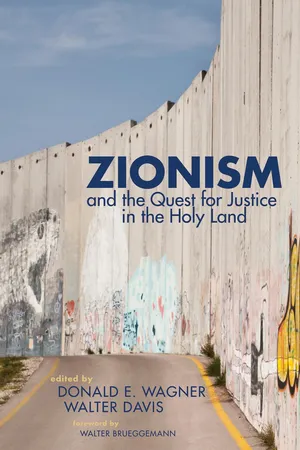
eBook - ePub
Zionism and the Quest for Justice in the Holy Land
- 274 pages
- English
- ePUB (mobile friendly)
- Available on iOS & Android
eBook - ePub
Zionism and the Quest for Justice in the Holy Land
About this book
A critical examination of political Zionism, a topic often considered taboo in the West, is long overdue. Moreover, the discussion of Christian Zionism is usually confined to Evangelical and fundamentalist settings. The present volume will break the silence currently reigning in many religious, political, and academic circles and, in so doing, will provoke and inspire a new, challenging conversation on theological and ethical issues arising from various aspects of Zionism--a conversation that is vital to the quest for a just peace in Israel and Palestine. The eight authors offer a rich diversity of religious faith, academic research, and practical experience, as they represent all three Abrahamic faiths and five different Christian traditions. Among the many themes that run through Zionism and the Quest for Justice in the Holy Land is the contrast between exclusivist narratives, both biblical and political, and the more inclusive narratives of the prophetic Scriptures, which provide the theological foundation and the moral imperative for human liberation. Readers will be drawn into a compelling, readable, and stimulating series of essays that tackle many of the complex issues that still confound clergy, politicians, diplomats, and academic experts.
Information
Topic
Theology & ReligionSubtopic
Christian ChurchChapter One
Political Zionism from Herzl (1890s)
to Ben-Gurion (1960s)
Historical Context
Political Zionism as Jewish Nationalism
In Europe during the second half of the nineteenth century, the Age of Nationalism and the Age of Imperialism converged. Building on ideas of the Enlightenment and the French Revolution, which promised equal rights for all, nationalist movements based on blood and soil arose all over Europe while their countries competed with each other to expand their colonial empires overseas. Political Zionism was one of these national-colonial movements, but Zionism faced obstacles that the other nationalist movements did not have: Jews were dispersed throughout Europe, had no common national identity, and possessed no common territory. Moreover, many had turned away from Jewish religious practices and become secular. In Western Europe this shift took the form of assimilation into the bourgeois culture of their host countries. In Eastern Europe, especially, many joined revolutionary socialist movements. Both forms of assimilation threatened Jewish identity.
Moving out of the sphere of religion, political Zionism sought to create a common secular ethnic identity among these diverse groups and to establish a homeland for all Jews in Palestine. Traditional Judaism had always taught that only God could redeem them and bring them back to Zion; political Zionism replaced the hope of divine redemption with the dream of national redemption and the creation of a “new Jew” through human agency, to remove the scars of humiliation and oppression inflicted by centuries of Christian anti-Semitism and state oppression.
Max Nordau, a leading Zionist at the turn of the twentieth century, explained two major forces that gave rise to this kind of Zionism—racial pride and anti-Semitism:
The new Zionism has grown only in part out of the inner impulses of Judaism itself, . . . out of an awakened pride in their racial qualities, out of ambition to save the ancient people for a long future and to add new great deeds of posterity to those of their ancestors.
. . . The Jewish nationalist . . . must make tireless efforts to render the name Jew a title of honor. . . . He knows what terrible harm centuries of slavery or disability have done to his originally proud and upright character and he seeks to cure himself by means of intense self-discipline.
. . . Only the return to their own country can save the Jewish nation, which is everywhere hated, persecuted, and oppressed, from physical and intellectual destruction.3
Nordau, like other Zionists before him, was fully aware of the depth of humiliation and shame of the past and the herculean tasks that the Zionist dream required:4
The Zionists know that they have undertaken a work of unparalleled difficulty. Never before has the effort been made to transport several million people peacefully and in a short space of time, from various countries; never has the attempt been made to transform millions of physically degenerate proletarians, without trade or profession, into farmers and herdsmen; to bring town-bred hucksters and tradesmen, clerks and men of sedentary occupation, into contact again with the plough and with mother earth.5
Toward Emancipation in Western Europe
In the early nineteenth century, after the French Revolution and the introduction of the Napoleonic Code, Jews in Western Europe gained equal rights and began an apparent process of assimilation. Although they quickly ascended to prominent positions in finance, education, science, government, business, and the arts, full equality and social acceptance by non-Jews eluded them. Like a simmering volcano, the millennia-old prejudice and discrimination against them were ready to erupt at any time. This gave rise to the “Jewish Question.”
The Question took a different form for Jews and for non-Jews. Non-Jews asked: “Can Jews be assimilated into our national culture without changing the nature of that culture?”6 Jews wondered: “Even if we assimilate, will we ever be accepted as equals, free of anti-Semitism? Can we fully assimilate into France or Germany or Britain and remain Jews?”
Ongoing Oppression in Eastern Europe
The situation of Jews in Eastern Europe and the Russian Empire was markedly different from that of Jews in Western Europe, who suffered discrimination from Gentile social rejection and government failure to implement laws granting equal rights to all. In the East official legal discrimination and periodic pogroms had traumatized and pauperized the masses of Jewish residents. Shortly after the widespread pogroms of 1881, Russian Jews under the leadership of Leo Pinsker created a political movement named Hibbat Zion (Love of Zion), the purpose of which was to urge persecuted Jews to resettle in Palestine and create a national life of their own. In response, between 1882 and 1903, over thirty-five thousand Jews emigrated to Palestine and established agricultural settlements or created Jewish communities in Arab towns.7 These agricultural settlements were capitalist, not socialist-communal, as would be the case in the following decades with the establishment of the collectivist kibbutzim. This wave of immigration is known as the First Aliyah.8 Because of illness, Arab resistance, and other hardships, almost half of these new arrivals left the country.9
At the same time, contact with the modernizing trends of their host societies in Eastern Europe and Russia had begun to dissolve the unifying fabric of Jewish religious life. “The eastern form of the spiritual problem is absolutely different from the western,” wrote Ahad Ha’am in 1897 shortly after the First Zionist Congress:
In the West it is the problem of Jews; in the East the problem of Judaism. The first weighs on the individual; the second, on the nation. The one is felt by Jews who have had a European education; the other by Jews whose education has been Jewish. . . .
It is not only the Jews who have come out of the ghetto; Judaism has come out, too. . . . of its own accord, wherever it has come into contact with modern culture. . . .
In exile, Judaism cannot, therefore, develop its individuality in its own way. When it leaves the ghetto walls, it is in danger of losing its essential being, or—at very least—its national unity; it is in danger of being split up into as many kinds of Judaism, each with a different character and life, as there are countries of the dispersion.10
The debate about the value of diversity among Jews continues today. It is documented in the 2011 film by Alan Snitow and Deborah Kaufman entitled Between Two Worlds, which the liberal Zionist author Peter Beinart calls “one of the best films I’ve ever seen about the contradictions of American Jewish life.”11 Fear that internal diversity of opinion among Jews may weaken Jewish commitment to Zionism and consequently undermine U.S. support for Israel may be a dominant factor in the...
Table of contents
- Title Page
- Acknowledgments
- Contributors
- Foreword - Walter Brueggemann
- Introduction to Chapters One and Two - Walter T. Davis and Pauline Coffman
- Chapter One: Political Zionism from Herzl (1890s) to Ben-Gurion (1960s) - Walter T. Davis and Pauline Coffman
- Chapter Two: From 1967 to the Present - The Triumph of Revisionist Zionism - Walter T. Davis and Pauline Coffman
- Chapter Three: Rising to the Challenge - Brant Rosen
- Chapter Four: Eastern Orthodox Perspectives on Zionism and Christian Zionism - Carole Monica Burnett
- Chapter Five: The Vatican, Zionism, and the Israeli-Palestinian Conflict - Rosemary and Herman Ruether
- Chapter Six: The Mainline Protestant Churches and the Holy Land - Donald E. Wagner
- Chapter Seven: Evangelicals and Christian Zionism - Gary M. Burge
- Chapter Eight: Zionism - Mustafa Abu Sway
- Chapter Nine: A Concluding Theological Postscript - Naim S. Ateek
- Appendix One
- Appendix Two
- Permissions
Trusted by 375,005 students
Access to over 1.5 million titles for a fair monthly price.
Study more efficiently using our study tools.
Frequently asked questions
Yes, you can cancel anytime from the Subscription tab in your account settings on the Perlego website. Your subscription will stay active until the end of your current billing period. Learn how to cancel your subscription
No, books cannot be downloaded as external files, such as PDFs, for use outside of Perlego. However, you can download books within the Perlego app for offline reading on mobile or tablet. Learn how to download books offline
Perlego offers two plans: Essential and Complete
- Essential is ideal for learners and professionals who enjoy exploring a wide range of subjects. Access the Essential Library with 800,000+ trusted titles and best-sellers across business, personal growth, and the humanities. Includes unlimited reading time and Standard Read Aloud voice.
- Complete: Perfect for advanced learners and researchers needing full, unrestricted access. Unlock 1.5M+ books across hundreds of subjects, including academic and specialized titles. The Complete Plan also includes advanced features like Premium Read Aloud and Research Assistant.
We are an online textbook subscription service, where you can get access to an entire online library for less than the price of a single book per month. With over 1.5 million books across 990+ topics, we’ve got you covered! Learn about our mission
Look out for the read-aloud symbol on your next book to see if you can listen to it. The read-aloud tool reads text aloud for you, highlighting the text as it is being read. You can pause it, speed it up and slow it down. Learn more about Read Aloud
Yes! You can use the Perlego app on both iOS and Android devices to read anytime, anywhere — even offline. Perfect for commutes or when you’re on the go.
Please note we cannot support devices running on iOS 13 and Android 7 or earlier. Learn more about using the app
Please note we cannot support devices running on iOS 13 and Android 7 or earlier. Learn more about using the app
Yes, you can access Zionism and the Quest for Justice in the Holy Land by Donald E. Wagner,Walter T. Davis, Wagner, Davis in PDF and/or ePUB format, as well as other popular books in Theology & Religion & Christian Church. We have over 1.5 million books available in our catalogue for you to explore.