- 212 pages
- English
- ePUB (mobile friendly)
- Available on iOS & Android
eBook - ePub
About this book
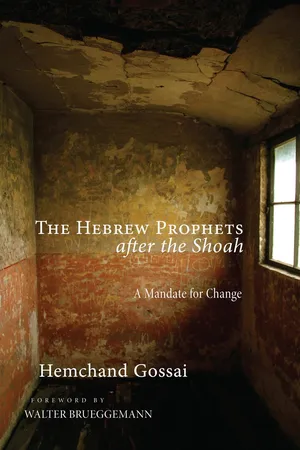
The Shoah is without question the defining moment in modern history, and it has transformed the manner in which the Bible is read and how God is understood. Questions that hitherto were rarely posed publicly must now be posed, and the human drama born out of exile, bondage, and genocide must be reckoned with in a new light.
These are issues that are predicated on a faithful God to whom challenging and even unanswerable questions must be voiced. So, how might the Hebrew prophets address such contemporary issues as imperial militarism, eminent domain, trust and trauma, hunger and power, memory and shame, blame and self-critique, madness and exceptionalism?
The daring words of the Hebrew prophets must have voices of testimony and witness in our time. This book speaks to that challenge.
Information
Topic
Theology & ReligionSubtopic
Biblical Commentary1
The Post-Shoah World
On the anniversary of the killing of Osama bin Laden, and in the midst of the politics and often politicizing of that moment, it was not unusual to hear the statement, “Of course if I were in power I would have made the same decision.” Perhaps for a little while, that statement will score political points with those who are supporters, and ideologically aligned with the speaker. But finally to have such a momentous event as the capture and death of a terrorist, where the decision was so extraordinary, to look in retrospect and use the language of “of course” is at best self-indulgent and self-aggrandizing. Indeed, I would argue that in seeking to show compassion, to listen intently, to console, etc. the vocabulary of “of course” should be stricken from our lexicon or used sparingly and with circumspection. Finally, one does not absolutely know. So then where does that leave us? Is this an implied suggestion that one cannot do anything; that one must have a particular experience in order to speak, console, show compassion? In a rather extraordinary document, Lawrence Langer in a prelude to interviewing Shoah survivors notes, “A statement like, ‘to understand, you have to go through with it,’ however authentic its inspiration, underestimates the sympathetic power of the imagination.”1
The Shoah evokes a redefining that permits and requires us to reread all else as fragment. It does not distort the Shoah nor does it trivialize to take the Shoah as the lens for reading the world of horror, abuse and violence everywhere all around, in forms of terrorism or in more institutionalized forms of capital punishment, and welfare reform and so on.2
The issues of understanding and memory are arguably no place more poignantly present and urgent, as in remembering and speaking about the Shoah. The ubiquitous statement “You have to go through it to understand” and the many variations, do have truth, but along the lines of Langer’s observation that in fact while absolute identification is not ever fully possible, the story nonetheless has to be told. One might say with some certitude that no two Shoah experiences are in fact identical; the experiences are also shaped by worldviews, internal capacity for faith, fortitude, religion, etc. Yet, the story must be told and personal identification cannot become a moment of silencing the voice or truncating the story. One must step away from the comfort and boundaries of lived experiences, and modes of thinking, and find a way of entering into the stories so that we might give voices to the memory. We must give voices, for we, unless we are survivors ourselves, cannot remember, and so we give voices to the memory of those who lost their voices, and those who have remembered and left us their memories. Listening to the voices of witnesses, we in turn become witnesses.
One of the most challenging ideas is that of the role of war as a means of punishment, or for injustices which often necessitates the resources for military power and might, over and against the need for bread. YHWH’s use of war and cosmic artillery in a variety of forms as punishment for a people who are involved in systemic and systematic injustices suggests two things. First, this level of violence and the magnitude of declaring war or cosmic cataclysm raises ethical questions, and the challenging prospects of reconciling the idea of God as one who is merciful and slow to anger with that of a God who launches a war and unleashes cosmic havoc on a people. Platitudes and clichès will not suffice here, nor will simple points of justification. Indeed, in large part this kind of challenge leads some to conclude that the “violent” and “warring” God is the God of the Old Testament and the God of Love is the God of the New Testament and with this comes salvation, redemption, etc. This kind of thinking creates an untenable and troubling dichotomy, and it is a variation of the flawed “promise and fulfillment” distinction that has for the most part been dismissed as indefensible. Second, one might argue that the issue of oppression and injustice is such that it transcends petty acts, but points to that which is systemic and systematic, and therefore must be met with a kind of punishment that is commensurate; hence war and acts of cosmic violence. Thus, with considerable reflection and circumspection one is compelled to ask: is genocide a proportionate response to injustice and idolatry? Janet Tollington has raised several pertinent and urgent questions in this regard. “‘Is war a divinely approved method of establishing justice, of settling territorial claims, of resolving power claims?’ ‘Is war divinely instigated and part of the overarching order between the nations?’ ‘Is war an inescapable fact of life and therefore understood as inevitable within Hebrew Bible traditions?’”3 The very questions in the context of injustices point to that which is significant in the lives and dynamics of the peoples’ lives.
One of the undeniable and unprecedented struggles that the victims of the Shoah face analogous to the experience of Jewish exiles in Babylon, is the loss of identity where not only are they stripped of their clothes and homes and land and temple, but are faced with the real possibility of death, family separation, and ongoing violence. There is also, in both instances, the real possibility of losing faith, whatever faith they might have had in God, and for that matter in humanity. In the Babylonian exile the Israelites are told that they will return home one day, and indeed God has plans for them. Yet, how could one realistically function in such a foreign and hostile society, and still maintain the level of faith, and believe that in fact God the architect of their exile, is the one who will deliver them, again. In both the Babylonian Exile and the Shoah is the fact that one could not quite fathom the new reality with the inherent questions. Certainly in the case of the Shoah it very quickly became apparent that staying alive was no longer a self evident reality but one had to reach into the recesses of one’s physical and mental strength, where it took all of the resources to simply stay alive. Langer suggests, “Once the impulse to stay alive begins to operate, the luxury of moral constraint temporarily disappears. Tainted memory then replaces judgment as it deposes guilt.”4
Rarely pursued is the issue regarding the prophets’ voice on behalf of the people to God. In this regard, Jeremiah and Amos are notable exceptions among the prophets, though Abraham, Moses, and Job also stand in the tradition of advocates though the divine responses vary. In the first instance the issue focuses on engaging God, but unlike Jeremiah and Amos, Isaiah is silent! God responded positively to Amos on both occasions, and Abraham stopped asking on behalf of Sodom and Gomorrah, not God. So, one is left to wonder about Isaiah’s silence.
Then I heard the voice of the Lord saying, “Whom shall I send, and who will go for us?” And I said, “Here am I; send me!”
And he said, “Go and say to this people:
‘Keep listening, but do not comprehend;
keep looking, but do not understand.’
Make the mind of this people dull,
and stop their ears,
and shut their eyes,
so that they may not look with their eyes,
and listen with their ears,
and comprehend with their minds,
and turn and be healed.”
Then I said, “How long, O Lord?” And he said:
“Until cities lie waste
without inhabitant,
and houses without people,
and the land is utterly desolate;
until the Lord sends everyone far away,
and vast is the emptiness in the midst of the land.
Even if a tenth part remains in it,
it will be burned again,
like a terebinth or an oak
whose stump remains standing when it is felled.”
The holy seed is its stump.5
While much has been written and spoken about the call of Isaiah, the details of the text beyond the well known and foundational “‘Whom shall I send, and who will go for us?’ And I said, ‘Here am I; send me!’” lies a very problematic and challenging outline of what is at the forefront of the call. Indeed the call of Isaiah is not only a matter of sending the prophet to proclaim a message to the people that contains a quality of indictment because of injustices, and perchance a possibility of redemption. Rather, this message given to Isaiah to be pronounced to the people, and in so doing be effected, is one of utter devastation. The principal message is to destroy and sever the relationship. There is no point of restoration, but rather an utter annihilation of the present. If the message that is given to Isaiah is taken for what it is, and not even to imagine it to a logical conclusion, it would be of apocalyptic proportions. The prophet is to speak to the people and cause them to lose their relational quality: no intellect, no hearing, no sight, no capacity to comprehend, no healing. But beyond their personal incapacities, the people are scattered, and land, homes are destroyed. No longer is there a sense of home or belonging, even as communities and families will be separated and scattered. One is left to wonder what is God’s end plan. The vocabulary in this text itself tells the devastating story: no comprehension; no perception, dull; deaf; blind; no healing; wasteland; forsaken; desolation; burnt to the ground; displacement; emptiness! With such destruction, the prophet’s response is encapsulated in, “How long?” Just as well that the prophet is not given an inkling of the message before he accepts! One is reminded that the “How long, O Lord?” question has more to do with a lamentation than a quest for a timeline. Yet, surely this cannot be enough. Such devastation cannot only be met with a sigh that suggests a sense of resignation. If the prophet does not raise his voice under such circumstances, then what is the message to those who today face such devastation and genocide by those with power to destroy? Painful as it is to say and acknowledge, Isaiah at this point is complicit with God’s and this complicity underlines the destructive role of silence under these circumstances. What might have been the difference or consequence had he said, no?
“In the end, Isaiah becomes complicit in the evil proposed by YHWH for the people by his failure to act.”6 While it almost certainly will not be overwhelmingly embraced or accepted, there is, I believe, truth to Sweeney’s observation. When translated into the context of the Shoah, and indeed in contexts such as Darfur, Rwanda and Kosovo, and certainly in the context of domestic abuse, the truth is much more striking, and cannot be dismissed casually or uncritically. The voice of the victim cannot be silenced, and be blamed for his or her suffering, as is...
Table of contents
- Title Page
- Foreword - Walter Brueggemann
- Preface
- 1. The Post-Shoah World
- 2. Prophecy and Prophetic Literature
- 3. Food and Power
- 4. Eminent Domain
- 5. Trust and Trauma
- 6. Challenging Imperial Militarism
- 7. Challenging the Empire
- 8. Justice and Redemption
- 9. Postscript
- Bibliography
Trusted by 375,005 students
Access to over 1.5 million titles for a fair monthly price.
Study more efficiently using our study tools.
Frequently asked questions
Yes, you can cancel anytime from the Subscription tab in your account settings on the Perlego website. Your subscription will stay active until the end of your current billing period. Learn how to cancel your subscription
No, books cannot be downloaded as external files, such as PDFs, for use outside of Perlego. However, you can download books within the Perlego app for offline reading on mobile or tablet. Learn how to download books offline
Perlego offers two plans: Essential and Complete
- Essential is ideal for learners and professionals who enjoy exploring a wide range of subjects. Access the Essential Library with 800,000+ trusted titles and best-sellers across business, personal growth, and the humanities. Includes unlimited reading time and Standard Read Aloud voice.
- Complete: Perfect for advanced learners and researchers needing full, unrestricted access. Unlock 1.5M+ books across hundreds of subjects, including academic and specialized titles. The Complete Plan also includes advanced features like Premium Read Aloud and Research Assistant.
We are an online textbook subscription service, where you can get access to an entire online library for less than the price of a single book per month. With over 1.5 million books across 990+ topics, we’ve got you covered! Learn about our mission
Look out for the read-aloud symbol on your next book to see if you can listen to it. The read-aloud tool reads text aloud for you, highlighting the text as it is being read. You can pause it, speed it up and slow it down. Learn more about Read Aloud
Yes! You can use the Perlego app on both iOS and Android devices to read anytime, anywhere — even offline. Perfect for commutes or when you’re on the go.
Please note we cannot support devices running on iOS 13 and Android 7 or earlier. Learn more about using the app
Please note we cannot support devices running on iOS 13 and Android 7 or earlier. Learn more about using the app
Yes, you can access The Hebrew Prophets after the Shoah by Hemchand Gossai in PDF and/or ePUB format, as well as other popular books in Theology & Religion & Biblical Commentary. We have over 1.5 million books available in our catalogue for you to explore.