eBook - ePub
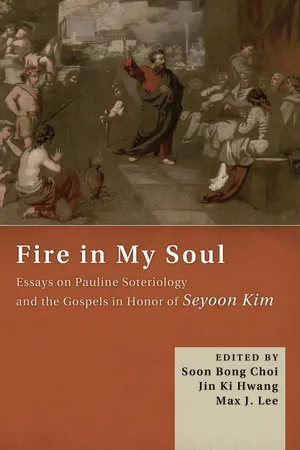
Fire in My Soul
Essays on Pauline Soteriology and the Gospels in Honor of Seyoon Kim
- 374 pages
- English
- ePUB (mobile friendly)
- Available on iOS & Android
eBook - ePub
Fire in My Soul
Essays on Pauline Soteriology and the Gospels in Honor of Seyoon Kim
About this book
Fire in My Soul pays tribute to the life and legacy of Dr. Seyoon Kim, who has taught as Professor of New Testament at Fuller Theological Seminary for almost two decades and is known internationally for his work on the origin of Paul's gospel. This collection of essays in his honor revisits classic issues in Pauline studies and offers fresh insights on Paul's use of righteousness language in his letters, the occasion and purpose of Romans, the problem of universal sinfulness, and justification by faith. It also presents several exegetical studies on the use of the Old Testament in the gospels. Scholars, students, and pastors interested in Pauline soteriology and gospel hermeneutics will find this volume helpful in their own research, teaching, and ministry.
Information
1
Greek Words and Roman Meanings, Part 1
(Re)mapping Righteousness Language
in Greco-Roman Discourse
in Greco-Roman Discourse
Introduction: Do Greek Words Only Have Hebrew Meanings?
Those familiar with David Hill’s classic study on soteriological terms in the biblical corpus will immediately recognize the appreciative nod that the title of this essay gives to his pioneering work. In Greek Words and Hebrew Meanings, Hill argues that the Greek words (i.e., ἱλάσκεσθαι, λύτρον, δικαιοσύνη, ζωή, and πνεῦμα) the Apostle Paul and other New Testament authors employ in their writings basically function as linguistic shells for new polysemous definitions. These definitions are atypical of normal Hellenistic usage and are derived from Hebrew words Paul translates through the Septuagint to Greek.1 When Paul, for example, utilizes the δικ(αιο)- word group, he does not use these words as they are commonly understood in Greco-Roman discourse but has the Hebrew meanings of tsedaqah / tsedeq in mind. By quoting or alluding to the Septuagint’s translations of tsedaqah / tsedeq, Paul redeploys the δικ(αιο)- word innovatively through bilingual interference. The Hebrew meanings of tsedaqah / tsedeq introduce new classifications well beyond the normal definitions of the Greek δικ(αιο)- lexemes.2 In short, Hill claims that though we read Greek words in Paul’s letters, these words essentially have Hebrew meanings.
This essay challenges the validity of Hill’s thesis. An artificial wall has been placed between Paul’s (Septuagintal) definitions of the δικ(αιο)- word group and their normal or Κοινή meanings in everyday discourse. Greek words have (Greco-)Roman meanings. Greek words are not empty shells into which the meanings of their Hebrew correlatives are infused. Much of the forensic dimensions of δικαιοσύνη and its cognates, for instance, that are attributed by past scholars to the Old Testament and Paul’s rereading of these OT texts,3 can also be found in the juridical and legal literature of the wider Roman Mediterranean world during the early imperial period. While Paul certainly contributes some unique usages of the δικ(αιο)- word group, for the most part, the uniqueness of Paul’s righteousness language in his letters has been exaggerated. Paul cannot use Greek words in such an innovative fashion that he becomes incomprehensible to the Greco-Roman readers of his day. He must have been coherent and his use of Greek understandable.
In what follows (i.e., a two-part study which comprises chapters 1 and 2 of this volume), I offer a detailed study of δικ(αιο)- lexemes as they were commonly deployed in Greco-Roman discourse and make suggestions how this study can inform our understanding of Paul. In this chapter (= Part 1), I first give a short description of early Homeric to Hellenistic usages of the δικ(αιο)- word group. This diachronic study is followed by an more extensive synchronic analysis of the semantic classifications or polysemous definitions of δίκαιος, δικαιοσύνη, δικαιόω, and δίκη during early imperial period of Rome. In Chapter 2 (= Part 2), I examine Paul’s (re)deployment of these terms in his Letter to the Romans (3:21–26 in the main). I suggest that Paul’s particularly forensic (and non-forensic) use of the δικ(αιο)- lexical group fits well within the semantic range of Greco-Roman social, legal and juridicial discourse and does not require an appeal to the idiolect of the Septuagint. Part 2 functions as a prolegomenon to a more comprehensive and future study of Paul’s use of righteousness language throughout his letter corpus.
Mapping Justice and Righteousness Language Lexically: The Unmarked and Marked Meanings of the Δικ(αιο)– Lexical Group in Greco-Roman Discourse
A Diachronic Perspective: From Homer to Hellenism
From ...
Table of contents
- Title Page
- Foreword - Won W. Lee
- Contributors
- Abbreviations
- Introduction - Soon Bong Choi, Jin Ki Hwang, and Max J. Lee
- 1. Greek Words and Roman Meanings, Part 1: (Re)mapping Righteousness Language in Greco-Roman Discourse - Max J. Lee
- 2. Greek Words and Roman Meanings, Part 2: A Prolegomenon to Paul's Use of Righteousness Language in His Letters - Max J. Lee
- 3. The Occasion and Purpose of Romans Revisited - Hae-Kyung Chang
- 4. Universal Sinfulness and Paul’s Reading of the Old Testament in Rom 3:9–18 - Kyoung-Shik Kim
- 5. The Antithesis between the Law and Grace in Gal 5:4 - Hung-Sik Choi
- 6. The Internal Integrative Motive Running through 2 Cor 11:23—12:10 - Chulhong Brian Kim
- 7. Matthew’s Use of the Septuagint and Its Implications - Jin Ki Hwang
- 8. The Understanding of στηρίζειν τὸ πρόσωπον in Luke 9:51 - Soon Bong Choi
- 9. Re-examining the Ironical Interpretation of the Parable of the Unjust Steward in Luke 16 - Chang Wook Jung
- 10. Forgiveness, Faith, and the Lordship of Jesus: A Contextual Reading of Luke 17:1-10 - Yon-Gyong Kwon
- 11. Was Johannine Christianity Sectarian? - Dongsoo Kim
- 12. The “Son of Man” in Johannine Eschatology - Stephen E. Young
- 13. The Bilingualism of the Hebrews and the Hellenists in the Jerusalem Church - Sang-Il Lee
- 14. “The Word of God” as a New Testament Term: An Investigation into Its Terminological Origin - Sung-Jong Oh
- 15. Methodological Similarity between Xunguxue and Biblical Exegesis - Hyeon Woo Shin
- Dr. Seyoon Kim: A Comprehensive Bibliography
- Epilogue: Words of Appreciation from Former Students and Colleagues of Dr. Seyoon Kim
Trusted by 375,005 students
Access to over 1.5 million titles for a fair monthly price.
Study more efficiently using our study tools.
Frequently asked questions
Yes, you can cancel anytime from the Subscription tab in your account settings on the Perlego website. Your subscription will stay active until the end of your current billing period. Learn how to cancel your subscription
No, books cannot be downloaded as external files, such as PDFs, for use outside of Perlego. However, you can download books within the Perlego app for offline reading on mobile or tablet. Learn how to download books offline
Perlego offers two plans: Essential and Complete
- Essential is ideal for learners and professionals who enjoy exploring a wide range of subjects. Access the Essential Library with 800,000+ trusted titles and best-sellers across business, personal growth, and the humanities. Includes unlimited reading time and Standard Read Aloud voice.
- Complete: Perfect for advanced learners and researchers needing full, unrestricted access. Unlock 1.5M+ books across hundreds of subjects, including academic and specialized titles. The Complete Plan also includes advanced features like Premium Read Aloud and Research Assistant.
We are an online textbook subscription service, where you can get access to an entire online library for less than the price of a single book per month. With over 1.5 million books across 990+ topics, we’ve got you covered! Learn about our mission
Look out for the read-aloud symbol on your next book to see if you can listen to it. The read-aloud tool reads text aloud for you, highlighting the text as it is being read. You can pause it, speed it up and slow it down. Learn more about Read Aloud
Yes! You can use the Perlego app on both iOS and Android devices to read anytime, anywhere — even offline. Perfect for commutes or when you’re on the go.
Please note we cannot support devices running on iOS 13 and Android 7 or earlier. Learn more about using the app
Please note we cannot support devices running on iOS 13 and Android 7 or earlier. Learn more about using the app
Yes, you can access Fire in My Soul by Soon Bong Choi,Jin Ki Hwang,Max J. Lee, Choi, Hwang in PDF and/or ePUB format, as well as other popular books in Theology & Religion & Biblical Criticism & Interpretation. We have over 1.5 million books available in our catalogue for you to explore.