- 92 pages
- English
- ePUB (mobile friendly)
- Available on iOS & Android
eBook - ePub
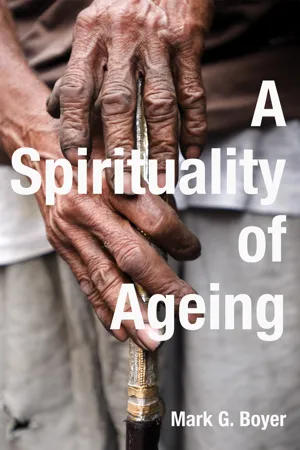
A Spirituality of Ageing
About this book
Sometime around the age of fifty--or as early as forty and as late as sixty--most of us come to terms with our age. We recognize that we have lived out at least half of the time allotted to us, and that the second half may be shorter than the first! Coming to terms with our age is a process, one that usually involves denial, anger, bargaining, depression, and acceptance. As we progresses through these stages, a spirituality of aging emerges. In this book, the reader is led on a quest to explore his or her own personal spirituality of aging. All the equipment--words of wisdom from the literature of the world's religions--has been gathered here. Each of the book's thirty-two exercises invites readers to reflect on a passage taken from the sacred literature of a world religion, then explore each passage for its meanings and applications through a meditative journaling question and a short prayer. While delving into the universal process of aging, the reader will be guided to discover his or her personal spirituality of aging.
Information
Topic
Theology & ReligionSubtopic
Biblical Studieschapter one
Denial

If you have any doubt, O men [and women],
about being raised to life again,
(remember) that We created you from dust,
then a drop of semen, then an embryo, then a chewed up lump
of flesh shaped and shapeless,
that We may reveal (the various steps) to you.
We keep what We please in the womb for a certain time,
then you come out as a child,
then reach the prime of age.
Some of you die, some reach
the age of dotage where they forget
what they knew, having known it once.
—Quran 22:5
Old Age at Hand
Scripture: “The Duke of She asked Tzu-lu about Master Kung (Confucius). Tsu-lu did not reply. The Master said, Why did you not say ‘This is the character of the man: so intent upon enlightening the eager that he forgets his hunger, and so happy in doing so, that he forgets the bitterness of his lot and does not realize that old age is at hand. That is what he is’” (Analects VII:18).
Reflection: A Chinese adventurer, who gave himself the title of Duke of She, asks Tzu-lu about Confucius. When Tzu-lu does not answer the adventurer, Confucius presumes to reveal his own character to the Duke of She. He declares that he is so focused on teaching the ignorant, who want to learn, that he forgets that he is hungry. He is so delighted when he is able to enlighten others that he forgets the bitterness of his state in life; he doesn’t even recognize that he is getting older.
When a person—even a teacher—fails to recognize that his or her older years are at hand, denial may be the cause. One can find all types of ways to deny age. “I don’t feel like I am sixty-five years old,” one person says. The presupposition in the statement is that there is a specific emotion that categorizes the elder years. “Sixty is the new forty,” states another. The presupposition is that people are getting younger as they get older! “I can still do the work of a forty-year-old,” states the eighty-year-old. And the presupposition is that there is a set amount of labor with which the eighty-year-old can match the forty-year-old. Laser surgery, cosmetic surgery, body hair removal, knee-, hip-, and rotator cuff-replacements, and other such techniques assist in the age-denial or old-age-forgetting process.
Some people forget about how old they are by continuing to work past retirement age. Some may need the money they make, but others use continued employment to deny their age. Others retire from their careers only to fill up their days with volunteer opportunities in an effort not to realize that old age is at hand.
In some cases, old age slaps one across the face with its glove, like a knight of old challenging another to a duel. A sudden fall on the ice with or without broken bones brings one face-to-face with age. A heart attack while shoveling snow off the driveway or sidewalk awakens a person to the fact that he or she is sixty-five, seventy, or seventy-five. A very active person is suddenly paralyzed by a stroke, and he or she must admit to his or her years.
The denial of one’s age may not be overt. One may never say, “I’m not getting old.” Denial may be covert. Like Confucius, a person does not realize that old age is at hand. The first step in developing a spirituality of ageing is to admit to the number of one’s years.
Journal/Meditation: In what specific ways do you deny your age?
Prayer: My days pass quickly and come to an end, like a sigh, Great Teacher. Assist me in realizing the number of my years, that I may not be so focused on others that I fail to appreciate the shortness of my life. Amen.
Old Age Characteristics
Scripture: “Remember your creator in the days of your youth, before the days of trouble come, and the years draw near when you will say, ‘I have no pleasure in them’; before the sun and the light and the moon and the stars are darkened and the clouds return with the rain; in the day when . . . the strong men are bent, and the women who grind cease working because they are few; . . . when one is afraid of heights . . . ; because all must go to their eternal home, and the mourners will go about the streets; . . . and the dust returns to the earth as it was, and the breath returns to God who gave it” (Eccl 12:1–3, 5, 7).
Reflection: The Hebrew Bible (Old Testament) Book of Ecclesiastes is classified as wisdom literature because it offers deep knowledge to those who read it. The author, who refers to himself as “the Teacher” (or “Qoheleth” or “the Preacher”), offers the advice that a person enjoy life and its pleasures as much as possible, as long as such enjoyment is informed by the inevitability of old age and death. The edited verses above come at the end of the book and emphasize the importance of facing one’s age in order to prepare for death.
The Teacher exhorts his readers to remember their creator while they are young. In the Hebrew Bible (Old Testament), the creator is, of course, God, who breathes the breath of life into people. Using a variety of metaphors for old age, the author refers to the elder years as days of trouble in which people take no pleasure. Eyesight begins to fail. Tears stream down one’s cheeks at the realization that he or she cannot see as well as he or she used to be able to see, that he or she cannot see in the dark.
In the older years, the men are stooped, the women can no longer work the long hours they used to toil, and both men and women are afraid of heights. Their days of climbing a ladder are long past; the days of stepping onto a stool to get things off of the highest shelf of the highest cabinet are over. The fear of a fall and broken bones takes precedence in one’s life.
As the Preacher reflects on the end of human life, he states the obvious that all must go to their eternal home, that is, all must die. There will be mourners at each person’s passing. But the inevitability of human life is that every person of dust—and that includes all people—returns to the earth. Another way to state this fact is to declare that one’s life breath returns to God who gave it.
A spirituality of ageing includes facing days of trouble when nothing seems to go the way it should; fixing failing eyesight with glasses, lasers, or surgery; not being able to work as long as one used to; becoming stooped or shrinking in size; not climbing ladders or stools; and accepting the fact that one day a person will take his or her last breath and return to dust through burial or cremation. These things cannot be denied.
Journal/Meditation: Which of the following do you deny: days of trouble, poor eyesight, shorter working hours, being stooped, climbing ladders or standing on stools, accepting death? What keeps you in denial?
Prayer: Creator God, you breathe the breath of life into me at the moment of my conception in my mother’s womb, and you fill me with your Spirit throughout my life. As I journey back to the dust out of which you formed me, remove all that hinders me from entering the eternal home you have prepared for me. Blessed is your name, now and forever. Amen.
Old Age Light Passage
Scripture: “This is the thunderbolt which often whirleth down from the lofty misty realm . . . . Beyond this realm there is another glory: so through old age they pass and feel no sorrow” (Rig Veda 10:27.21).
Reflection: From the sacred literature of Hinduism comes The Rig Veda, which means “praise knowledge” or “praise wisdom,” a collection of over 1,000 hymns, each with numbered verses, divided into ten books. All totaled, there are over 10,000 verses in this oldest collection of sacred hymns intended to lead the reader into rational contemplation.
The verse above begins with the image of a lightning bolt, which flashes from the lofty misty realm of the sky when a massive electrostatic discharge between the electrically charged regions within clouds—or between one cloud and another cloud or between a cloud and the ground—occurs. A thunderbolt usually occurs when warm air is mixed with a cold air mass which results in an atmospheric disturbance that polarizes the atmosphere. The lightning flash indicates that the charged regions are once again temporarily equalized.
The wisdom taught by The Rig Veda is that beyond the sky is another realm. In ancient cosmology, the world was understood to be a three-storied universe. On the bottom story is where the dead lived. People lived on the second story. And the gods lived on the third story, located above the sky or the dome of the earth. Lightning gives those who live on the second story a peek into the top story. Just as lightning streaks from the top story to the middle story, so will those who pass through old age streak from the second story to the glory of the top story.
Another image imbedded in the verse employs the experience of mist or fog. A mist or fog often disappears as quickly as it appears. Such is life; it appears like a mist, and then it disappears like a mist. People pass through old age and should feel no sorrow, because they know that there is something for th...
Table of contents
- Title Page
- Abbreviations
- Bible Note
- Introduction
- Chapter One: Denial
- Chapter Two: Anger
- Chapter Three: Bargaining
- Chapter Four: Depression
- Chapter Five: Acceptance
- Chapter Six: Synthesis
- Bibliography
Trusted by 375,005 students
Access to over 1.5 million titles for a fair monthly price.
Study more efficiently using our study tools.
Frequently asked questions
Yes, you can cancel anytime from the Subscription tab in your account settings on the Perlego website. Your subscription will stay active until the end of your current billing period. Learn how to cancel your subscription
No, books cannot be downloaded as external files, such as PDFs, for use outside of Perlego. However, you can download books within the Perlego app for offline reading on mobile or tablet. Learn how to download books offline
We are an online textbook subscription service, where you can get access to an entire online library for less than the price of a single book per month. With over 1.5 million books across 990+ topics, we’ve got you covered! Learn about our mission
Look out for the read-aloud symbol on your next book to see if you can listen to it. The read-aloud tool reads text aloud for you, highlighting the text as it is being read. You can pause it, speed it up and slow it down. Learn more about Read Aloud
Yes! You can use the Perlego app on both iOS and Android devices to read anytime, anywhere — even offline. Perfect for commutes or when you’re on the go.
Please note we cannot support devices running on iOS 13 and Android 7 or earlier. Learn more about using the app
Please note we cannot support devices running on iOS 13 and Android 7 or earlier. Learn more about using the app
Yes, you can access A Spirituality of Ageing by Mark G. Boyer in PDF and/or ePUB format, as well as other popular books in Theology & Religion & Biblical Studies. We have over 1.5 million books available in our catalogue for you to explore.