eBook - ePub
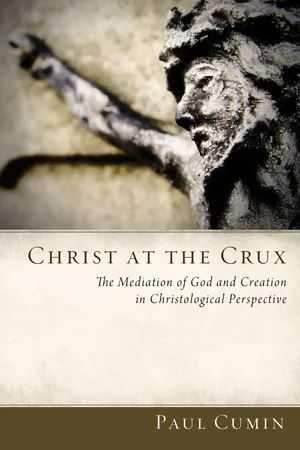
Christ at the Crux
The Mediation of God and Creation in Christological Perspective
- 236 pages
- English
- ePUB (mobile friendly)
- Available on iOS & Android
eBook - ePub
About this book
How can Christian theology confess God as both other than the world and also related to it in a way that compromises neither of these? Most modern thought has offered a simple reply: it cannot. Christ at the Crux analyzes one element of the roots of this denial and charts a route toward rapprochement. The Christologies of eight theologians offer various attempts to relate the Creator and the creature in Christ: Irenaeus of Lyon, Cyril of Alexandria, John Philoponus, Martin Luther, John Calvin, John Zizioulas, Robert Jenson, and Colin Gunton. Within the patristic era the question is grounded in theology about the incarnation; with the Reformers the focus is on the mediation between creation and Creator; and with the three modern theologians the breadth of the issue is completed with theology proper. Together, these eight offer a grand-scale perspective on much of the christological possibilities for conceiving the relation between God and everything else.
In the end Paul Cumin shows how the doctrine of the Trinity appears to open new possibilities for Christology and in particular for the way theology about the Spirit enables a reimagining of those items of Christian thought most likely at the roots of our modern rejection of God-as-other.
Information
Topic
Teologia e religioneSubtopic
Teologia cristiana1
Irenaeus and the Gnostic Option
Monism, Duality, and the “Two Hands” of God
(A Trinitarian Concept of Mediation)
For the only consistent position outside of Christianity is that of pantheism,
the taking of oneself out of existence by way of recollection into the eternal,
whereby all existential decisions become mere shadow-play
beside what is eternally decided from behind.
—Sören Kierkegaard
“[T]hat God creates means that there is other reality than God and that it is really other than he.” So begins Robert Jenson’s systematic development of the doctrine of creation.1 Similarly, Eric Osborn has expressed near-consensus among scholars by identifying the primary characteristic of Gnostic2 thought as “cosmic dualism” wherein “matter and spirit are sharply opposed.”3 The main task of this chapter will be to consider an element of the trend in which the former properly Christian duality has come to be neglected as guilty by association with the unholy latter—characteristically Gnostic—dualism. Irenaeus of Lyons should serve us well in this regard as he is unique in the tradition as one familiar with both key terms in the discussion. He is at once the one largely responsible for developing the ontology that has equipped Jenson for his observation, and the one who did so within the context of precisely the same Gnosticism to which Osborn is referring with his.
As a theologian whose thought has been characterized by one commentator as “relatively clear at the outlines and at the same time fuzzy in its details,” Irenaeus may be particularly susceptible to the tendency for modern readers to peer down at him as if at their own reflection in the water at the bottom of a deep well.4 To complicate matters further the precise nature of second century Gnosticism is presently a subject of so much scholarly attention that one can hardly use the term at all without a lengthy explanation for the absence of inverted comas at either end of it.5 That said, and although Irenaeus is no longer regarded as an authority on the content and finer contours of Gnostic thought, he did, I will argue, analyze their theology with brilliant accuracy. Despite the immense variety and incredibly labyrinthine nature of Gnostic theology, Irenaeus saw in it repeated conceptual patterns and large-scale logical connections. Indeed, we might say he studied Gnostic theology systematically. If this is a fair claim—and if Richard Norris has correctly represented Irenaeus’ dispute with the Gnostics as “perhaps the classical statement of Christian belief in terms of the problems and conceptions native to the rational theology of the Greeks”6—we have a sizeable, but highly significant task ahead of us.
One of the most important arguments to be made in this chapter is the one least likely to meet with widespread approval and for this reason ought to be said up-front: the Gnostics to which Irenaeus responded were not wrong about the gospel because they distinguished spirit from matter and God from world too sharply, but because they distinguished them insufficiently. Although Irenaeus did indeed take great pains to reunite all that was separated by the “dualizing” Gnostics, more importantly, he was able to see that the driving force behind the Gnostic impulse to divide was an ontology that was impotent to distinguish. Simply put, Gnostic thought is fundamentally monistic.
To support such a claim we will need to gain some perspective on Gnostic theology by climbing with Irenaeus above their “terminological fog”7 and trying to see larger movements in the course of their thought as a whole. What we will find is a recurring tendency to tell the cosmological story in terms of a fall and return to the One. Kurt Rudolph makes the crucial observation: “[Gnostic] dualism is carried along or, to put it more accurately, interwoven with a monistic idea which is . . . the basis for the identification of man and deity.” Rudolph later refers to this “upward and downward” double movement in Gnostic thought as a “dualism on a monistic background.”8 Hans Jonas offers a similar sketch:
The Gnostic doctrines of the origin of the world, because of their central importance, are very richly developed, so that it is not easy to organize them systematically . . . Essentially it is always a question of the downward development from the highest being, already mentioned, which leads by ways usually described in very complicated fashion on the one hand to the creation of the world, but at the same time on the other hand to the embodiment of a divine and spiritual particle (which really makes possible the very creation itself, but is also a pledge of the later redemption).9
In the opening half of this chapter I will investigate briefly each of the two elements of this double movement in Gnostic thought. First in view will be themes that suggest everything comes from the One, and then those that suggest everything returns to the One. In the second half of the chapter we will see how Irenaeus responds, and come near its end to a consideration of his uniquely Trinitarian concept of christological mediation.
The Gnostic doctrine of creation—if this is what it should be called—is indeed a dizzying program. An initial observation will recur several times throughout this study: whatever else might be true of Gnostic theology about God and the world, it is almost entirely vertical. At the top of being there is an ontological singularity from which everything else is derived, and things descend from this one source directly or indirectly at more or less whimsical frequency. In one way or another, all of the characters in Gnostic myth have a common generic origin. One could almost randomly select a passage from Irenaeus’ accounts of his opponents to illustrate the point,
These Aeons having been produced for the glory of the Father, and wishing, by their own efforts, to effect this object, sent forth emanations by means of conjunction . . . In a like manner, the rest of the Aeons also, in a kind of a quiet way, had a wish to behold the Author of their being, and to contemplate that First Cause which had no beginning. But there rushed forth in advance of the rest that Aeon who was much the latest of them, and was the youngest of the Duodecad which sprang from Anthropos and Ecclesia, namely Sophia, and suffered passion apart from the embrace of her consort Theletos. (1.1.2 and 1.2.2)
With this we come to the element of Gnostic theology that functions as much like a presiding theme as is imaginable in such a diverse range of thought. The apparently endless stream of squabbling and copulating mediatorial “Aeons” in Gnostic myth is essentially a highly protracted theodicy. Richard Norris explains: “The myth of Achmoth and the story of the Demiurge are both attempts to explain the origin of evil without impu...
Table of contents
- Title Page
- Acknowledgments
- Introduction: God for the Time Being—The Need for a Concept of Mediation
- Chapter 1: Irenaeus and the Gnostic Option—Monism, Duality, and the "Two Hands" of God (A Trinitarian Concept of Mediation)
- Chapter 2: Cyril of Alexandria and the Nestorian Option—Theotokos, Communicatio Idiomatum, and the Single Subjectivity of Christ (A Soteriological Concept of Mediation)
- Chapter 3: John Philoponus and the Miaphysite Option—Substantiality and Creatio ex nihilo after Chalcedon (A Cosmological Concept of Mediation)
- Chapter 4: Martin Luther and the Problem of Distant Grace—Faith, Jesus, and the Immediacy of God (A "Theological" Concept of Mediation)
- Chapter 5: John Calvin and the Problem of a Logos Asarkos—When Creation and Revelation Collide (An Ontological Concept of Mediation)
- Chapter 6: Robert Jenson and the Spirit of It All—Christ as Space-time (A Dialectical Concept of Mediation)
- Chapter 7: John Zizioulas and Being Free—Christ as Personal Paradigm (An Existential Concept of Mediation)
- Chapter 8: Colin Gunton and the Integrity of Creation—Christ as a Particular Human (An Economic Concept of Mediation)
- Conclusion: God for the Time-Being—The Need for a Christological Concept of Mediation
- Bibliography
Trusted by 375,005 students
Access to over 1.5 million titles for a fair monthly price.
Study more efficiently using our study tools.
Frequently asked questions
Yes, you can cancel anytime from the Subscription tab in your account settings on the Perlego website. Your subscription will stay active until the end of your current billing period. Learn how to cancel your subscription
No, books cannot be downloaded as external files, such as PDFs, for use outside of Perlego. However, you can download books within the Perlego app for offline reading on mobile or tablet. Learn how to download books offline
We are an online textbook subscription service, where you can get access to an entire online library for less than the price of a single book per month. With over 1.5 million books across 990+ topics, we’ve got you covered! Learn about our mission
Look out for the read-aloud symbol on your next book to see if you can listen to it. The read-aloud tool reads text aloud for you, highlighting the text as it is being read. You can pause it, speed it up and slow it down. Learn more about Read Aloud
Yes! You can use the Perlego app on both iOS and Android devices to read anytime, anywhere — even offline. Perfect for commutes or when you’re on the go.
Please note we cannot support devices running on iOS 13 and Android 7 or earlier. Learn more about using the app
Please note we cannot support devices running on iOS 13 and Android 7 or earlier. Learn more about using the app
Yes, you can access Christ at the Crux by Paul Cumin in PDF and/or ePUB format, as well as other popular books in Teologia e religione & Teologia cristiana. We have over 1.5 million books available in our catalogue for you to explore.