- 268 pages
- English
- ePUB (mobile friendly)
- Available on iOS & Android
eBook - ePub
About this book
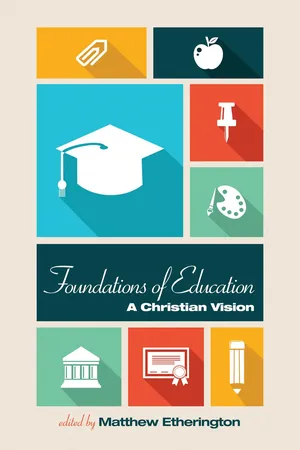
Ideas about education have consequences. This book, edited by Matthew Etherington, provides readers with ideas and insights drawn from fifteen international scholars in Christian thought within the fields of philosophy, theology, and education. Each author responds to the philosophical, historical, and sociological challenges that confront their particular line of educational inquiry. The authors offer a view of Christian education that promotes truth, human dignity, peace, love, diversity, and justice. The book critically analyzes public discourse on education, including the wisdom, actions, recommendations, and controversies of Christian education in the twenty-first century. This timely book will appeal to those concerned with Christian perspectives on education, Aboriginality, gender, history, evangelism, secularism, constructivism, purpose, hope, school choice, and community.
Information
Topic
Theology & ReligionSubtopic
Philosophy History & Theory1
The Christian Roots of Public Schooling in North America
A remarkable educational event took place around 450 BC. In a large square in Jerusalem, the priest Ezra taught a large proportion of the fifty thousand Jews who had returned from captivity in Babylon. For eight days, Ezra and his helpers taught them the Law, the Torah, “making it clear and giving the meaning so that the people could understand what was being read.” It became a joyful celebration, with the governor Nehemiah supplying “choice food and sweet drinks.”1
This account is just one example of how the Judeo-Christian tradition has championed the importance of education. As this chapter describes, in the Western world it was Christian leaders who founded schools. They believed that serving God and neighbor demanded widely available schooling for all children. They were intent to foster an educated citizenry that could contribute responsibly and significantly to all aspects of society.
Education in Biblical Times
Long before Ezra, education was already important to the Jews. Teachers—originally priests and parents—instructed children with knowledge and authority. Teaching the Law and Israel’s cultural narrative gave children an anchor in life. They learned about their responsibilities to God, their community, and their fellow human beings. Psalm 78 points out the importance the Jewish nation put on education. Children were to be taught “things we have heard and known” and “the praiseworthy deeds of the Lord” (vv. 3–4). Those praiseworthy deeds, as God made clear when he spoke to Job, were not restricted to religious knowledge but also included the marvels and intricacies of the physical world.2
In the century before the birth of Jesus the Jews established schools in every synagogue in Israel. These schools offered instruction to both boys and girls until age ten. This was the first school system in the world that was universal, compulsory, and supported by a tax (levied by the high priest). At the time of Jesus, 480 synagogue schools existed in Jerusalem alone. Students attended every day, even on the Sabbath, with sessions in the early morning and late afternoon. Apparently boys used the time in between to learn a craft, often the trade of their fathers, and girls performed duties in the home. Teachers were highly respected. As a popular saying put it, “Respect your teacher as you would God.”3
Thus it was a mark of esteem that the Jews called Jesus a rabbi or teacher who taught with unusual authority.4 Jesus testified to the truth. He taught people, as the Old Testament had enjoined teachers, God’s marvelous deeds as well as the way they should live. He took persons where they were at and encouraged them to change and enrich their lives. He encouraged meaningful response and personal responsibility. He lived what he taught, showing genuine respect and concern for others. He demonstrated empathy and compassion while modeling humility, self-sacrifice, and integrity. Jesus has been a compelling and influential model for teachers ever since he lived on earth.
The last instruction that Jesus gave his followers was to teach all nations “everything I have commanded you.”5 The disciples and the Apostle Paul therefore stressed the importance of teaching. A large part of Paul’s letter to Titus, for instance, discusses what it means to teach with integrity, seriousness, and soundness of speech.6 For Jesus’ followers, education was important. It initiated children into their faith tradition, and it helped them “assess and synthesize their Christian life with the best of secular culture.”7
Education in the Early Church
During the first few centuries after Jesus’ death, Christians set up few schools. Their small communities often suffered persecution. They considered religious and moral education to be primarily the responsibility of parents. Therefore early Christians stressed education in homes and churches rather than in schools. They taught mainly religious history and doctrines that prepared for baptism.
Gradually larger centers established catechetical schools. Like the synagogue schools, but unlike the Roman ones, they taught both boys and girls. Their programs included both theological and literary emphases. In the second century, Justin Martyr in his catechetical school advanced the concept that all knowledge stems from God. Therefore Christians should study not only theology but also philosophy and literature. Two centuries later Augustine built on this. He said that Christians should be well grounded in classical and general studies since all truth belongs to God. At the same time, the intent of such study should be to understand how to serve God. Reason, while important, is to be used within the biblical framework of faith, hope, and love. The catechetical schools were the first Christian ones that influenced culture beyond the church.8
During the medieval period in Europe, education was the virtual monopoly of the Catholic Church. Most parishes had a school. However, usually only boys who were academically inclined and belonged to higher social classes had access. Monastic and convent schools prepared their students primarily for religious vocations. Despite the fact that Emperor Charlemagne at the end of the eighth century issued several directives that boys should learn to read in schools, the universality of education in Jesus’ time no longer existed. Also, those who wrote about education addressed mainly the study of theology. Neither Jesus’ example of master teaching nor some rudimentary pedagogical thought by Christian thinkers such as Augustine seems to have had much effect on medieval schools.
Christians Lead the Way to Universal Education in Europe
The sixteenth-century Reformers revitalized universal elementary education, and for the first time did so across a cluster of countries. Martin Luther (1483–1546) argued that a lack of education was a “great and murderous harm.” It was shortsighted for parents not to send their children to school. Society needed not only clerics but also lawyers, secretaries, teachers, and doctors. Moreover, merchants and miners and other “common folk” were also God’s servants and would therefore also benefit from schooling.9
In 1524 Luther wrote a lengthy letter to the mayors and councilors of all cities in Germany that it was their duty to maintain schools for all boys and girls.10 Schools would provide spiritual, material, and political benefit for the German nation. They would promote the fear of God, faith, and good works in the service of others. God’s Word was to be a central focus of the curriculum. Nonetheless, since all truth is from God, children would also study languages, history, music, and mathematics. Luther’s letter about schooling led to the establishment of schools throughout Germany, ones where the poor were assisted to attend. Luther is recognized as...
Table of contents
- Title Page
- Foreword - Dr. Edwin Boyce
- Introduction
- Contributors
- 1. The Christian Roots of Public Schooling in North America - Harro Van Brummelen
- 2. Christian Educators Who Made an Impact: Comenius and His "School as a Forging Place of Humanity" - Jan Hábl
- 3. Christian Women and Their Influence on Education: The Contributions of Mary Wollstonecraft, Jane Addams, Lois LeBar, and Nel Noddings - Allyson Jule
- 4. Christianity and Special Education: The Concern for the Blind and the Deaf - Matthew Etherington
- 5. Religion and the Science Classroom - Arnold E. Sikkema
- 6. Educating for Faithful Presence - June Hetzel and Tim Stranske
- 7. Educating for the Good Life - Perry L. Glanzer
- 8. Evangelism in the Classroom - Elmer John Thiessen
- 9. The Peculiar Hope of the Educator - Nicholas Wolterstoff
- 10. Truth, Traditional Teaching, and Constructivism - Rev. Keith Mitchell
- 11. Education for What Matters: Aims for Christian Schooling - Ted Newell
- 12. Faith in the Humanities - Karen Swallow Prior
- 13. School Choice and Church School Education in the United Kingdom - Elizabeth Green
- 14. The Global Electric Republic - Teaching the Timeless in the Digital Age
- 15. Religion, Secularity, and Education: On Not Taking Things for Granted - Doug Blomberg
- 16. Walking Humbly, Listening Compassionately and Living Justly: A Way Forward in Our Relations with Aboriginal Peoples in Canada - David Long and William Van Arragon
- 17. Educating for Public Life - Angus Brook
- 18. The School as Community: Learning for Service in an Era of Educational Narcissism - Stephen Fyson
Trusted by 375,005 students
Access to over 1.5 million titles for a fair monthly price.
Study more efficiently using our study tools.
Frequently asked questions
Yes, you can cancel anytime from the Subscription tab in your account settings on the Perlego website. Your subscription will stay active until the end of your current billing period. Learn how to cancel your subscription
No, books cannot be downloaded as external files, such as PDFs, for use outside of Perlego. However, you can download books within the Perlego app for offline reading on mobile or tablet. Learn how to download books offline
Perlego offers two plans: Essential and Complete
- Essential is ideal for learners and professionals who enjoy exploring a wide range of subjects. Access the Essential Library with 800,000+ trusted titles and best-sellers across business, personal growth, and the humanities. Includes unlimited reading time and Standard Read Aloud voice.
- Complete: Perfect for advanced learners and researchers needing full, unrestricted access. Unlock 1.5M+ books across hundreds of subjects, including academic and specialized titles. The Complete Plan also includes advanced features like Premium Read Aloud and Research Assistant.
We are an online textbook subscription service, where you can get access to an entire online library for less than the price of a single book per month. With over 1.5 million books across 990+ topics, we’ve got you covered! Learn about our mission
Look out for the read-aloud symbol on your next book to see if you can listen to it. The read-aloud tool reads text aloud for you, highlighting the text as it is being read. You can pause it, speed it up and slow it down. Learn more about Read Aloud
Yes! You can use the Perlego app on both iOS and Android devices to read anytime, anywhere — even offline. Perfect for commutes or when you’re on the go.
Please note we cannot support devices running on iOS 13 and Android 7 or earlier. Learn more about using the app
Please note we cannot support devices running on iOS 13 and Android 7 or earlier. Learn more about using the app
Yes, you can access Foundations of Education by Matthew Bruce Etherington, Etherington in PDF and/or ePUB format, as well as other popular books in Theology & Religion & Philosophy History & Theory. We have over 1.5 million books available in our catalogue for you to explore.