- 232 pages
- English
- ePUB (mobile friendly)
- Available on iOS & Android
eBook - ePub
About this book
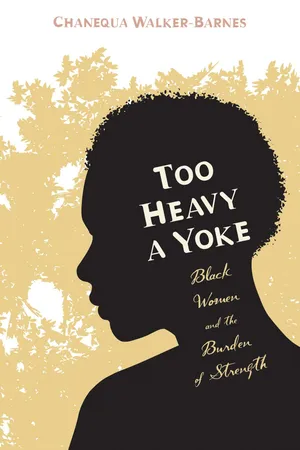
Black women are strong. At least that's what everyone says and how they are constantly depicted. But what, exactly, does this strength entail? And what price do Black women pay for it? In this book, the author, a psychologist and pastoral theologian, examines the burdensome yoke that the ideology of the Strong Black Woman places upon African American women. She demonstrates how the three core features of the ideology--emotional strength, caregiving, and independence--constrain the lives of African American women and predispose them to physical and emotional health problems, including obesity, diabetes, hypertension, and anxiety. She traces the historical, social, and theological influences that resulted in the evolution and maintenance of the Strong Black Woman, including the Christian church, R & B and hip-hop artists, and popular television and film. Drawing upon womanist pastoral theology and twelve-step philosophy, she calls upon pastoral caregivers to aid in the healing of African American women's identities and crafts a twelve-step program for Strong Black Women in recovery.
Information
Topic
Teologia e religioneSubtopic
Chiesa cristiana1
This Thing Called Strength
A Portrait of the StrongBlackWoman
Time and again the needs of others have been superimposed on us. The need to believe that a black woman will love you come rain or come shine, that no matter how heavy the burden we can shoulder it, that we are naturally more resilient, that mothering and self-sacrifice are second nature to us, that we are called to be of service to others, that we will bear the shield. Strong Black woman is the amalgam of all that and so much more. She’s flesh and blood real, myth and fiction, fact and lie. The assumption that we African American females are inherently strong, as if it were woven into our mitochondrial DNA, is taken as Gospel by our tribe as well as by others.14
Just say “StrongBlackWoman” and nearly anyone who has significant relationships with Black women has some idea of what you are talking about. Indeed, the word strong is such a frequent descriptor of Black women that it could be argued that the term StrongBlackWoman is virtually redundant. It is certainly the case that an individual can be strong, black, and a woman without being the “StrongBlackWoman.” Yet, the societal pressure to be strong is so intense for Black women that many, if not most, embody at least some aspect of the StrongBlackWoman at some point in their lives. Black women are expected to be strong. And conversations about them—as individuals or as a collective—routinely invoke the notion of their strength.15 It is not uncommon, for example, to hear stories like this:
No one knows how Ms. Martha does it.16 She lost her husband and only child in the same year. The day after her husband’s funeral, she came to church. We weren’t expecting to see her in worship that day. But there she was, singing in the choir and praising God! Then, that same year, her son was in a car accident that left him comatose. When she went to see him, just before leaving his side, she kissed him on the forehead and said, “If you’re not here when I get back, I’ll see you on the other side.” He passed away a few hours later. But Ms. Martha never missed a beat. She shows up every Sunday with a smile on her face. No one has ever seen her cry. She didn’t even cry at either of their funerals. What an incredibly strong woman of faith!
I heard the story of Ms. Martha while sitting in the pastor’s study of a church at which I was a guest preacher. The pastor had just returned from out of town. In the hour before the worship service began, several church leaders dropped by to welcome us both and to update the pastor on the happenings in the congregation during his absence. Although he was one of my seminary students, he was not familiar with my research on the StrongBlackWoman. Thus, he could not have known that the discussion about Ms. Martha was a cultural goldmine for me. As I silently listened in on the conversation about Ms. Martha, I tried to detect any signs of recognition that there might be more behind the scenes of Ms. Martha’s strength or that there might be some awareness that it’s unhealthy not to grieve the major losses that she had sustained. Yet the praise for Ms. Martha’s strength was unwavering. No one questioned whether her outward appearance of strength held up when she was alone at home, or whether it gave way to depression and despair.
Ms. Martha could have easily been a stand-in for any number of the African-American women whom I had treated in therapy over the years. These women were highly diverse, ranging in age from their twenties to their fifties. They were students at Ivy League schools, minimum wage workers who struggled to make ends meet, corporate employees, and management level professionals in university and government agencies. Some were married, with or without children; others were single. And despite their great socioeconomic diversity, they were similar in many respects. Most of them had no serious psychopathology; in fact, it was often difficult to find any psychiatric disorder for which they met the diagnostic criteria. Usually, I diagnosed them with dysthymia—a chronic, low grade depression sometimes associated with chronic stress. But the real issue that brought each of them into therapy was being the StrongBlackWoman.17
Each of these women was under significant stress related to a common cause—their roles as caregivers. Regardless of their age or station in life, each had a high sense of responsibility and consequently served as a load bearer. That is, they were the individuals who could be relied upon most when something went wrong in their extended families, on their jobs, and in their churches and communities. They were the women who took care of ailing family members and who were generally the first called whenever someone had a problem. At work and at church, they could be counted upon to take up the slack when someone else failed to live up to their responsibilities. Often, in fact, they foresaw the probability that the other person would fall short and they stepped up to the plate long before they were asked. They were the individuals who made sure that everything was done in its appointed place and time. They tried to be helpful to everyone who asked and even to those who did not. They rarely said no to anyone. And they hardly ever asked for help, instead relying solely upon God to be their ultimate load bearer. These women were all faithful Christians, active churchgoers. Like Ms. Martha, each possessed a strong sense of faith that was often publicly heralded by those who knew them. Indeed, it was often out of their faith that they felt both compelled and empowered to serve others so endlessly. Whenever they felt the weight of responsibility bearing upon them, they ignored it, believing sincerely that God would continue to empower them to serve.
Ironically, the more that they did, the more people asked them to do. And on the rare occasions that they did ask for help or voice a complaint, their cries were unheard, not because others were trying to be cruel to them, but because people had come to think of them as strong and capable of handling all that life threw at them. Over time, the burden of responsibility became too heavy to bear. But because they did not want to let anyone down (and because their pride would not allow themselves to be seen as persons in need of help), they kept giving, even as they felt their physical and/or emotional health giving way. They ignored the weight gain, hypertension, and migraines. They hid their chronic unhappiness and crying spells from their family and friends until finally, feeling on the verge of a breakdown, they decided to see a therapist. And in classic StrongBlackWoman style, they never told anyone that they were in therapy, not their spouses, parents, children, best friends, or pastors. Especially not their pastors.
Each of my clients, in some way, was a Ms. Martha in her congregation. She was a woman whose perceived success was lauded in her church, sometimes in a very public way, as an outworking of her great spiritual faith. During one session, for example, a young female client described her frustration at her pastor’s incessant praise of her achievements:
Client: He did it again.
Me: Who did what?
Client: The pastor. On Sunday, he brought me up in front of the entire congregation and began talking about what a wonderful example I am. I wish he would stop doing that. It makes me feel like such a fraud.
Often, my clients openly stated that they could not turn to their pastors or fellow church members for support precisely because those individuals expected them to do well all the time. They were afraid that any admission of difficulty or weakness would be interpreted as a sign of failure or, worse, a lack of faith. The memories of these women lurked in my consciousness as I listened to the accolades being lavished upon Ms. Martha. I wondered whether she was as strong as she appeared to be, or whether she, like my clients, was wearing the armor of the StrongBlackWoman.
Three Core Features of the StrongBlackWoman
“What’s so bad about being the StrongBlackWoman?” That’s the response that I receive from churchwomen and from students when I teach and preach on this subject. It is a fair question. After all, the image of the StrongBlackWoman is an infinitely more palatable alternative to the negative stereotypes of African-American womanhood that have been propagated since our arrival on the shores of the United States: the sexually promiscuous and manipulative Jezebel, the asexual and happily oppressed Mammy, and the sharp-tongued and emasculating Sapphire. Indeed, the image of the StrongBlackWoman has become an icon precisely because it is a counter to those other images. Yet, for all its superficial positivity, this image is no more freeing than the others.18
To be clear, being the StrongBlackWoman is not the same as being strong, being Black and being a woman. That is, one can be a Black woman who is strong without falling into the cultural trap of the StrongBlackWoman. The StrongBlackWoman is a very specific way of being in the world, with three core features—emotional strength/regulation, caregiving, and independence. Obviously, these characteristics are not unique to StrongBlackWomen or even to Black women. Many individuals—regardless of race or gender—embody each of them to some degree. Further, these are not inherently bad attributes. Indeed, possessed in moderation, they are desirable and commendable qualities. In the case of the StrongBlackWoman, however, there is no moderation. As described below, the StrongBlackWoman possesses each of these characteristics to such an excessive degree that it interferes significantly with her physical health, her emotional and spiritual well-being, and her relationships.
A STRONG Sista
As might be expected, emotional strength/regulation is the central defining characteristic of the StrongBlackWoman. Yet while there seems to be a nearly universal consensus that Black women are strong, the meaning of their strength is nebulous. People use the word loosely to refer to Black women, with little to no attempt to explain what is meant. When explanation is rendered, it usually focuses upon superficial characteristics. For example, in the case of Ms. Martha, her designation as a strong woman was based upon her attendance at worship on the day after her husband’s funeral and her capacity to restrain tears in the presence of others following the death of her husband and son. Rarely do people take the time to probe beneath the surface of this thing called strength and to figure out what is really happening in the life of the StrongBlackWoman.19
The use of the word strong as a distinctive descriptor for African-American women has a peculiar history. During the American slavocracy, Black women were routinely depicted as being unusually strong, possessing physical hardiness that far exceeded that of women of other races and even rivaled that of men. In contrast to the “delicate” White woman, Black women were seen as capable of performing heavy physical labor in the plantation fields and household.20 They could work through sickness and needed little recovery time after childbirth. And they were able to endure separation from their children and families. Indeed, the “unfeminine” strength of Black women was seen as evidence of their inferior humanity. It “proved” that they were incapable of full citizenship in society and that they were suitable for little more than the menial physical and reproductive labor that were characteristic of their slave status. In her narrative Incidents in the Life of a Slave Girl, Harriet Jacobs narrates an incident within the plantation household where she was enslaved that well illustrates how the supposed strength of Black women was utilized to justify inhumane treatment:
[The Flints] had a pet dog, that was a nuisance in the house. The cook was ordered to make some Indian mush for him. He refused to eat, and when his head was held over it, the froth flowed from his mouth into the basin. He died a few minutes after. When Dr. Flint came in, he said the mush had not been well cooked, and that was the reason the animal would not eat it. He sent for the cook and compelled her to eat it. He thought that the woman’s stomach was stronger than the dog’s; but her sufferings afterwards proved that he was mistaken.21
During and since slavery, then, the “strength” of Black women has been a backhanded compliment, a convenient rationalization for the oppressive circumstances under which Black women lived and labored. Most Americans, however, ignore the history of this particular depiction of African-American women and continue to internalize the notion that they are exceptionally strong. While our modern sensibilities reject the notion that Blacks are physically superior to Whites, we have retained the idea that Black women have an innate emotional and spiritual strength that exceeds that of Black men and individuals of other racial/ethnic groups. We only have to look as far as popular culture to find evidence of this belief. For example, in the television and film industry, where women of color are underrepresented, Black women are frequently chosen to play characters who possess emotional and spiritual wisdom in abundance. Take, for example, the role of Whoopi Goldberg as Guinan on Star Trek: The Next Generation. As a 600-year-old member of the “Listener” race, Guinan’s presence on the show was almost totally restricted to the bar of the U.S.S. Enterprise, where she serenely dispensed drinks and wisdom as she listened to the problems of the ship’s officers, while dressed in a shapeless head-to-toe uniform that left only her face and hands visible. Her near-disembodiment was sharply contrasted by the other counselor figure on the show, Deanna Troi, played by Greek actress Martina Sirtis. Genetically gifted with heightened emotional empathy, Troi was a fully-developed character with her own story lines, which included both romance and danger. Whereas Guinan (she only had one name) was a nearly stoic bartender with heightened spiritual wisdom and no life outside the bar, Troi was the ship’s official counselor with a vibrant professional and personal existence. Similar Sophia characters are found in: the Oracle in The Matrix trilogy, portrayed by Mary Alice and Gloria Foster; CCH Pounder’s role as Mrs. Frederic, the mysterious sage and warehouse caretaker in Syfy’s Warehouse 13; and Alfre Woodard’s character, Lt. Tanya Rice, the maternal character on TNT’s Memphis Beat. Sophia characters are frequently unnamed (or have only one name) and often have no role or presence outside of the moments when they appear to dispense wisdom or to pronounce judgment. Yet because they represent a dramatic departure from the typically negative ...
Table of contents
- Title Page
- Acknowledgments
- Introduction
- Chapter 1: This Thing Called Strength
- Chapter 2: Too Heavy a Yoke
- Chapter 3: "To Carry Your Burden in the Heat of the Day"
- Chapter 4: Pride and Prejudice
- Chapter 5: Must Black Women Bear the Yoke Alone?
- Chapter 6: "For My Yoke Is Easy"
- Appendix
- Bibliography
Trusted by 375,005 students
Access to over 1.5 million titles for a fair monthly price.
Study more efficiently using our study tools.
Frequently asked questions
Yes, you can cancel anytime from the Subscription tab in your account settings on the Perlego website. Your subscription will stay active until the end of your current billing period. Learn how to cancel your subscription
No, books cannot be downloaded as external files, such as PDFs, for use outside of Perlego. However, you can download books within the Perlego app for offline reading on mobile or tablet. Learn how to download books offline
Perlego offers two plans: Essential and Complete
- Essential is ideal for learners and professionals who enjoy exploring a wide range of subjects. Access the Essential Library with 800,000+ trusted titles and best-sellers across business, personal growth, and the humanities. Includes unlimited reading time and Standard Read Aloud voice.
- Complete: Perfect for advanced learners and researchers needing full, unrestricted access. Unlock 1.5M+ books across hundreds of subjects, including academic and specialized titles. The Complete Plan also includes advanced features like Premium Read Aloud and Research Assistant.
We are an online textbook subscription service, where you can get access to an entire online library for less than the price of a single book per month. With over 1.5 million books across 990+ topics, we’ve got you covered! Learn about our mission
Look out for the read-aloud symbol on your next book to see if you can listen to it. The read-aloud tool reads text aloud for you, highlighting the text as it is being read. You can pause it, speed it up and slow it down. Learn more about Read Aloud
Yes! You can use the Perlego app on both iOS and Android devices to read anytime, anywhere — even offline. Perfect for commutes or when you’re on the go.
Please note we cannot support devices running on iOS 13 and Android 7 or earlier. Learn more about using the app
Please note we cannot support devices running on iOS 13 and Android 7 or earlier. Learn more about using the app
Yes, you can access Too Heavy a Yoke by Chanequa Walker-Barnes in PDF and/or ePUB format, as well as other popular books in Teologia e religione & Chiesa cristiana. We have over 1.5 million books available in our catalogue for you to explore.