- 220 pages
- English
- ePUB (mobile friendly)
- Available on iOS & Android
eBook - ePub
About this book
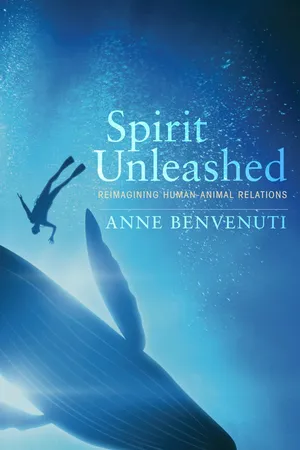
In Spirit Unleashed, Anne Benvenuti uses analysis of real encounters with wild animals to take us on an intellectual tour of our thinking about animals by way of biological sciences, scientific psychology, philosophy, and theology to show that we have been wrong in our understanding of ourselves amongst other animals. The good news is that we can correct our course and make ourselves happier in the process. Drawing us into encounters with a desert rattlesnake, an offended bonobo, an injured fawn, a curious whale, a determined woodpecker, and others, she gives us a glimpse of their souls. Benvenuti strongly makes the case that to change the way we think about animals--and our way of relating to them--holds the possibility of changing all life on Earth for the better.
Information
Topic
Teología y religiónSubtopic
Ética y religiónchapter 1
The Great Western Divide, Multiplied
Before I built a wall I’d ask to know
What I was walling in or walling out.
What I was walling in or walling out.
—robert frost, the mending wall1
Encounters with the Very Other
Every summer morning I take my dogs out early, before the heat sets in, to hike up a nearby mountain into wilderness, not a nature preserve but wilderness. The dogs, Bunny and Lexi, rescued Jack Russell terriers, are trained to the command, “On the trail,” or just “Trail.” This morning’s walk was so interesting as to call for understatement. I met up with both death and danger in two separate events within thirty minutes and one mile of each other. Those last few steps back down the mountain, my dogs alive and with me, my heart didn’t know whether to sink down in quiet despair or to beat wildly in fear and joy and the clean, clear desire to live.
Death. I first noticed the beautiful lush gray fur, unusual in our dry scrabble summer heat, and then I noticed the deadness of the animal and the fact that this beautifully furred dead thing was lying in the middle of the trail. This was most unusual because if a coyote or bobcat had killed this little one, it would have been carried off as dinner, and not dumped in the middle of the trail. Just as I processed this thought, I wondered about sickness and noticed that the little rodent was likely a rat, notoriously disease carrying and so perhaps disease killed. My curiosity aroused, I came in for a closer look, first noticing the exquisite round ears; then I saw the puncture on the back of the head, just at the neck juncture. But why would a hunted rat be left to die on the trail? It should have been carried off and quickly munched. I picked it up by the very tip of its long sleek tail to look for other bite marks. There were none. The puncture wound was round and clean and single. Had this little wood rat, of whom the field guide extols its virtue of cleanliness, been shot in the back of the head, executioner style, as the journalists say, for the entertainment of a human? I tossed its dead body into the tall grasses to feed the bellies of other creatures; the ants would probably have done with it before coyotes began their nightly hunt and forage. My heart sank that someone thought this was both fun and his right to do, and worse, that such a thing is considered normal by a great many people, even virtuous given that the victim was a rat.
I could not help but think about this as I walked up and up the steep part of the trail towards the mountain pass with its “singing gate” that the afternoon winds play like a flute. The temperature was in the low seventies, cool for the middle of July in the southern Sierras. I tried not to obsess about the rat and the human, so as to be there for the rest of the show, ridge upon ridge as I looked up towards the mountains, a hawk soaring in the blue bowl of sky, and at eye level oak trees and boulders and tall oat grasses gone dry weeks ago in this very dry year, some blue jays and chickadees darting from tree to tree; and at foot level, cottontail bunnies and quail in abundance, along with a variety of ground squirrels.
I was thinking to have another look at the rat on my way down, so that I could examine that wound again. It seemed so preposterous that anyone would execute a rat. I was thinking so much about that little rat that I did not notice when I reached the singing gate, when I turned back down the mountain. And I was thinking about the rat when I came around the bend to see a rattlesnake, somewhere between four and five feet in length, fat and sleek, sprawled across the trail. I watched my dog Bunny run right over the big snake, and then stop curious on the other side, looking back at me, even as my smaller dog Lexi ran towards the snake from behind me.
The snake began to coil. I had to get Bunny contained. I did not want her in a prolonged dance with this snake. She would certainly not survive multiple strikes. I had to get to her. But the snake was between us.
As Lexi catches up to me, I scoop her up into my right arm, looking, assessing, strategizing, thinking fast. A steeply descending drainage to the right of the trail, a steeply ascending boulder field to the left. There is no way around the snake. Bunny is looking from the snake to me, from me to the snake, trying to decide if she should hunt it. In an instant, I make the decision and I call to her as sharply as I can. “Bunny! Come! Bunny! Come!” Yes, I call her right back over the snake who has not yet rattled but who has moved his head into the air, tongue flicking. I know his little heat sensors will make his aim precise. I know he can move a distance the length of his body in a flash of scales and teeth and venom. I know he is a diamond backed western rattlesnake, responsible for more deaths than any other snake in America, easily agitated and very aggressive. Bunny comes running to me, here she comes flying in the air as the snake’s tongue flicks. I am thinking that I will have to get her past the snake again to get her to the vet immediately, knowing she has been vaccinated for just this moment, wondering if she will survive it.
I watch my dog catapult through the air. The snake is alert, head up and tongue flicking, the several rattles on his tail telling me that he has lived years enough to shed that many skins. My heart is pounding in my chest like the desperate pump that it is, sending adrenaline out to every capillary. But the snake does not strike. He senses the heat of her body as she flies overhead, smells me as I scoop her up with my free arm.
Now I have a dog in each arm and am backing away, heart pounding, thinking, thinking. The snake appears healthy and normal. I have seen enough of his motion to know that he does not have a broken spine, but he is not striking, nor rattling, nor going anywhere, just watching and flicking, still half coiled and half looped across the trail. He is alert and ready, but not agitated, just the boss. And the boss is stretched across my only way out. One thing I know about rattlesnakes is that they like to be shown a little respect, make that a lot. I attempt to go through the high grasses and over the boulders on my left, but quickly see that it will be an impossible climb with a dog in each arm, and I will lose sight of the snake while still being very near to it, not to mention that there might well be more snakes in those rocks, given that snakes like to den together. I return to the trail, assessing, waiting. I finally decide that I have to walk on the trail, even though it is not wide enough to bypass sir snake. I move slowly toward him, telling him that I have no choice, asking him to make a way for us. I am desperately but calmly and intently thinking, and saying, “Come on, let us through, snake; mister snake, I need you to let us through.”
He reaches his head higher, flicks that tongue one more time, and then slowly glides off towards the boulders, not leaving the trail entirely but giving us leave to pass. Yes, the snake gave us leave to pass; and pass we did, respectfully.
For a two full minutes I was 100 percent engaged with the world around me, mindfully present indeed, gift of a snake. Go ahead: try now to stay mindfully present for two full minutes. You see? It is no small gift.
The Great Western Divide
Going beneath the surface of what happened to the four of us, the encounter leads me to a simple but far from easy question: how shall we conceptualize it? Was it a story of a human controlling three animals? Was it a human, two domesticated mammals, and a reptile? How about one western diamond backed rattlesnake, two Jack Russell terriers, and me? Was it four animals who inhabit the same world yet are utterly alien to one another? Or four sets of mechanical operations, with preset instructions? The questions each represent common ways of conceptualizing what happened on the trail, some of them more common than others.
At first glance, the cognitive framing may not seem to matter so long as I get out alive, with my living dogs. However, I think that the cognitive framing makes all the difference in the world, both to me in that specific situation, and to us as humans who share the planet with other animals, and of course it makes a difference to those other animals.
I have gradually come to see that almost everything I was taught about animals, and a great deal of what I was taught about humans, is wrong: wrong as in incorrect, and wrong as in morally wrong, having deleterious consequences for the animals and for the humans. Another thing I have learned is how easy it is to be wrong. A human did not execute that exceptionally pretty and very clean wood rat that I had found a mile before the rattlesnake on the way up; the punctured rat was the abandoned breakfast of the first snake I might have encountered but did not. I did not understand this until after I got home, then it was the light bulb with the “Aha!” sign. I was relieved to have been wrong.
I live in the Sierra Nevada mountains of California, home of the famous giant Sequoia trees. Very near to the magnificent Sequoia groves is another magnificent feature, enhanced for tourists with pull-over stations and signs that point them to the view: the Great Western Divide, a sub-range of 13,000-foot peaks that separate the river drainages and cause the waters to flow in opposite directions.
These peaks come to mind as I consider the conceptual great divide between humans and other animals in the Western world. It is a pun, of course, a kind of mental Great Western Divide; but it too has causal effects, channeling the waters of thought and behavior in culturally specific directions. From the earliest writings of Western civilization onward is found the idea that humans are the apex of creation, different from and superior to a...
Table of contents
- Title Page
- Preface
- Acknowledgments
- Chapter 1: The Great Western Divide, Multiplied
- Chapter 2: Other Nations: Thinking in terms of Multiplicity of Being
- Chapter 3: What a Piece of Work Is Man, the Thinking Thing
- Chapter 4: Lost in Thought: Human Psychology
- Chapter 5: The Tune Without the Words
- Chapter 6: Spirit Unleashed: Becoming Homo Sapiens
- Bibliography
Trusted by 375,005 students
Access to over 1.5 million titles for a fair monthly price.
Study more efficiently using our study tools.
Frequently asked questions
Yes, you can cancel anytime from the Subscription tab in your account settings on the Perlego website. Your subscription will stay active until the end of your current billing period. Learn how to cancel your subscription
No, books cannot be downloaded as external files, such as PDFs, for use outside of Perlego. However, you can download books within the Perlego app for offline reading on mobile or tablet. Learn how to download books offline
Perlego offers two plans: Essential and Complete
- Essential is ideal for learners and professionals who enjoy exploring a wide range of subjects. Access the Essential Library with 800,000+ trusted titles and best-sellers across business, personal growth, and the humanities. Includes unlimited reading time and Standard Read Aloud voice.
- Complete: Perfect for advanced learners and researchers needing full, unrestricted access. Unlock 1.5M+ books across hundreds of subjects, including academic and specialized titles. The Complete Plan also includes advanced features like Premium Read Aloud and Research Assistant.
We are an online textbook subscription service, where you can get access to an entire online library for less than the price of a single book per month. With over 1.5 million books across 990+ topics, we’ve got you covered! Learn about our mission
Look out for the read-aloud symbol on your next book to see if you can listen to it. The read-aloud tool reads text aloud for you, highlighting the text as it is being read. You can pause it, speed it up and slow it down. Learn more about Read Aloud
Yes! You can use the Perlego app on both iOS and Android devices to read anytime, anywhere — even offline. Perfect for commutes or when you’re on the go.
Please note we cannot support devices running on iOS 13 and Android 7 or earlier. Learn more about using the app
Please note we cannot support devices running on iOS 13 and Android 7 or earlier. Learn more about using the app
Yes, you can access Spirit Unleashed by Anne Benvenuti in PDF and/or ePUB format, as well as other popular books in Teología y religión & Ética y religión. We have over 1.5 million books available in our catalogue for you to explore.