eBook - ePub
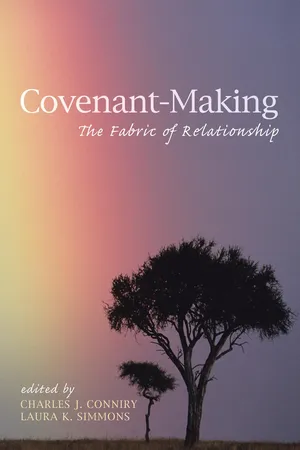
Covenant-Making
The Fabric of Relationship
- 198 pages
- English
- ePUB (mobile friendly)
- Available on iOS & Android
eBook - ePub
About this book
This collection explores the central theological notion of covenant. It has been produced in honor of Dr. R. Larry Shelton, respected scholar and beloved husband, father, colleague, and friend. Covenant--the unifying theme of this book--is a subject to which Dr. Shelton devoted considerable attention over his forty-five-year career as a scholar and teacher. His 2006 book, Cross and Covenant: Interpreting the Atonement for 21st Century Mission, stands as one of the most incisive treatments of the atonement from a covenantal perspective. The contributors of this volume consist of Shelton's current colleagues at George Fox Evangelical Seminary, those with whom he served in other institutions, and friends and former students whose vision of covenant Shelton inspired. These writers demonstrate that whether one considers such diverse subject matter as atonement theory, the church's mission, the discernment of (prophetic) spirits, non-western ontologies, soteriology, biblical interpretation, sanctification, theodicy, family life, or theology proper, one's understanding is deficient without giving due consideration to the role of covenant relationality.
Information
Subtopic
Église chrétienne1
The Man behind the Curtain
Who Is This Covenant Theologian?
In the classic story, The Wizard of Oz, Dorothy and her friends travel to the Emerald City to have an audience with the Great and Powerful Wizard. They each have a request and each meets the Wizard, who appears to them in a variety of astonishing and terrifying forms. The Wizard has a reputation for his wisdom and his ability to work wonders, and they believe he can solve their problems. In the end, they discover that the real Oz behind the curtain is an ordinary man from Omaha, Nebraska.
The Wizard is akin to the world of academics. He has an impressive name: Oscar Zoraster Phadrig Issac Norman Henkel Emmannuel Ambroise Diggs. Academics cultivate impressive “names” by detailing their accomplishments in curricula vitae (CV). William H. Bergquist and Kenneth Pawlak, in their book Engaging the Six Cultures of the Academy, note that the academy culture is a world “with a strong emphasis on often subtle but nevertheless quite powerful competition and striving for prestige and dominance.”1 Academicians cultivate their CVs and use them as brands for their accomplishments and status.
Though the curricula vitae become a testimony to greatness and wonders, they do little to reveal much about the true character of the academic behind the curtain. This can create an unhealthy and false self, which is presented to students and faculty while the true self stays hidden behind the curtains. This is especially troubling for those who are Christian academics and who desire to emulate the servant leadership of Jesus. The purpose of this chapter is to pull back the curtain and reveal one academic, Dr. Larry Shelton, born in Hooper’s Creek, North Carolina, on January 10, 1942. He is an accomplished academic who has put more value on moral authenticity than accomplishments in the academy; thus, he has influenced with his life and not just his words.
Larry Shelton has served in Christian higher education for 45 years, beginning as an Assistant Professor of Religion at Azusa Pacific University in California and ending his teaching career as the Richard B. Parker Professor of Wesleyan Theology at George Fox Evangelical Seminary. Throughout his career he had a unique trifecta of callings. He not only excelled as a scholar, but as a teacher and academic administrator, and as a church pastor.
Shelton is an ordained elder in the Free Methodist church, having served in various pastoral roles including ministry with the Foursquare church, while he worked full-time as a theologian and professor. Shelton also served tirelessly in various administrative roles as a Board member for several Christian camps, in various Free Methodist district positions, and in service to various Christian colleges and universities as department chair or dean. He is committed to promoting those whose voices are marginalized, such as women called to ministry and Latino and Native American leaders and scholars. He is also a devoted husband and father.
From the beginning, Shelton showed promise as a scholar. He graduated as the class valedictorian from Pfeiffer College, where he majored in English and minored in psychology. He received a Master of Divinity and a ThM in Biblical Liturature from Asbury Theological Seminary, studying under George Turner and Robert A. Traina and graduating number one in his class. He went on to complete a ThD in Historical Theology at Fuller Theological Seminary. Calvin Shoehoven and Geoffrey W. Bromiley were his advisors, with Bromiley serving also as his mentor. Shelton graduated with a doctoral major in the History of Hermeneutics, primarily under the guidance of Bromiley, and he completed a doctoral minor in New Testament Theology under George Eldon Ladd. He also completed a minor in Christian Ethics under Lewis B. Smedes. Shelton finished his doctorate in five years, writing his dissertation on Martin Luther’s Concept of Biblical Interpretation in Historical Perspective. He published three articles out of that material, and it formed the backbone of his academic work.
Shelton’s scholarship includes an important book on covenant theology titled Cross and Covenant: Interpreting the Atonement for 21st Century Mission (Paternoster, 2006). His scholarship is purposed towards the church. David Wilson wrote in a review of the book, “Cross and Covenant is a fresh and thought-provoking contribution to contemporary soteriology and mission. It is not, however, merely the outline of yet another theory of the atonement. Larry Shelton’s own exegetical and biblical-theological intent persists in its implications for mission and praxis where the focus of theology remains in the life of the church as God’s covenant community.”2
Academics lead with their research and teaching; Shelton has led as a theologian, pastor, and administrator. Much of the current leadership literature and research understands the flawed approach of focusing on the “great man or woman,” “the Wizard,” and his or her accomplishments. This has proven to be an insufficient understanding of leadership illustrated by the many spectacular moral failures of prominent leaders, pastors, and academicians. When the “great-man-or-woman show” collapses, we see that the person behind the curtain is deeply flawed.
Howard Gardner, professor at Harvard Graduate School, wrote in Five Minds for the Future about the importance and nature of the ethical mind. His premise is that because we are living in times of tremendous change and global challenges, we need leaders in business and schools who have the capacity to learn and think differently than leaders have in the past. He proposes five particular cognitive abilities, one of them being the ethical mind.3 He and his research team found that leaders with an ethical mind:
1) Had parents who raised their children in an environment where morals and open-mindedness were normative;
2) Had values that were not undermined during their school and early adult years;
3) Believed in the mission of their organizations and were able to overcome odds for the benefit of the organizations;
4) Had mentors or were influenced by anti-mentors (persons they didn’t want to emulate);
5) Were able to speak truth to power, consulting with others and being prepared to resign or be fired in the process; and
6) At the end of the day would do the right thing to contribute to improving conditions in the world.4
I spent seven hours interviewing Larry Shelton; the interviews were taken verbatim and checked for accuracy with him. He thought the interviews were in preparation for my part in his retirement party.5 I began asking him to tell the story of his life and then I concluded with some specific questions about theological education, the church, and his legacy. From these interviews, I will illustrate each of the above six points by using representative stories from Shelton’s life to illustrate his ethical mind; he is a covenant theologian who speaks and walks as one.
Has an Ethical and Open-Minded Upbringing
Bernard Bass and Ronald Riggio, in Transformational Leadership, reviewed the research literature on the correlation of one’s family upbringing to having a transformational leadership style.6 They wrote, “Highly transformational executives came from families who stressed high standards of excellence along with strong, supportive homes.”7 Persons who grew up with moral and spiritual values as a consistent part of their home life are less likely to act unethically as leaders. Shelton was the only child in a family of ministers in the Wesleyan Holiness tradition:
My life story begins before I was born. Dad grew up in the Appalachian Mountains in Eastern Kentucky in a family of 8. His mother died when his youngest sister was 11 days old. Father was a mountain preacher and circuit rider, a farmer and brick maker. His mother died during the depression and the family was destitute. My dad, Raymond Samuel Shelton, began preaching when he was 16 in the mountains. He went to God’s Bible School in Cincinnati. My dad was in the Pilgrim Holiness tradition. My mother was born in Hendersonville, NC. She grew up and went to college at Marion College Wesley Methodist, and became a teacher. She was a devoted Christian and committed to the church her whole life. She was a leader, an ordained deaconess in the Wesleyan Methodist Church.
We lived in Winnsboro, South Carolina. We went to different churches and my dad preached from point to point. My mother sang and played the piano. I grew up in the very inner belly of the church and that’s really the core of the life that I knew. And though the church I grew up in was part of a very legalistic holiness movement known for its notion of separateness, I learned how to find ways around the legalism.
I was an only child. It was a lot of pressure, though I didn’t perceive it. I was inwardly motivated. I wasn’t greatly athletic, but I could hold my own. In wrestling I always won my weight class in Physical Education, but I couldn’t go out for a team because competitive sports were worldly. I remember in 9th grade I realized that I couldn’t go to football or baseball games because they were worldly amusements. But if there was a practical purpose connected to education that required me to go, then I could go. So I decided to join the band so I could go to the ball games. I decided to play the clarinet and learned to play. For 3 years I played in the HS band and went to most of the games and had a great time.
When I was a senior and was going to order class rings, it was worldly apparel, so it became an issue for those in our church. We had an active youth group and my mother was the force behind it. We couldn’t get the rings. I found out that they had class pins. The issue wasn’t the gold but wearing something around the finger, so we proposed to church elders that we order class pins and they approved it.
During the summer between high school and college I came to a real faith renewal. I began to realize that I needed to rethink my values. God was working with me in different ways. I made a definite recommitment to the calling God wanted for my life. I needed to go in the direction of becoming a minister. My mom and dad were ecstatic: “Thank you Jesus, the prodigal has come home.” I always knew what they preferred and what they sensed about my direction, but they never did try to interfere or influence my choices even after I entered the ministry.
Larry Shelton was beloved of his parents and they did not try to force him in any one direction professiona...
Table of contents
- Title Page
- Foreword - Charles J. Conniry Jr.
- Introduction - Laura K. Simmons
- Chapter 1: The Man behind the Curtain - MaryKate Morse
- Chapter 2: Finding a Home in Shelton’s Vision of the Atonement - Steve Sherwood
- Chapter 3: Participation and Dignity - David R. Wilson
- Chapter 4: Creation’s Cry against Shallow Shalom - Steve Delamarter
- Chapter 5: Did Jesus or Custer Die for Our Sins? - Randy S. Woodley
- Chapter 6: The Salvation of a “Sinister Kid” - Robert W. Wall
- Chapter 7: The Kerygmatic Covenant - Eugene E. Lemcio
- Chapter 8: Rehabilitating Good Works - Kent L. Yinger
- Chapter 9: Suffering, Creation, and Luther’s Theologia Crucis - Daniel L. Brunner
- Chapter 10: Covenantal Responses after Nine Minutes of Horror in Newtown - Susie C. Stanley
- Chapter 11: Marriage as a Metaphor for God’s Covenant Love and Faithfulness - Clifford W. Berger
- Chapter 12: Theologians in Covenant - A.J. Swoboda
- Afterword - Leonard I. Sweet
- Bibliography
Trusted by 375,005 students
Access to over 1.5 million titles for a fair monthly price.
Study more efficiently using our study tools.
Frequently asked questions
Yes, you can cancel anytime from the Subscription tab in your account settings on the Perlego website. Your subscription will stay active until the end of your current billing period. Learn how to cancel your subscription
No, books cannot be downloaded as external files, such as PDFs, for use outside of Perlego. However, you can download books within the Perlego app for offline reading on mobile or tablet. Learn how to download books offline
Perlego offers two plans: Essential and Complete
- Essential is ideal for learners and professionals who enjoy exploring a wide range of subjects. Access the Essential Library with 800,000+ trusted titles and best-sellers across business, personal growth, and the humanities. Includes unlimited reading time and Standard Read Aloud voice.
- Complete: Perfect for advanced learners and researchers needing full, unrestricted access. Unlock 1.5M+ books across hundreds of subjects, including academic and specialized titles. The Complete Plan also includes advanced features like Premium Read Aloud and Research Assistant.
We are an online textbook subscription service, where you can get access to an entire online library for less than the price of a single book per month. With over 1.5 million books across 990+ topics, we’ve got you covered! Learn about our mission
Look out for the read-aloud symbol on your next book to see if you can listen to it. The read-aloud tool reads text aloud for you, highlighting the text as it is being read. You can pause it, speed it up and slow it down. Learn more about Read Aloud
Yes! You can use the Perlego app on both iOS and Android devices to read anytime, anywhere — even offline. Perfect for commutes or when you’re on the go.
Please note we cannot support devices running on iOS 13 and Android 7 or earlier. Learn more about using the app
Please note we cannot support devices running on iOS 13 and Android 7 or earlier. Learn more about using the app
Yes, you can access Covenant-Making by Charles J. Conniry Jr.,Laura K. Simmons, Conniry, Simmons in PDF and/or ePUB format, as well as other popular books in Théologie et religion & Église chrétienne. We have over 1.5 million books available in our catalogue for you to explore.