eBook - ePub
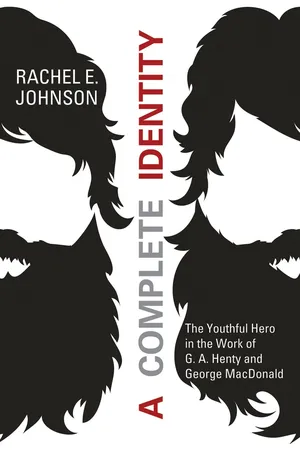
A Complete Identity
The Youthful Hero in the Work of G. A. Henty and George MacDonald
- 256 pages
- English
- ePUB (mobile friendly)
- Available on iOS & Android
eBook - ePub
A Complete Identity
The Youthful Hero in the Work of G. A. Henty and George MacDonald
About this book
This book offers an examination of the hero figure in the work of G. A. Henty (1832-1902) and George MacDonald (1824-1905) and a reassessment of oppositional critiques of their writing. It demonstrates the complementary characteristics of the hero figure which construct a complete identity commensurate with the Victorian ideal hero.
The relationship between the expansion of the British Empire and youthful heroism is established through investigation of the Victorian political, social, and religious milieu, the construct of the child, and the construct of the hero. A connection between the exotic geographical space of empire and the unknown psychological space is drawn through examination of representation of the "other" in the work of Henty and MacDonald.
This book demonstrates that Henty's work is more complex than the stereotypically linear, masculine, imperialistic critique of his stories as historical realism allows, and that MacDonald's work displays more evidence of historical embedding and ideological interpellation than the critical focus on his work as fantasy and fairy tale considers.
Greater understanding of the effect of this heroic ideal on nineteenth-century society leads to a greater understanding of the implications for subsequent children's literature and Western cultures, including that of the twenty-first century.
Information
1
My Hero
Method and Text
A key to the construct of the hero figure in the nineteenth century lies in the realms of both the real and the imagined. The image as an ideal represents a combination of both these aspects of the figure. I begin my investigation of the construct of the image of the hero with an analysis of story and character in terms of the ideological implications of genre.
Method
G. A. Henty and George MacDonald are cited as writing not only in different but in opposing genres, that is, historical/realism as opposed to fantasy/fairy tale. The extent of this perceived difference can be gauged from Hugh Walpole’s comment in 1926, on writing for children, “. . . children divide into the two eternal divisions of mankind, . . . Romantics and Realists, Prosists . . . and Poets, Business Men and Dreamers, Travellers and Stay-at-Homes, Exiles and Prosperous Citizens. . . . I fancy that all the children of my day who gloried in Henty were Realists and Hans Andersen was for the others.”1 Walpole makes clear that his reference to Andersen is representative of fairy tale writers or retellers. The continued critique in terms of opposition is evident in John Stephens’ statement that the distinction between realism and fantasy is “the single most important generic distinction in children’s fiction.”2 These quotations demonstrate the enduring nature of the perceived gulf between writing critiqued as realism and writing critiqued as fantasy or fairy tale. My intention is to interrogate this oppositional categorization with reference to the work of Henty and MacDonald and to demonstrate the mixing of genre apparent in the narrative structures of their writing. I examine this narrative structure from the position of generic conventions previously determined by critics so that I may investigate the structure as a vehicle to convey ideology and values. Critical opinion from F. J. Harvey Darton (1932)3 through Guy Arnold (1980), Humphrey Carpenter and Mari Pritchard (1984)4 to William Potter (2000)5, categorizes Henty’s writing as historical adventure story within the broader genre of realism. Critics contributing to works on the history of children’s literature such as those cited above have drawn on previous histories thereby perpetuating the stereotypical criticism of Henty’s work, using the same texts as examples. The exception to this predominant critique is Dennis Butts (1992), who notes the aspects of romance in Henty’s stories.
The most critiqued stories in MacDonald’s writing for children are those categorized as fantasy and fairy tale, for example At the Back of the North Wind, The Golden Key, The Wise Woman, The Princess and the Goblin, and The Princess and Curdie. Specialist studies such as The Bright Face of Danger: An Exploration of the Adventure Story by Margery Fisher, and Fairy Tales and the Art of Subversion by Jack Zipes, have furthered the categorical generic distinctions between Henty and MacDonald.
It therefore appears that the genres represented by Henty and MacDonald are so different that readers are expected by the critic to approach them with differing expectations based upon their knowledge of the conventions of the two broad categorizations of realism and fantasy. The assumption that Henty is a realistic children’s writer because of his historical approach and his description of specific battles, causes the reader to focus on this aspect of the text rather than on the narrative structure to be found in the progress of the hero through this realistic landscape. MacDonald’s writing for children, critiqued as fantasy and fairy tale, challenges conventional categorization. For example, in the instances where fantasy and realism intertwine, such as At the Back of the North Wind (1871), critiqued predominantly as fantasy, and A Rough Shaking (1891), in which the critical emphasis is on realism. Walpole noted the preference for realism in the active, out-going child, a stereotypical perception of the male reader and aligning with the assumed audience of Henty. The “dreamers . . . and stay-at-homes”6 who read fairy tales are aligned with the stereotypical perception of the female reader. Appealing to a more passive audience who live in the world of the imagination, the fairy tale is seen to appear less threatening to the status quo. Yet the way in which the author structures the narrative in order to present reality to the reader carries ideological implications. The apparent lack of political threat from the fairy tale resulted in its use as a vehicle for societal critique, a precedent set in seventeenth-century France with the development of the literary fairy tale. The way the text interweaves with the dominant or subordinate discourse and draws on familiar narrative patterns to enhance the process of what Louis Althusser has described as interpellation,7 that is, the drawing-in of the reader to the ideological position of the text, is therefore significant.
Whilst “every use of language carries freight, a freight of what I am calling ‘values’ and others might call ‘ideology,’”8 the writing of Henty and MacDonald was intended to carry value-laden “freight.” They wrote with the intention of not only engaging the attention of young readers, none of whom were divided in their preference for enjoyable stories, but with the stated objective of educating the reader. Henty began the majority of his stories with a short preface in which he stated his intention “to mix instruction with amusement,”9 specifying which part of the story was historical “fact” and which part fiction. He also encouraged emulation of the hero with a view to success in life, success in this instance majoring on character development and work ethic. The influence of this intent on contemporary decisions to reprint the work of Henty and MacDonald is primary. In the preface to The Boy’s Guide to the Historical Adventures of G. A. Henty, Schmitt notes, “the rich legacy which Mr Henty left to the boys of the world.”10 The author of this book spells out this “rich legacy” in terms of how the Henty hero behaves and the need for such role models in the context of contemporary children’s literature. Johannesen Printing and Publishing, who reprint the work of George MacDonald, also emphasize the ethical benefits of reading MacDonald. His books are advertised as, “Century-old literature that transcends time, culture and history . . . stimulating higher, nobler & pure...
Table of contents
- Title Page
- Foreword - Jean Webb
- Preface
- Acknowledgements
- Introduction
- Chapter 1: My Hero
- Chapter 2: Historical Context
- Chapter 3: Genre, Mode, and Ideology
- Chapter 4: Child and Hero
- Chapter 5: The Construct of the Hero 1850–1900
- Chapter 6: The Ideology of the Hero and the Representation of the “Other”
- Chapter 7: My Hero
- Bibliography
Trusted by 375,005 students
Access to over 1.5 million titles for a fair monthly price.
Study more efficiently using our study tools.
Frequently asked questions
Yes, you can cancel anytime from the Subscription tab in your account settings on the Perlego website. Your subscription will stay active until the end of your current billing period. Learn how to cancel your subscription
No, books cannot be downloaded as external files, such as PDFs, for use outside of Perlego. However, you can download books within the Perlego app for offline reading on mobile or tablet. Learn how to download books offline
Perlego offers two plans: Essential and Complete
- Essential is ideal for learners and professionals who enjoy exploring a wide range of subjects. Access the Essential Library with 800,000+ trusted titles and best-sellers across business, personal growth, and the humanities. Includes unlimited reading time and Standard Read Aloud voice.
- Complete: Perfect for advanced learners and researchers needing full, unrestricted access. Unlock 1.5M+ books across hundreds of subjects, including academic and specialized titles. The Complete Plan also includes advanced features like Premium Read Aloud and Research Assistant.
We are an online textbook subscription service, where you can get access to an entire online library for less than the price of a single book per month. With over 1.5 million books across 990+ topics, we’ve got you covered! Learn about our mission
Look out for the read-aloud symbol on your next book to see if you can listen to it. The read-aloud tool reads text aloud for you, highlighting the text as it is being read. You can pause it, speed it up and slow it down. Learn more about Read Aloud
Yes! You can use the Perlego app on both iOS and Android devices to read anytime, anywhere — even offline. Perfect for commutes or when you’re on the go.
Please note we cannot support devices running on iOS 13 and Android 7 or earlier. Learn more about using the app
Please note we cannot support devices running on iOS 13 and Android 7 or earlier. Learn more about using the app
Yes, you can access A Complete Identity by Rachel E. Johnson in PDF and/or ePUB format, as well as other popular books in Literature & 19th Century History. We have over 1.5 million books available in our catalogue for you to explore.