eBook - ePub
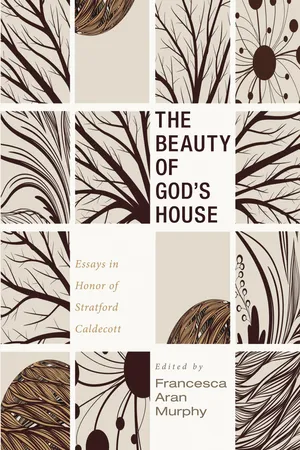
The Beauty of God’s House
Essays in Honor of Stratford Caldecott
- 306 pages
- English
- ePUB (mobile friendly)
- Available on iOS & Android
eBook - ePub
About this book
For thirty years, Stratford Caldecott has been an inspirational figure in liturgy, fantasy literature, graphic novels, spirituality, education, ecology and social theory. Hundreds of people have learned from his spiritual approaches to the great existential questions. The Beauty of God's House is a Festschrift dedicated to him. The book seeks to cover the whole range of Caldecott's interests, from poetics to politics. Anyone interested in the field of theology and the arts will find much to intrigue them in this delightful multi-authored volume. The common core of Stratford's interests is in the beauty of the cosmos and how it reflects the beauty of God. This book is about the beauty of God's "realm," and it conceives God's realm as the arts, politics, liturgy, religions, and human life. It touches on the many places where beauty and spirituality overlap. It is an engagement in theological aesthetics that goes well beyond the "aesthetic."
Information
Topic
Teologia e religioneSubtopic
Estetica in filosofia1
It Is a Wonder, How Much the Clay Can
Be Imprinted with the Beauty of Its Potter!
Saint Ephrem the Syrian, Hymns on Virginity, XXV
The authentic hymns of Saint Ephrem of Nisibis, or Saint Ephrem the Syrian as he is more widely known, are considered today among the best pieces of Christian theological poetry ever written. Saint Ephrem, who lived in the fourth century (between roughly 306–373 AD) in northern Mesopotamia, in Nisibis and Edessa—the modern-day cities of Nusaybin and Urfa, in eastern Turkey—was considered in his own era “the harp of the Holy Spirit.”2 Even in our time, Robert Murray SJ, a leading scholar of early Syriac theology and literature, has written that Ephrem is “the greatest poet in the Patristic period, and perhaps the only poet theologian to be placed next to Dante.”3 Interestingly, Hans Urs von Balthasar does not include him in his list of great poet-theologians in the Christian tradition studied in volumes 2 and 3 of Herrlichkeit, a list that includes, besides Dante, Saint John of the Cross, Charles Péguy, and Gerard Manley Hopkins. I have the impression that Balthasar only came to know Ephrem when these volumes of Herrlichkeit were already well on their way or almost finished (the first quotation of Ephrem’s works appears in volume 6, and the way it is introduced in a footnote looks very much as a discovery),4 and I often think that if he had known Ephrem’s works before, he would have doubtless included him among his collection of great Christian writers for whom the glory of God—the infinite beauty of God manifested in the beauty of God’s love—is a major theme, first in their Christian experience and then in their poetic language. For Saint Ephrem, indeed, this is not only a major theme: it is the theme of his writing. When I have tried to think about a phrase that would present a synthesis of his theology, it is this one that comes to my mind: “The Lord’s glory, or the divine in the flesh.” Saint Ephrem is really the poet of the sacramentality of all creation, as the necessary implication of the incarnation of the Son of God. This sacramentality is a perception most strange to the modern worldview (and also, for this reason, one of the most needed if modernity is to be saved from its own self-destructive forces). In Ephrem’s view, it is this sacramental sense of creation that unites the whole work of God in creation and redemption, in nature and grace, leaving no space for any dualism, ancient or modern. This divine presence in the flesh, and indeed in the whole material world, happens in Ephrem’s view in various ways and degrees: its summit (the princeps analogatum) is the physical body of Christ himself, inhabited by the Logos. This presence is mysteriously prolonged in the waters of baptism, or in his body and blood in the Eucharist. Then there is also Mary and the church (the church as a whole and every single member of the church), where he also dwells. His presence in the church is truly a mysterious one, just as that presence is mysterious in the Eucharist, although in a different way and in different degrees. Just to give one example of this, let me quote this stanza of his hymn De Fide XIV, 5. Saint Ephrem is singing about the eucharistic celebration:
The soul is Your bride; the body too is Your bridal chamber,
Your guests are the senses and the thoughts.
And if a single body is a wedding feast for You,
How great is Your banquet with the whole Church!5
Finally, there is his presence in history and in nature. He is present first of all in history, that is, especially in the symbols, types, images, and titles of the Old Testament. But also contemporary history is judged in the light of Christ’s presence: good examples of this are the “Carmina Nisibena I–XII,” on the difficulties and sieges suffered by the city of Nisibis, harassed by the Persians between 337–361 AD, and the hymn “Against Julian” (the Apostate), written in 363 AD, on the occasion of Julian’s corpse passing through Nisibis, and the city being handed over to the Persians in the peace treaty that followed the emperor’s defeat. In both these instances, as true heir of the prophetic tradition of the Old Testament, which saw history from God’s covenant with Israel, Ephrem sees all the events of history from their fulfillment in Christ. As regards nature, Christ is also present in the things and events of nature, whose silent language speaks permanently about him. They not only speak about Christ, they in some way contain him. Also, the realities of nature constitute symbols full of Christ to those who look with the “luminous eye” of faith. Saint Ephrem has been able to compare the Lord’s Incarnation in the womb of the Virgin Mary with his incarnation in the realities of nature. He could write, without the slightest reticence, “Creation was pregnant with the symbols of Christ, like Mary had been pregnant with His members.”6
Of course, this small paper is not the place to make any introduction to Saint Ephrem’s hymns or to his other works, and even less to his theology, which is quite articulate and complex. On the other hand, there are several excellent introductions in English relating to his biography, to the cultural context in which he lived, to his ways of thinking, and even to his theological methods.7 My goal in this paper is just to offer an English version of one of his beautiful hymns, one in which some of his theological themes appear in quite a creative manner, and to add some comments to my English version of it.
In his efforts to maintain and foster the communion of the Syriac-speaking church with the main body of the Nicaean church in the cultural melting pot of Mesopotamia, Ephrem struggled with four main difficulties, two ...
Table of contents
- Title Page
- Contributors
- Introduction
- Chapter 1: It Is a Wonder, How Much the Clay Can Be Imprinted with the Beauty of Its Potter! - Francisco Javier Martínez
- Chapter 2: The Beauty of Being Christian - Marc Ouellet
- Chapter 3: The Loss of Beauty and the De-naturing of Faith - D.C. Schindler
- Chapter 4: An Observation about Saint Thomas Aquinas's Idea of the Intellect - Jean Borella
- Chapter 5: Wisdom Has Built Her Beautiful House for Liturgy - David W. Fagerberg
- Chapter 6: Eating Fire and Spirit - Nicholas J. Healy Jr.
- Chapter 7: "Wisdom Hath Builded Herself a House" (Prov 9:1) - Adrian Walker
- Chapter 8: Health and Hope - Michael Cameron
- Chapter 9: Stratford Caldecott - Mary Taylor
- Chapter 10: Beyond the Binary Logic of Market-Plus-State - David L. Schindler
- Chapter 11: The Politics of the Soul - John Milbank
- Chapter 12: The New Atheism and Christian Cosmology - Aidan Nichols
- Chapter 13: Many Mansions in My Father's House - Reza Shah-Kazemi
- Chapter 14: What Is the Place of the Nude in Sacred Art? - David Clayton
- Chapter 15: Newman for a New Generation - Carol Zaleski
- Chapter 16: The Prayer of Saint Francis and the Grammar of Communion - Derek Cross
- Chapter 17: Stratford Caldecott - Philip Zaleski
- Bibliography
Trusted by 375,005 students
Access to over 1.5 million titles for a fair monthly price.
Study more efficiently using our study tools.
Frequently asked questions
Yes, you can cancel anytime from the Subscription tab in your account settings on the Perlego website. Your subscription will stay active until the end of your current billing period. Learn how to cancel your subscription
No, books cannot be downloaded as external files, such as PDFs, for use outside of Perlego. However, you can download books within the Perlego app for offline reading on mobile or tablet. Learn how to download books offline
Perlego offers two plans: Essential and Complete
- Essential is ideal for learners and professionals who enjoy exploring a wide range of subjects. Access the Essential Library with 800,000+ trusted titles and best-sellers across business, personal growth, and the humanities. Includes unlimited reading time and Standard Read Aloud voice.
- Complete: Perfect for advanced learners and researchers needing full, unrestricted access. Unlock 1.5M+ books across hundreds of subjects, including academic and specialized titles. The Complete Plan also includes advanced features like Premium Read Aloud and Research Assistant.
We are an online textbook subscription service, where you can get access to an entire online library for less than the price of a single book per month. With over 1.5 million books across 990+ topics, we’ve got you covered! Learn about our mission
Look out for the read-aloud symbol on your next book to see if you can listen to it. The read-aloud tool reads text aloud for you, highlighting the text as it is being read. You can pause it, speed it up and slow it down. Learn more about Read Aloud
Yes! You can use the Perlego app on both iOS and Android devices to read anytime, anywhere — even offline. Perfect for commutes or when you’re on the go.
Please note we cannot support devices running on iOS 13 and Android 7 or earlier. Learn more about using the app
Please note we cannot support devices running on iOS 13 and Android 7 or earlier. Learn more about using the app
Yes, you can access The Beauty of God’s House by Francesca Aran Murphy, Murphy in PDF and/or ePUB format, as well as other popular books in Teologia e religione & Estetica in filosofia. We have over 1.5 million books available in our catalogue for you to explore.