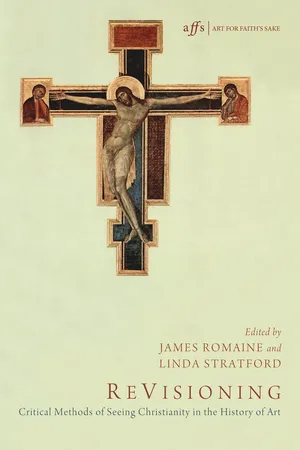
eBook - ePub
ReVisioning
Critical Methods of Seeing Christianity in the History of Art
- 376 pages
- English
- ePUB (mobile friendly)
- Available on iOS & Android
eBook - ePub
ReVisioning
Critical Methods of Seeing Christianity in the History of Art
About this book
ReVisioning: Critical Methods of Seeing Christianity in the History of Art examines the application of art historical methods to the history of Christianity and art. As methods of art history have become more interdisciplinary, there has been a notable emergence of discussions of religion in art history as well as related fields such as visual culture and theology. This book represents the first critical examination of scholarly methodologies applied to the study of Christian subjects, themes, and contexts in art.
ReVisioning contains original work from a range of scholars, each of whom has addressed the question, in regard to a well-known work of art or body of work, "How have particular methods of art history been applied, and with what effect?" The study moves from the third century to the present, providing extensive treatment and analysis of art historical methods applied to the history of Christianity and art.
Information
Part I
Methodological Issues of Iconography in Early Christian and Medieval Art

Figure 3. Jonah sarcophagus (Vatican 31448), upper right central scene, third quarter of the 3rd century, marble, 27 ³⁄₁₆ x 87 ¹³⁄₁₆ x 7 ⁷⁄₁₆ in. (69 x 223 x 19 cm). Museo Pio Cristiano of the Vatican Museums, Vatican City. Photo by Linda Fuchs, courtesy of the Vatican Museums.
Iconographic Structure
Recognizing the Resurrected Jesus on the Vatican Jonah Sarcophagus1
Salvation was suggested by André Grabar as the most prominent theme of early Christian art in his 1961 A. W. Mellon Lectures in the Fine Arts.2 While Grabar was the first to introduce this proposition to an American audience, his method of framing early Christian art in association with salvation had been previously discussed in the early twentieth-century work of Joseph Wilpert and Henri Leclercq, and in even earlier observations by Edmond Le Blant.3 As support for this interpretation of early Christian imagery, Le Blant, and those scholars who followed him, cited a ninth-century liturgical prayer, a commendatio animae, which prayed for the dead, “God, deliver him as you delivered Noah from the flood, . . . Daniel from the den of lions, . . . three youths from the burning fiery furnace . . .”4 However, this foundation for salvation as a theme is weak because it rests on a prayer in use six centuries later.5
In his own study, Grabar separated image-signs of early Christian catacombs and sarcophagi into two types: those related to sacraments of the church (baptism and communion) and those suggesting divine intervention for the salvation or preservation of individual believers. This theory that salvation, as rescue from physical peril, was the predominant theme of early Christian art remains a formative paradigm through which its iconography is often interpreted.
More recently, scholars have expanded the terms and themes applied to early Christian art. John Beckwith ascribed resurrection and salvation to catacomb painting, adding “life after death,” which, while closely tied to resurrection, could include more generic visual motifs like pastoral scenes or a meal scene.6 Ernst Kitzinger inclined toward a general theme of “deliverance and security through divine intervention.”7 Thomas Mathews has suggested that “magic provides the first coherent theme of Christian art.”8 He based this primarily on equating miracles of Christ with magic, but less than a tenth of scenes created before Constantine portray miracles of Jesus. Robin Jensen named both the general theme of deliverance or salvation as well as the more specific theme of resurrection.9 She noted that, while initially scholars had stressed religious literary sources over images, other scholars, such as Kitzinger, later sought to disengage images from the literature of religion as much as possible. Jensen rightly suggests that the time has come to incorporate more textual scholarship into the advances made in examining the visual images on their own terms.
Although salvation is a theme that has often been ascribed to third-century Christian funerary art, reading this art in terms of a theme of resurrection may be more useful in identifying and describing early Christian iconography. In Christian theology, salvation refers primarily to the saving of souls from the penalty of sin. However, in the literature on early Christian art, salvation is more often applied to rescue from physical danger, eluding death, or divine intervention in a general sense. To make this case, examples such as Noah saved from the flood and Daniel saved from lions have been cited.
Most third-century Christian art—catacomb painting and sarcophagus relief sculpture—was created for burial purposes. Salvation as rescue from physical peril would not directly address the situation of individuals who have finished their earthly lives. Subjects with resurrection themes would be better suited to this context. For Christians, resurrection represented an outright conquering of death. The Apostle Paul wrote in a letter to Christians in Corinth, “O death, where is your victory?”10 For Christians, the resurrection was a distinctive premise of their faith. In Paul’s previously quoted letter he also wrote, “If there is no resurrection of the dead, then Christ has not been raised; and if Christ has not been raised, then our proclamation has been in vain and your faith has been in vain.”11 As we will see, third-century Christians developed funerary iconography that expressed their hope of resurrection.
For Christian art created before Constantine declared Christianity to be a legal religion of the Roman Empire, the most complete motif census has been prepared by Graydon Snyder.12 More items could perhaps be added, but his census, the single most complete and representative sampling,13 will serve the purposes of this investigation. As this essay will show, when distinctively Christian art begins to flourish in the third century, most of the biblical motifs selected appear to be linked to biblical texts connected with resurrection, a theme suited to Christian burial art.
The figure that appears most frequently in early Christian art is the prophet Jonah. Among known surviving Christian images that precede Constantine’s rule, three episodes of the Jonah story—Jonah resting under the gourd vine, Jonah cast into the sea, and Jonah spewn from the mouth of the sea creature—are the first, second, and third most frequently depicted motifs. Taken together, these three Jonah motifs outnumber all other non-Jonah motifs combined, accounting for about 60 percent of the total images in Snyder’s motif census.14
As a representation of resurrection in early Christian art, the Jonah motif(s) had both biblical and Roman cultural bases. Matthew 12:38–42, 16:4, and Luke 11:29–32 are the key gospel passages in which Jesus referred to his own time-limited burial (“three days in the heart of the earth”) as the “sign of Jonah.”15 Accordingly, Christians understood the iconography of Jonah as a symbol of Jesus’ resurrection and an expression of their own hope. Linked with the burial function of the sarcophagus, Jonah iconography would have been a powerful statement of faith in the resurrection of the dead.
Images of Jonah also reflect a preference in early Christian art for Old Testament subjects. Roman culture valued tradition more than new ways, an outlook reflected in Roman criticism of Christianity as an upstart religion. Christians responded that the holy scriptures of the Jews were also the scriptures of Christians, and that Moses preceded Homer.16 Jews had received the unusual favor of being able to legally practice their religion in the Roman Empire, and Christians sought the same favor on the basis of using the scriptures employed by Jews. When Christians in Rome sought to signal their faith, they wisely chose primarily Old Testament characters and motifs, a practice reflected in third-century Christian catacomb painting and sarcophagus carving.
The association of the predominant Jonah motif with the resurrection of Jesus in the Gospels prompts an investigation of resurrection themes associated with other early Christian art motifs. In fact, 92.8 percent of the images in Snyder’s census may be associated with resurrection.17 After representations of Jonah (59.7 percent), the next 19.4 percent of images depicting frequently occurring subjects (with their resurrection references) are: Noah in the Ark18 (4.4 percent), Daniel19 (3.3 percent), the Baptism of Jesus20 (3.3 percent), Abraham Sacrificing Isaac21 (2.8 percent), the Raising of Lazarus22 (2.8 percent), and Moses Striking the Rock23 (2.8 percent).24 Less frequently depicted motifs which also can be associated with resurrection constitute another 13.7 percent of the total images in Snyder’s census: Adam and Eve, Three Young Men in the Fiery Furnace,25 Multiplication of the Loaves, Women at the Tomb of Jesus, Meeting of the Resurrected Christ, and Moses before the Burning Bush.26
Having located resurrection associations for more than 92 percent of the motifs named in Snyder’s census of Christian art before AD 313, it is possible to build a case study of one of the earliest Christian sarcophagi with multiple Biblical scenes. The Jonah sarcophagus now in the Vatican’s Museo Pio Cristian...
Table of contents
- Title Page
- Acknowledgments
- Expanding the Discourse on Christianity in the History of Art
- Methodological Issues from the Fields of Art History, Visual Culture, and Theology
- Part 1: Methodological Issues of Iconography in Early Christian and Medieval Art
- Part 2: Methodological Issues of Reading Theology in Renaissance and Baroque Art
- Part 3: Methodological Issues of Historical-Religious Context in Nineteenth-, Twentieth-, and Twenty-first Century Art
- Contributors
Trusted by 375,005 students
Access to over 1.5 million titles for a fair monthly price.
Study more efficiently using our study tools.
Frequently asked questions
Yes, you can cancel anytime from the Subscription tab in your account settings on the Perlego website. Your subscription will stay active until the end of your current billing period. Learn how to cancel your subscription
No, books cannot be downloaded as external files, such as PDFs, for use outside of Perlego. However, you can download books within the Perlego app for offline reading on mobile or tablet. Learn how to download books offline
Perlego offers two plans: Essential and Complete
- Essential is ideal for learners and professionals who enjoy exploring a wide range of subjects. Access the Essential Library with 800,000+ trusted titles and best-sellers across business, personal growth, and the humanities. Includes unlimited reading time and Standard Read Aloud voice.
- Complete: Perfect for advanced learners and researchers needing full, unrestricted access. Unlock 1.5M+ books across hundreds of subjects, including academic and specialized titles. The Complete Plan also includes advanced features like Premium Read Aloud and Research Assistant.
We are an online textbook subscription service, where you can get access to an entire online library for less than the price of a single book per month. With over 1.5 million books across 990+ topics, we’ve got you covered! Learn about our mission
Look out for the read-aloud symbol on your next book to see if you can listen to it. The read-aloud tool reads text aloud for you, highlighting the text as it is being read. You can pause it, speed it up and slow it down. Learn more about Read Aloud
Yes! You can use the Perlego app on both iOS and Android devices to read anytime, anywhere — even offline. Perfect for commutes or when you’re on the go.
Please note we cannot support devices running on iOS 13 and Android 7 or earlier. Learn more about using the app
Please note we cannot support devices running on iOS 13 and Android 7 or earlier. Learn more about using the app
Yes, you can access ReVisioning by James Romaine,Linda Stratford, Romaine, Stratford in PDF and/or ePUB format, as well as other popular books in Social Sciences & World History. We have over 1.5 million books available in our catalogue for you to explore.