eBook - ePub
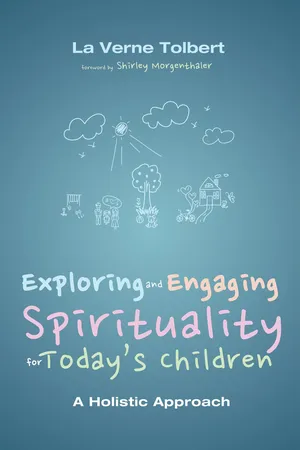
Exploring and Engaging Spirituality for Today’s Children
A Holistic Approach
- 364 pages
- English
- ePUB (mobile friendly)
- Available on iOS & Android
eBook - ePub
About this book
Exploring and Engaging Spirituality for Today's Children: A Holistic Approach answers questions about the most effective ways to help children, pre-teens, and teens develop spiritually. This collection of research gleaned from presentations during the Fourth Triennial Children's Spirituality Conference at Concordia University in 2012 is divided into four major sections: (1) theological and historical foundations, (2) engaging parents and congregations, (3) engaging methodologies, and (4) exploring children at risk, child pornography, social justice, intercultural diversity, and abstinence education.
Researchers acknowledge that the home is the foundation for Christian nurture. In Exploring and Engaging Spirituality for Today's Children, both scholars and ministry leaders come together with parents to promote a holistic environment where children are encouraged to love, respect, and obey God. From birth to high school, children's voices resonate throughout these studies as they are invited to share their reflections and experiences. Exploring and Engaging Spirituality for Today's Children is a lively, easy-to-read collection that reflects a broad range of faith traditions and is ideal for all those who are committed to the spiritual development of children.
Information
Topic
Theology & ReligionSubtopic
Biblical StudiesSECTION TWO
Engaging Parents and Congregations
Chapter 7
Re-Forming a Kingdom Worldview
Exploring Spirituality with Families Through the Christian Church Year
Those of us who have served in church ministry long enough have been witnesses to a monumental paradigm shift for ministry with children, youth and families. From the waning years of the twentieth century to the dawning of the twenty-first we have paddled fast to keep up with the bombardment of cultural values that have buoyed the evangelical church along with the shifting tide of secularization.
An examination of the spiritual lives of the children, youth and families that make up many North American congregations demonstrates the influence of a culture saturated with consumerism, individualism, rights and entitlements, confusion over marriage, and the breakdown of community relationships. One might say that too many of the families in our church communities are dis–oriented, dis–tracted and dis–integrating despite our best ministry practices. The best practices of the twentieth century that seemed to serve us so well are proving impotent in the face of the current North American cultural ethos.
In order to begin to understand this monumental paradigm shift in families and in ministry, perhaps we need to begin with a brief historical overview and a couple of questions: (1) When did the church begin to accommodate the surrounding culture? and, (2) In what ways has a secular worldview formed us more profoundly than a Christian worldview?
By the mid-twentieth century, North America had successfully moved out of WWII with new prosperity, a new rise in technology with new media influences we had never encountered before, new theories in human development, influences from the social sciences, and educational expectations including age-segregated classrooms and age-appropriate curriculum. The local church no longer found itself in the favored position of impacting and influencing the surrounding culture but rather found itself competing with the cultural ethos for the hearts, minds, and attention even of the non-nominal Christians.
This historical paradigm shift in the culture also brought a plethora of ministry shifts in the way the church functioned within the surrounding culture. These paradigm shifts are explored at length by Thomas Bergler (2012) and C. Ellis Nelson (2008). However, for our purposes in this chapter we will deal primarily with: (1) a shift away from the parent’s role as spiritual educators in the home and, (2) the formation—or lack of formation—of a biblical worldview lens through which we see ourselves and the surrounding culture.
One result of the mid-twentieth century’s new prosperity, new theories in human development, and influences from the social sciences on the way the church competed with and at times accommodated the surrounding culture has been to take spiritual formation out of the hands of the parents and give it to professionals, which included directly or indirectly selling the perspective that Christian education could be done best with flashy, well-designed, age-appropriate and age-segregated, published curriculum.
Another result of church accommodation has been the shift from a Christian worldview to a more secularly influenced view of life. In other words we have inadvertently trained many parishioners to view Scripture through a consumerist, individualistic perspective. By the last few decades of the twentieth century the cultural accommodation by the church had unintentionally convinced parents that their responsibility was only to get their children and youth to the church building where professional church educators and youth ministers would do it for them.
The church had, inadvertently, dis–integrated the family even as the church and the para–church organizations struggled to hold the family together. Show me a church with a state–of–the–art youth and children’s facility and highly visible trained staff and I’ll show you too many young people walking away from faith. (For more in depth research on this phenomenon see: Bergler (2012); Smith and Denton (2009); Kinnaman (2011).
The good news is that “after decades of departmentalizing and compartmentalizing members of the family, the church [realized] that maybe it was time to start putting the family back together again,” (Penner, 2003). A 1998 Barna survey discovered that 85 percent of Christian parents agreed that the spiritual nurture of their children is their job, but most also agreed that they felt inadequately prepared for the task, primarily due to the church’s emphasis on specialized children and student ministries resplendent with all the latest curriculum and technology prepared to accomplish what Scripture had clearly commanded parents to do.
For the purposes of this chapter, we will now narrow our focus to practical ways that parents might be equipped and empowered by the church in this new cultural context to re–integrate the dis–integrating family, re–align and find balance for dis–tracted lives, and re–orient their vision as witnesses to God’s Kingdom—the practices of seeing life through the lens of the historical, biblical narrative.
RE–Integration: RE–Membering our Faith Family
Integrity and integration are key components for healthy families and healthy churches and for a healthy witness to a longing world. A myriad of books, articles, surveys and studies attest to the fact that in order to re–member who we are as the family of God that witnesses to an individualized culture that pulls us apart, the church must be more intentional and keenly focused on this integration of ages, stages and styles, mission, and service.
However, integration is more than simply putting generations together for worship and service; to truly become authentic in our witness our integration dare not neglect the integrity of our historical metanarrative. As the church became an accommodation of the surrounding culture, we allowed ourselves and our church’s children to be formed outside of that historically informed Christian metanarrative, risking the free-floating insecurity so prevalent in our nation today which lacks a sense of transcendent identity, purpose and direction.
By integrating Christian worship, our Christian mission, and the intentional nurture of our children within an integrated narrative greater than ourselves, we begin to form and re–form a community that transcends current media trends: we are held by and developed into the sort of people who are so very much needed in God’s Kingdom. Although media and neo–church leaders want us to believe it, authenticity is not about the latest and newest and far removed from the “boring” past. Authenticity is really about something that is authoritative and something that has passed the test of time.
For most people worshiping in North American churches today, it is not that they actually reject the traditions, rituals and rites of passage that have existed in the church down through the centuries and have the integral power to hold us together; it is...
Table of contents
- Title Page
- Section One: Exploring Theological and Historical Foundations
- Section Two: Engaging Parents and Congregations
- Section Three: Engaging Methodologies
- Section Four: Exploring Children At-Risk, Child Porn, Social Justice, Intercultural Contexts and Abstinence Education
- Contributor Biographies
Trusted by 375,005 students
Access to over 1.5 million titles for a fair monthly price.
Study more efficiently using our study tools.
Frequently asked questions
Yes, you can cancel anytime from the Subscription tab in your account settings on the Perlego website. Your subscription will stay active until the end of your current billing period. Learn how to cancel your subscription
No, books cannot be downloaded as external files, such as PDFs, for use outside of Perlego. However, you can download books within the Perlego app for offline reading on mobile or tablet. Learn how to download books offline
Perlego offers two plans: Essential and Complete
- Essential is ideal for learners and professionals who enjoy exploring a wide range of subjects. Access the Essential Library with 800,000+ trusted titles and best-sellers across business, personal growth, and the humanities. Includes unlimited reading time and Standard Read Aloud voice.
- Complete: Perfect for advanced learners and researchers needing full, unrestricted access. Unlock 1.5M+ books across hundreds of subjects, including academic and specialized titles. The Complete Plan also includes advanced features like Premium Read Aloud and Research Assistant.
We are an online textbook subscription service, where you can get access to an entire online library for less than the price of a single book per month. With over 1.5 million books across 990+ topics, we’ve got you covered! Learn about our mission
Look out for the read-aloud symbol on your next book to see if you can listen to it. The read-aloud tool reads text aloud for you, highlighting the text as it is being read. You can pause it, speed it up and slow it down. Learn more about Read Aloud
Yes! You can use the Perlego app on both iOS and Android devices to read anytime, anywhere — even offline. Perfect for commutes or when you’re on the go.
Please note we cannot support devices running on iOS 13 and Android 7 or earlier. Learn more about using the app
Please note we cannot support devices running on iOS 13 and Android 7 or earlier. Learn more about using the app
Yes, you can access Exploring and Engaging Spirituality for Today’s Children by La Verne Tolbert in PDF and/or ePUB format, as well as other popular books in Theology & Religion & Biblical Studies. We have over 1.5 million books available in our catalogue for you to explore.