- 252 pages
- English
- ePUB (mobile friendly)
- Available on iOS & Android
eBook - ePub
About this book
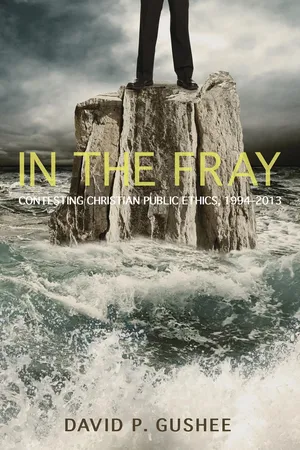
In the Fray collects David Gushee's most significant essays over twenty years as a Christian intellectual. Most of the essays were written in situations of ethical conflict on the highly contested ground of Christian public ethics. Topics addressed include torture, climate change, marriage and divorce, the treatment of gays and lesbians in the church, war, genocide, nuclear weapons, race, global poverty, faith and politics, Israel/Palestine, and even whether Christian ethics is a real academic discipline. Quite visible in the collection is Gushee's deep research interest in the Nazi era in Germany and how the churches fared in resisting Nazi intimidations and seductions and, finally, the Holocaust. All essays reflect the desire for a church that has learned the lessons of that period--a church with resistance to racism, militarism, nationalism, and other social-ideological toxins, and with the discernment and courage to resist these in favor of a courageous allegiance to the lordship of Christ at the time of testing. Considerable attention is directed to contesting some of the public ethics found in the author's own US evangelical Christian community. Concluding reflections on Gushee's ethical vision are offered in an illuminating essay by senior Christian ethicist Glen Harold Stassen.
Information
Topic
Theology & ReligionSubtopic
Christian Theology1
Learning from the Christian Rescuers
Lessons for the Churches
1996
While Nazi Germany was undertaking the destruction of the Jews of Europe during World War II, only a very small proportion of Europe’s non-Jews took action to help their Jewish neighbors survive. At the same time, the Nazis found a significant number of Europeans willing to collaborate with them—on grounds of self-interest or conviction or both. Meanwhile, until 1945, no power on Earth was both able and willing to take the kinds of political and military actions that would end or even seriously hinder Nazi Germany’s mass killing of Jews. And so, preyed upon by the most powerful nation in Europe, murdered by some of their neighbors, abandoned by almost all of the rest of them, and largely unaided by the world, the Jews of Europe were slaughtered.
The spirit of an examination of the Holocaust, it seems to me, ought to be something like the spirit of an investigation of a fatal airplane crash (though, of course, even this metaphor is not nearly grave enough). As tears sting the eyes and the stench of death overwhelms the senses, the investigators nonetheless pick through the rubble, in search of the answer to two critical questions: Why did this catastrophe happen? How can another disaster like this be prevented in the future?
This article concerns that tiny minority of non-Jews who attempted to help Jews survive the Holocaust. As such, it attends to what must be seen as the only glimmer of light in the Holocaust’s overwhelming darkness.1 The danger of examining this light-in-darkness is that a focus on the light should make the darkness seem, somehow, less dark than it was. This is an especially acute concern when the examination is made by a Christian researcher, whose community loyalties might incline him toward too much celebration of European Christian moral goodness and too little grief over European Christian moral evil. Maybe rescuers should not be studied, or perhaps they should be studied only by Jews, who are unlikely indeed to mistake a glimmer of light in the Holocaust for a bright and sunny sky.
It seems probable, however, that the shattering moral failure of a community of people—and the scattered moral successes of some within that community—might best be understood by other members of that community. As well, it seems likely that members of the community in question are the ones best positioned to interpret the historic failures and successes of the group in a way that can effectively improve the behavior of that community today, which must be a fundamental goal of such explorations. Perhaps these are among the reasons why at least two Jewish scholars who have researched the rescuers have asked Christians to join them in this work.2 As a Christian scholar working in the U.S. setting and primarily with Southern Baptists and other evangelicals, I am among those who have taken up that invitation. My task, as I see it, is to help to interpret for my faith community—and others who listen in—the contemporary significance for us both of the Holocaust and of those Christians who tried to save Jews from it. Why? In order that my community will be a morally healthier place than it would have been otherwise, especially with regard to antisemitism; in order that it might do better today in facing its moral challenges than most Christians did in Europe during World War II; in order, frankly, that it might be more faithful to the one it claims as Lord. Mine is an exercise in “remembering for the future.”
The Religiously Motivated Christian Rescuers
Mordecai Paldiel, director of the Department for the Righteous Among the Nations at Yad Vashem, Israel’s Holocaust museum and research center, has said that one hundred thousand is a conservative estimate of the number of European non-Jews who aided Jews during the Holocaust.3 At this writing, more than eleven thousand Gentiles have been verified as rescuers by Yad Vashem, and more names continue to be submitted even now. Celebration of these one hundred thousand or so rescuers is appropriately muted, however, by knowledge that three hundred million European non-Jews lived in Nazi-controlled areas during the Holocaust.4 Even if we generously assume that only one-third of these non-Jews had any kind of realistic opportunity at all to help their Jewish neighbors, the numbers still mean that no more than one-tenth of 1 percent of Europe’s Gentiles did anything to help Jews survive the Holocaust.
Thus the study of rescuers is the study of a tiny minority. This tiny minority has been the subject of a number of social-scientific and other types of research projects, especially within the past ten years or so.5 Most of these projects have involved interviews with persons verified as rescuers by Yad Vashem. These interviews have probed not only the rescuers’ wartime deeds but also their motivations, personalities, family backgrounds, and any other shred of evidence that can help illuminate why the rescuers risked their lives to help Jews when their neighbors did not.6
Consistently, these studies have found that a certain percentage of rescuers—on average, in the vicinity of 20 percent—cite religious motivations as one of the reasons why they rescued Jews.7 Likewise, these inquiries and primary and secondary documents—memoirs, profiles, postwar testimonies, biographies, films, interviews, and so forth—give evidence of the religious practices, convictions, and way of life of some religiously motivated rescuers and rescuer networks. These religious motivations and practices were, of course, overwhelmingly Christian in origin, as one would expect in the heart of (post-) Christian Europe. But, given the history of virulently anti-Jewish Christian thought and practice in this same Europe, the existence of understandings of the Christian faith—and of ways of being Christian—that led to compassion and care for Jews is a matter of considerable interest.
In work published elsewhere, I have attempted to isolate and explore some of the most important religious motivations and practices of those rescuers who claim their Christian convictions as significant for their wartime activities or give other kinds of evidence of the behavioral significance of their Christian faith.8 It has seemed to me that these particularly and explicitly Christian reasons for rescue offer especially useful clues to those of us working with and in Christian faith communities today. Here I want to return to the theme not by repeating findings presented elsewhere but by reflecting briefly on eight lessons that religiously motivated Christian rescuers might offer to the churches as the latter seek to improve the quality of their moral practice today. Though these reflections will be rooted in evidence that has emerged from the rescuer literature, and though I will offer stories and other data from this literature, I do not claim that this material proves anything about what the churches should be and do today. I simply believe that these narratives and research findings speak quite powerfully to the churches in my own North American, Southern Baptist, and evangelical context, and I hope that they might speak effectively to other contexts as well.
Lesson 1: Freeing Christian Faith from Antisemitism
The horrors of the Holocaust have caused a number of Christians to take seriously at last the long-standing and accurate accusation that aspects of traditional Christian theology and church life have been fundamentally important in generating and inflaming hatred of Jews. For fifty years, much of Jewish-Christian dialogue has focused on this history of Christian anti-Judaism and antisemitism and the moral obligation incumbent upon Christian leaders to articulate and practice a non-antisemitic faith. At the same time, a considerable body of Christian theological and biblical scholarship has emerged that clearly reflects the impact of the Holocaust and postwar Jewish-Christian dialogue. This trailblazing scholarship and the changes it has sometimes generated in church life are to be commended.
Yet the impact of the Holocaust and of this dialogue has not been distributed evenly across the Christian world. In terms of American church life, with which I am most familiar, it appears that post-Holocaust theological and ecclesial reformation has not significantly penetrated the self-identified evangelical world, including Southern Baptists. The Christian side of the Jewish-Christian post-Holocaust dialogue has been led, on the whole, by Catholic and mainline Protestant intellectuals and church officials. Protestant evangelicals have not played a prominent role. Two unfortunate results have followed. First, evangelical theology and evangelical churches have not confronted, or been confronted by, the Holocaust. Second, a considerable amount of Christian post-Holocaust reflection is built on presuppositions that are rejected by evangelical Christians, or results in theological claims that would likewise be rejected if evangelicals paid any attention to them. For example, evangelical Christians will not accept any theological claim that abandons classic Christian beliefs about the person of Jesus: his messiahship, incarnation, bodily resurrection, or divinity. Likewise, most will reject any claim that the New Testament itself, erroneously and tragically, is antisemitic. The net result of these two problems is that the fastest-growing portion of the American church today, and the sector with the fastest-growing political and cultural strength, is coming to its ascendancy without serious reflection on the meaning of the Holocaust for its theology and church life. This is both lamentable and potentially disastrous.
What might the Christian rescuers have to offer those of us who want to articulate a Christian faith free of antisemitism? The following excerpts from interviews with Christian rescuers offer some guidance:
We were brought up in a tradition in which we had learned that the Jewish people were the people of the Lord.
The main reason [for rescue] is [that] we know that they are the Chosen People of God. We had to save them.
My background is Christian Reformed; Israel has a special meaning for me. We have warm feelings for Israel.9
Research on the religiously motivated Christian rescuers has revealed that a significant percentage of such people refer to a special sense of religious kinship with Jews as a key motivation for their rescue work.10 The most prominent single group of Christians thus motivated appear to have been those of the Dutch Reformed tradition. But the same pronounced religious philosemitism-of-a-sort can be found among representatives of other theologically orthodox or even fundamentalist groups involved in rescue. Examples of philosemitic French (Reformed) Protestants, French Darbyites, Ukrainian Baptists, Hungarian Methodists, and German Plymouth Brethren are available in the literature.11 It should also be noted that individual rescuers who did not come from these kinds of Christian groups also sometimes held understandings of the Christian faith in which Jews were singled out not for particular contempt but for particular appreciation. This understanding of Jews and Judaism more than occasionally proved fruitful in motivating rescue.
What ...
Table of contents
- Title Page
- By David P. Gushee
- Preface and Acknowledgments
- Chapter 1: Learning from the Christian Rescuers
- Chapter 2: Tears of a Generation
- Chapter 3: Just War Divide
- Chapter 4: The Church, the Nazis, and the Holocaust
- Chapter 5: Remembering Rwanda
- Chapter 6: Can Christian Ethics Be Saved?
- Chapter 7: Dietrich Bonhoeffer and the Evangelical Moment in American Public Life
- Chapter 8: Who Needs a Covenant?
- Chapter 9: Evangelicals and Politics
- Chapter 10: An Evangelical Declaration against Torture
- Chapter 11: Faith, Science, and Climate Change
- Chapter 12: Church-Based Hate
- Chapter 13: What the Torture Debate Reveals about American Evangelical Christianity
- Chapter 14: Scripture, Government, and the World's Poor
- Chapter 15: Biblical Reflections on a World without Nuclear Weapons
- Chapter 16: Religion, Science, and the Weakening Quest to Save Creation
- Chapter 17: America's Unfinished Racial Reconciliation
- Chapter 18: Christian Public Theology and Israel-Palestine
- Chapter 19: Closing Reflections - Glen H. Stassen
- Works Cited
Trusted by 375,005 students
Access to over 1.5 million titles for a fair monthly price.
Study more efficiently using our study tools.
Frequently asked questions
Yes, you can cancel anytime from the Subscription tab in your account settings on the Perlego website. Your subscription will stay active until the end of your current billing period. Learn how to cancel your subscription
No, books cannot be downloaded as external files, such as PDFs, for use outside of Perlego. However, you can download books within the Perlego app for offline reading on mobile or tablet. Learn how to download books offline
Perlego offers two plans: Essential and Complete
- Essential is ideal for learners and professionals who enjoy exploring a wide range of subjects. Access the Essential Library with 800,000+ trusted titles and best-sellers across business, personal growth, and the humanities. Includes unlimited reading time and Standard Read Aloud voice.
- Complete: Perfect for advanced learners and researchers needing full, unrestricted access. Unlock 1.5M+ books across hundreds of subjects, including academic and specialized titles. The Complete Plan also includes advanced features like Premium Read Aloud and Research Assistant.
We are an online textbook subscription service, where you can get access to an entire online library for less than the price of a single book per month. With over 1.5 million books across 990+ topics, we’ve got you covered! Learn about our mission
Look out for the read-aloud symbol on your next book to see if you can listen to it. The read-aloud tool reads text aloud for you, highlighting the text as it is being read. You can pause it, speed it up and slow it down. Learn more about Read Aloud
Yes! You can use the Perlego app on both iOS and Android devices to read anytime, anywhere — even offline. Perfect for commutes or when you’re on the go.
Please note we cannot support devices running on iOS 13 and Android 7 or earlier. Learn more about using the app
Please note we cannot support devices running on iOS 13 and Android 7 or earlier. Learn more about using the app
Yes, you can access In the Fray by David P. Gushee in PDF and/or ePUB format, as well as other popular books in Theology & Religion & Christian Theology. We have over 1.5 million books available in our catalogue for you to explore.