eBook - ePub
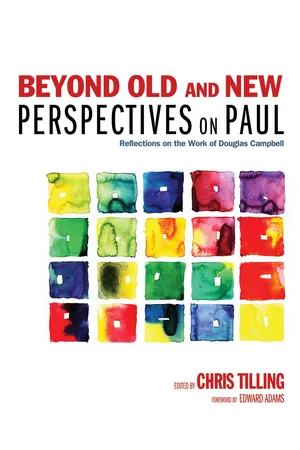
Beyond Old and New Perspectives on Paul
Reflections on the Work of Douglas Campbell
- 356 pages
- English
- ePUB (mobile friendly)
- Available on iOS & Android
eBook - ePub
Beyond Old and New Perspectives on Paul
Reflections on the Work of Douglas Campbell
About this book
New Testament studies are witnessing many exciting developments. And Douglas Campbell's groundbreaking publications are an important contribution to future discussions relating to Paul. Familiar problems relating to justification, "old" and "new" perspectives, and much more besides, have been tackled in fresh and exciting ways, setting down challenge after challenge to all those involved in Pauline studies. Campbell's publications therefore demand serious engagement. This book seeks to facilitate academic engagement with Campbell's work in a unique way. It contains numerous chapters critiquing his proposals, while others summarize the key themes succinctly. But it also contains Campbell's own response to the reception of his work, allowing him space to outline how his thinking has developed. In so doing, this work allows readers to be drawn into a vitally important conversation. It is academic theology in the making and constitutes the cutting edge of Pauline studies.
Information
Topic
Theology & ReligionSubtopic
Biblical StudiesPart One
Campbell and the Problem
1
A Review of Douglas Campbell’s The Deliverance of God from a Theological Perspective13
I have been invited to assess Douglas Campbell’s door-stopper of a tome from a theological perspective. Given that this is a work in Pauline scholarship by a leading New Testament scholar, what is the justification for involving a theologian? Clearly, it is because the argumentation of this book is driven by a theological critique of certain key methodological, epistemological, and indeed, ontological suppositions that have functioned to sustain what Campbell calls “justification discourse”—an approach to Pauline interpretation that Campbell argues is outmoded, confused, and ultimately incoherent.
So, very briefly, what are the core concerns of this book? The first is to expose the fallacious reasoning underpinning justification theory as this has characterized Pauline scholarship since the Reformation. Justification theory or discourse, Campbell argues, has provided the Western church with an interpretive framework that has distorted the core of Paul’s theology and notably its ethical, anthropological, theological, soteriological, and epistemological implications.
The second related aim is to solve the problem of the apparent tension between Romans 1:18–32, on the one hand, which underpins justification theory, and Romans 5–8 (anticipated in 3:21–26), which he sees as expounding the glorious heart of Pauline theology—his profound, apocalyptic, and participative vision of the gospel. What is presented here is nothing less than what Campbell describes as a divine “rescue mission” that liberates and reconstitutes a confused humanity, which is otherwise dysfunctional (ethically, epistemically, spiritually, and theologically), by giving it to participate en Christo and, thereby, in all-embracing and all-transforming communion with God—a communion that requires to be conceived in irreducibly Trinitarian terms with an essentially christological and pneumatological grammar. The associated interpretations of God, the character of the divine will, salvation, as also the role of Christ and the Spirit, constitute a profoundly coherent yet also a very different gospel from that presented in Romans 1–4. Although the tension here was already recognized by Deissmann, Schweitzer, Wrede, and others, none of the revisionist scholars who challenged the justification discourse offered a “satisfactory explanation of how the two discourses, forensic and mystical, might fit together either in Romans or in Paul’s thinking about salvation as a whole.”
Campbell’s solution to this tension is to argue that the early chapters of Romans are a kind of rhetorical exposé of a legalistic “alternative gospel” that is not the gospel Paul himself is proclaiming. In short, in opposing this alternative soteriological program Paul uses various rhetorical devices (here Campbell utilizes the work of Stanley Stowers) which, as Campbell explains in chapter 14, would have made it clear to his contemporary audience that Paul was not himself endorsing the programme of Romans 1–4 and certainly not its building blocks as if they provided the route into the affirmations of 5–8. Although the rhetorical cues communicated to the performers are lost, we should not be misled by the naked text as it stands, given that there is much within it that serves to establish this reading.
Campbell goes on to draw parallels between Paul’s concerns in Romans and those in Galatians, where he also opposed teachers who were presenting “an alternative soteriological program.” Just as Galatians is written in a context in which there were two gospels in play, two gospels were also in play in Romans, occasioned by “the spectre of the Teachers’ arrival” (DofG, 522).
I am not qualified to assess Campbell’s explanation of what is going on here. What I would like to do, however, is to consider Campbell’s analysis of the methodological moves and theological suppositions that have supported the justification discourse and its utilization of Romans 1–4 for its specific ends. What must be clear to all is that justification discourse does not simply emerge in a spontaneous and unmediated way from Pauline texts. It is a theological doctrine, formulated on the basis of a series of theological premises, which addresses a particular problem, and is driven by a whole series of apologetic and other concerns. In other words, the genetic confusions here can be traced to doctrinal exposition rather than biblical scholarship per se. Lying behind the relevant theological moves is one of the tragedies of Western thought, namely, the manner in which theological and biblical interpretation has been driven by the mistranslation of Hebrew terms—let me mention three in particular. First, berith, as it is used in the Pentateuch to denote the Lord’s relationship to Israel, denotes an unconditioned and unconditional covenant commitment to Israel grounded in love and characterized by hesed—God’s sustained and unconditional covenant faithfulness. Berith in Hebrew and diatheke in Greek, were translated foedus in Latin, giving rise to federal theology. Foedus makes no distinction between covenant and contract and essentially means “contract.” Subliminal within the Western tradition, not least the Calvinist tradition, as Campbell so rightly argues, was a contractual model of the relationship between God and Israel—contract of nature, contract of faith, etc.
The second concept, Torah (nomos in Greek), was translated lex in Latin, which was immediately interpreted in the light of categories of Roman or natural law. Whereas Torah articulated the unconditional, apodictic obligations that stem from God’s covenant commitment to Israel, lex came to be interpreted in terms of a contract of nature—the contractual conditions of the divine acceptance of humanity. These legal conditions were perceived as being met by Jesus’ death on the cross—the necessary condition of God’s forgiveness of humanity.
Tsedaqah, dikaiosune in Greek, was interpreted iustitia in Latin. The righteousness that characterized God’s covenant faithfulness toward an unfaithful people, and that placed them under unconditional obligations to be faithful (literally to image God’s righteousness), was reinterpreted by means of a juridical concept of justice—initially distributive and, later, retributive justice, worked out in much Western theology in contractual terms.
In short, on the one side of this translation process we have God’s purposes conceived as covenant, Torah (the obligations to be faithful), and righteousness. On the other side, we have God’s essential purposes conceived through the categories of contract (conditional acceptance), lex (Stoic notions of natural law), and iustitia (justice). What takes place is nothing less than a metabasis eis allo genos of the very heart of Judaism. We have, in short, a foreign religion emerging—the re-schematization of a primarily filial relationship towards humanity as a fundamentally legalistic one, where divine acceptance is conceived as conditional upon our meeting legal requirements and the satisfaction of the demands of justice conceived in retributive terms. This, of course, led to the emergence of the various forms of the Western ordo salutis, together with juridical constructions of the atonement whereby the Son conditions the Father into having mercy on those who have offended his holy will by breaching the contractual conditions of his legal demands. The Father is conditioned into loving and forgiving sinners through the satisfaction of his wrath by the blood and innocent suffering of his Son.
For Campbell, when Romans 1–4 is taken as underwriting this kind of program, it is simply not possible to make it consistent with the thrust and implications of chapters 5–8. It is entirely unclear, that is, how the graft can be made to take—and no book I know of exposes this more effectively or more rigorously than this one!
So how precisely does Campbell conceive of the essential shape of the justification model?
First, it interprets human beings in essentially individualistic terms as rational, self-interested beings who possess immanent, epistemic access to God’s ethical demands and, thereby, to the essential conditions of God’s contractual acceptance of them. This is what Federal Calvinists referred to as the foedus naturae (contract of nature) or the foedus operum (contract of works). Contemplating the cosmos without provides veridical knowledge of God’s nature and contemplating the conscience within provides knowledge of God’s justice and just requirements. Whereas for Jews, therefore, God’s ethical demands are revealed through written legislation, those same demands are revealed to everyone innately. Here we must note that, as Campbell rightly points out, this involves the de-historicization of the Torah, its divorce from its covenantal context, and its identification, in effect, with the dictates of natural law—and too often natural law is conceived in ways that bear little resemblance to the obligations of the Torah or, indeed, to the law as it is summarized by Jesus! The next step in the argument is the recognition that rewards/punishments are apportioned according to an individual’s fulfilment or otherwise of God’s ethical demands as these are apparent to our consciences.
This brings us to the next key moves in the reasoning of the justification discourse, namely, what Campbell describes as the introspective twist (DofG, 28) and the loop of despair (DofG, 29)—that is, self-perceived ethical incapacity (DofG, 34), the awareness that we violate God’s ethical demands and that a negative divine judgement is unavoidable. On this basis, the gift of grace is then presented—the “compensatory mechanism of satisfaction, namely, Christ’s atonement” (DofG, 34) whereby God redirects that punishment which is our due to...
Table of contents
- Title Page
- Foreword
- Preface
- Contributors
- Introduction
- Part 1: Campbell and the Problem
- Chapter 1: A Review of Douglas Campbell’s The Deliverance of God from a Theological Perspective
- Chapter 2: Luther and the Deliverance of God
- Chapter 3: The Current Crisis
- Chapter 4: Campbell’s Apocalyptic Gospel and Pauline Athanasianism
- Chapter 5: “Arian” Foundationalism or “Athanasian” Apocalypticism
- Chapter 6: Connecting the Dots
- Chapter 7: A Response to Campbell’s “Connecting the Dots”
- Chapter 8: The Legal Mind of American Christianity
- Part 2: Campbell’s Solution
- Chapter 9: Rereading Romans 1–3
- Chapter 10: Beyond Reasonable Hope of Recognition?
- Chapter 11: Rereading Romans 1–3 Apocalyptically
- Chapter 12: Rereading Paul’s ΔΙΚΑΙΟ-Language
- Chapter 13: Reading Paul’s ΔΙΚΑΙΟ-Language
- Chapter 14: Campbell’s Faith
- Chapter 15: The Faith of Jesus Christ
- Appendix A: Covenant or Contract?
- Appendix B: The Contribution of McLeod Campbell to Scottish Theology
- Bibiography
Trusted by 375,005 students
Access to over 1.5 million titles for a fair monthly price.
Study more efficiently using our study tools.
Frequently asked questions
Yes, you can cancel anytime from the Subscription tab in your account settings on the Perlego website. Your subscription will stay active until the end of your current billing period. Learn how to cancel your subscription
No, books cannot be downloaded as external files, such as PDFs, for use outside of Perlego. However, you can download books within the Perlego app for offline reading on mobile or tablet. Learn how to download books offline
Perlego offers two plans: Essential and Complete
- Essential is ideal for learners and professionals who enjoy exploring a wide range of subjects. Access the Essential Library with 800,000+ trusted titles and best-sellers across business, personal growth, and the humanities. Includes unlimited reading time and Standard Read Aloud voice.
- Complete: Perfect for advanced learners and researchers needing full, unrestricted access. Unlock 1.5M+ books across hundreds of subjects, including academic and specialized titles. The Complete Plan also includes advanced features like Premium Read Aloud and Research Assistant.
We are an online textbook subscription service, where you can get access to an entire online library for less than the price of a single book per month. With over 1.5 million books across 990+ topics, we’ve got you covered! Learn about our mission
Look out for the read-aloud symbol on your next book to see if you can listen to it. The read-aloud tool reads text aloud for you, highlighting the text as it is being read. You can pause it, speed it up and slow it down. Learn more about Read Aloud
Yes! You can use the Perlego app on both iOS and Android devices to read anytime, anywhere — even offline. Perfect for commutes or when you’re on the go.
Please note we cannot support devices running on iOS 13 and Android 7 or earlier. Learn more about using the app
Please note we cannot support devices running on iOS 13 and Android 7 or earlier. Learn more about using the app
Yes, you can access Beyond Old and New Perspectives on Paul by Chris Tilling, Tilling in PDF and/or ePUB format, as well as other popular books in Theology & Religion & Biblical Studies. We have over 1.5 million books available in our catalogue for you to explore.