eBook - ePub
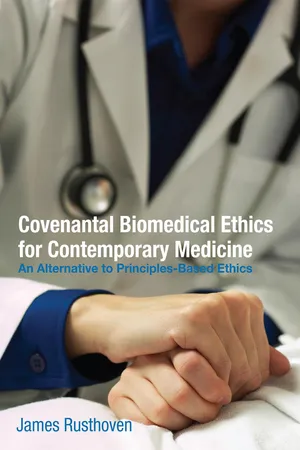
Covenantal Biomedical Ethics for Contemporary Medicine
An Alternative to Principles-Based Ethics
- 330 pages
- English
- ePUB (mobile friendly)
- Available on iOS & Android
eBook - ePub
Covenantal Biomedical Ethics for Contemporary Medicine
An Alternative to Principles-Based Ethics
About this book
Principles-based biomedical ethics has been a dominant paradigm for the teaching and practice of biomedical ethics for over three decades. Attractive in its conceptual and linguistic simplicity, it has also been criticized for its lack of moral content and justification and its lack of attention to relationships. This book identifies the modernist and postmodernist worldviews and philosophical roots of principlism that ground the moral minimalism of its common morality premise. Building on previous work by prominent Christian bioethicists, an alternative covenantal ethical framework is presented in our contemporary context. Relationships constitute the core of medicine, and understanding the ethical meaning of those relationships is important in providing competent and empathic care. While the notion of covenant is articulated through the richness of meaning taught in the Christian Scriptures, covenantal commitment is also appreciated in Islamic, Jewish, and even pagan traditions as well. In a world of increasing medical knowledge and consequent complexity of care, such commitment can help to resist enticements toward the pursuit of self-interest. It can also improve relationships among caregivers, each of whose specific expertise must be woven into a matrix of care that constitutes optimal medical practice for each vulnerable and needy patient.
Information
Topic
Theology & ReligionSubtopic
Christian TheologyPart One
The Rise and Dominance of Principles-Based Biomedical Ethics
1
The Rise of Principlism in Response to an Ethical Crisis
My conscience is clear, but that does not make me innocent. It is the Lord who judges me. Therefore, judge nothing before the appointed time; wait till the Lord comes. He will bring to light what is hidden in darkness and will expose the motive of people’s hearts. At that time, each will receive his praise from God.
—1 Cor 4:4–5 (Today’s NIV)
Historical Backdrop to Principlism
Development of Natural Law, Casuistry, and Moral Certainty
To understand the philosophical and worldview roots of principlism, it is important to understand a few highlights of the history of ethics that have influenced bioethical thinking and practice. In early medieval times, neither systematic ethics nor formal ethical theory existed. Ethics was taught by clergy, particularly monks who taught using stories about the virtues and actions of saints. Sources of ethical authority included Scripture, the patristic writings, and Latin fragments of classical texts.
By the thirteenth century, ethics had become entrenched in the discipline of rhetoric, as practiced within the new universities arising throughout Europe. As such, scholars such as Roger Bacon and Abelard systematized ethical concepts, bringing together church teachings and pagan traditions. Bacon attempted to merge, on the one hand, Aristotle’s ideas of virtues, gleaned in part from the latter’s Nicomachean Ethics (“rediscovered” in 1245) and Stoic teachings with, on the other hand, Christian doctrine and Scriptural interpretations of the day.16
In the same period, some scholars began to consider the post-Fall vestigial remnant of humanity’s moral law. For many, natural law represented simple obligations to do no harm while also actively doing good for others. Over time, ethicists—and, later, bioethicists of various faith persuasions—looked to natural law as a justification for moral decisions. Noting that the scholastic concept of natural law was formulated from Scripture, reason, and nature, Jean Porter agrees with Richard Horsley regarding the significance of Stoic influence on the medieval scholastic idea of natural law, particularly the influence of Cicero and the Roman jurists under Justinian. For Stoics, humanity is under one universal law of justice within a single commonwealth.17 In stark departure from Aristotle, the natural equality of all persons manifests as an equal capacity to practice virtue, providing a basis for egalitarian arguments for common-morality theory today.18 To these Stoic concepts was added the notion of a transcendent deity as divine legislator. With reason and nature grounded in, and reflective of, a transcendent reality, the law of nature could be understood as an expression of the will of a divine legislator.19
Porter points out that theologians of the scholastic period understand natural law as precepts. For them, moral discernment derives its strength from fundamental norms, basic principles, or axioms of natural law that are starting points for rendering moral judgments. The canon lawyers, on the other hand, see natural law as a capacity for judgment. Neither group understands natural law as specific moral rules but neither do they clarify the relationship between these precepts (principles) and the capacity to make judgments and specific moral rules.20
Thomas Aquinas tries to link these concepts by relating Jesus’s summary of the law with the Ten Commandments. For Aquinas, the overarching commands to love God and neighbor that summarize the Decalogue are self-evident principles of natural law knowable to all persons, requiring some reflection of which all humans are capable.21 He proposes natural law to be the form of “general processes” by which all creatures participate in God’s eternal law. However, only human beings as rational creatures can follow natural law rationally and virtuously.22 Acknowledging conflicting interpretations of the relative importance of reason among scholastic thinkers, Porter suggests that their idea of reason is neither the autonomous, self-legislating practical reason of Kant nor equivalent to a newer formulation of natural law.23 Aquinas, himself, identifies a first principle of practical reason: that is, pursing good and avoiding evil. However, how he assigns self-evident principles is not always clear. In some of his writings, practical reason is self-evident and the most fundamental precept of natural law, whereas in other writings, Jesus’s summary of the law is called a self-evident principle.24
For Aquinas, principles derived from primary principles of natural law are natural inclinations, expressed during moral deliberations and decisions, directed toward the moral good. They may also become evident from common conclusions derived from first principles. Other principles arise as human persons move toward their proper end; for the Christian, this is death, followed by the final judgment day. Either way, principle-associated obligations may fail to apply or be adhered to in unusual situations, due to unrevealed or unappreciated aspects of a situation “deformed by passion or poor education or poor habits.”25
Casuistry arose in the medieval period out of established traditions regarding rabbinic Judaism and early Christian decision-making. According to Jonsen and Toulmin, the moral challenges and perceived moral paradoxes of some of Jesus’ ethical teachings promote casuistic methods that were later developed and practiced in the church.26 For instance, Jesus teaches using various methods, including reinterpretations of familiar rules or laws in order to teach moral behavior beyond the letter of the law. In Acts and 1 Corinthians, situations arise among Christians that require reflection on previous practices, teachings, and laws, all of which may be interpreted differently in light of particular situations. Ultimately, decisions are made and carried out after an invocation for assistance from the Holy Spirit. For example, in Acts 15, a problem arises regarding the observance by Gentile converts of Judaic rituals and moral obligations. In 1 Corinthians 8, 10, and 11, the church debates what constitutes appropriate associations with pagans. After the apostolic period, church authorities wrote about specific cases that they were asked to adjudicate. After the persecutions under emperor Dacia (c. 250), Cyprian published a treatise concerning cases of Christians who chose to renounce their faith rather than flee to avoid persecution. From Cleme...
Table of contents
- Title Page
- Foreword - Craig G. Bartholomew
- Acknowledgments
- Introduction
- Part One: The Rise and Dominance of Principles-Based Biomedical Ethics
- Part Two: A Modest Proposal for a Biblical Covenantal Biomedical Ethic
- Epilogue: The End of the Beginning
- Appendix: The Hippocratic Oath
- Bibliography
Trusted by 375,005 students
Access to over 1.5 million titles for a fair monthly price.
Study more efficiently using our study tools.
Frequently asked questions
Yes, you can cancel anytime from the Subscription tab in your account settings on the Perlego website. Your subscription will stay active until the end of your current billing period. Learn how to cancel your subscription
No, books cannot be downloaded as external files, such as PDFs, for use outside of Perlego. However, you can download books within the Perlego app for offline reading on mobile or tablet. Learn how to download books offline
Perlego offers two plans: Essential and Complete
- Essential is ideal for learners and professionals who enjoy exploring a wide range of subjects. Access the Essential Library with 800,000+ trusted titles and best-sellers across business, personal growth, and the humanities. Includes unlimited reading time and Standard Read Aloud voice.
- Complete: Perfect for advanced learners and researchers needing full, unrestricted access. Unlock 1.5M+ books across hundreds of subjects, including academic and specialized titles. The Complete Plan also includes advanced features like Premium Read Aloud and Research Assistant.
We are an online textbook subscription service, where you can get access to an entire online library for less than the price of a single book per month. With over 1.5 million books across 990+ topics, we’ve got you covered! Learn about our mission
Look out for the read-aloud symbol on your next book to see if you can listen to it. The read-aloud tool reads text aloud for you, highlighting the text as it is being read. You can pause it, speed it up and slow it down. Learn more about Read Aloud
Yes! You can use the Perlego app on both iOS and Android devices to read anytime, anywhere — even offline. Perfect for commutes or when you’re on the go.
Please note we cannot support devices running on iOS 13 and Android 7 or earlier. Learn more about using the app
Please note we cannot support devices running on iOS 13 and Android 7 or earlier. Learn more about using the app
Yes, you can access Covenantal Biomedical Ethics for Contemporary Medicine by James J. Rusthoven in PDF and/or ePUB format, as well as other popular books in Theology & Religion & Christian Theology. We have over 1.5 million books available in our catalogue for you to explore.