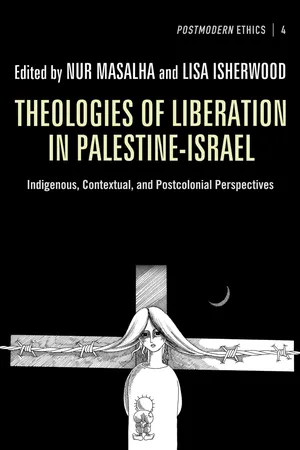
eBook - ePub
Theologies of Liberation in Palestine-Israel
Indigenous, Contextual, and Postcolonial Perspectives
- 246 pages
- English
- ePUB (mobile friendly)
- Available on iOS & Android
eBook - ePub
Theologies of Liberation in Palestine-Israel
Indigenous, Contextual, and Postcolonial Perspectives
About this book
This collection of essays concerns the development of contextualized theologies of liberation in Palestine and the indigenous Palestinian people's struggle for justice and liberation. The work is innovative because of its inclusion of indigenous perspectives within its remit and the introduction of new concepts such as civil liberation theology. The collection offers other ways to look at biblical discourses and their impact on the ongoing conflict, ways to live peace, ways to be ethical when visiting these conflicted lands, understandings of resource ethics, and even a new way to understand how we approach our understanding of liberation theology. Contributors include well-known scholars from Muslim, Jewish, Christian, Palestinian-Israeli, Indian, American, and British contexts. This work goes beyond standard academic collections. It is aimed not only at scholars and students but also at peace activists and policymakers. It should be of use not only in academic courses but also for practitioners of conflict resolution, peace and reconciliation.
Information
Topic
Theology & ReligionSubtopic
Christian Church1
Liberation Theology in Latin America and Palestine-Israel: Practical Similarities and Contextual Differences
Dr. Samuel J.
The Origins of Liberation Theology
Liberation theology has complex origins which include the tradition of the church’s thinking on politics and economics, going all the way back to the Church Fathers; more immediately Catholic Social Teaching and Catholic Action, which followed from that, with its motto of “See, Judge, Act;” Vatican II and the ferment which followed from it; European political theology; the educational philosophy of Paulo Freire; and the “Christian-Marxist dialogue” of the 1960s (Dawson 1998).
Catholic Social Teaching and the long tradition on which it draws such as Leo XIII’s Rerum Novarum, promulgated in 1891, condemned the bad living conditions of the urban poor of Europe. Since then, successive Popes have taken it upon themselves to condemn European liberal capitalism while taking a stand in favor of the poor and the down-trodden. Pius XI in 1931 issued Quadragesimo Anno which affirmed certain Christian attributes in socialism such as the sharing of property for the common good, something long advocated by Christian reformers over the ages. All Popes since Leo XIII, while staunchly conservative and fiercely anti-Communist, were still sympathetic to moderate versions of socialist endeavor.
Vatican II, called by Pope John XXIII in 1962, took the concern with peace and justice further. Paul VI’s Encyclical Populorum Progressio was concerned with the question of worldwide poverty and development, particularly in the two-thirds world. It traced “Third World” poverty to the impact and continuing end-results of colonialism, neo-colonialism, unfair trade practices and the great inequality in power among the nations. It was critical of laissez-faire capitalism that was responsible for ensuring the wealth and prosperity of Western elite societies at the expense of deprivation and poverty in much of the rest of the world. However, it spoke of “development,” which still entailed capitalism, as a “new name for peace” (Dawson 1998, 126).
When the Vatican II Conference was over, two conferences in Latin America, one in Medellin in Colombia and the other in Puebla, Mexico, took these ideas further and first came up with the phrase, “theology of liberation” (Boff 1987, 9). For theologians like Gustavo Gutiérrez, the term “development” could not fully embrace the needs of the people and especially the poor of Latin America, who were being sidelined in the lop-sided development that takes place in most third world countries. On the Protestant side, an organization known as “Church and Society in Latin America” (popularly known by its Spanish acronym of ISAL-Iglesia y Sociedad en America Latina-Church and Society in Latin America), had been founded by Richard Shaull and supported by the World Council of Churches-WCC (Smith 1991, 17). This organization was involved in developing what they termed a theology of revolution, as opposed to a theology of development. As a Protestant theological cum social action movement, ISAL, in its early days, was convinced that a gradualist approach to social transformation in Latin America was quite inadequate, given the entrenched and exploitative nature of the rule of dominant groups in these countries.
Shaull and his organization were interested in trying to develop a Christian basis for revolutionary socio-political transformation, one that would not necessarily involve the need for violence (Rider 1998, 61). The theology of revolution certainly made its mark on Latin American Catholic theologians who were already becoming more and more ecumenically-oriented as a result of the post-World War II changes and the Second Vatican council. In the late 1960s, ISAL itself began to feel that the terminology of a so-called theology of revolution was not particularly appropriate to the Latin American situation and then the term liberation began to be spoken of.
The works of European political theologians, in particular Jürgen Moltmann and Johann Baptist Metz, were also important. They regarded Christianity as a “critical witness in society” (Gutierrez 2001, 208). European political theology was very evident in the writings of all the main liberation theologians, especially those trained in Europe in the 1950s and 1960s. Both Moltmann and Metz sought to make theology responsive to its socio-political situation.
The Main Emphases of Liberation Theology
Liberation theologians have always insisted that their interpretation of theology was not just a “re-interpretation of what is generally known as Western theology,” but an “irruption” of God active and living among the poor (Chopp and Regan 2005, 469). Liberation theology, at least in the way it was practiced in Latin America, claimed to be a new method of developing a theology that would seek to address the “seemingly hopeless” situation of the poor people of Latin America.
I shall seek to highlight four key themes of liberation theology in this essay. The first was the priority of praxis. For Gutiérrez, theology was a “second step,” reflection on action. However for Gutierrez, this “reflection on action” should also be based on the “indisputable” Word of God, the Holy Scriptures of the Christian faith. In this context, the Brazilian Catholic theologian Hugo Assman argued that, “ . . . the Bible, tradition, the magisterium or teaching authority of the Church, history of dogma, and so on . . . even though they need to be worked out in contemporary practice, do not constitute a primary source of ‘truth-in-itself’” (Assman 1975, 104–5).
Assman has also been critical of the hermeneutical approach of many so-called liberation theologians, critiquing the relevance and necessity of a biblical hermeneutics, which did not take into consideration the masses of new techniques and data offered by secular and social sciences as well as the need to think practically about the situation at hand. He was equally critical of the “biblicists” as well as those Marxist historians and analysts who sought in his view to impose a “fundamentalism of the Left” by attempting to transplant biblical paradigms and situations into this world without understanding their historical context and situation. He saw the theology of liberation as a critical reflection on the present historical situation “in all its intensity and complexity.” Instead of the Bible, the “text” of current reality should be the situational précis point that requires analysis and theologizing. As a result, the main issue for Assman was one of hermeneutical criteria. He had little use for those who claim that the best sets of hermeneutics available to Christians are located in the “sacred text,” arguing instead for an analysis of reality based on the circumstances of “today” (Assman 1975, 104–5).
Rather, it was liberative action which was the indispensable basis for reflection. Early on, the Exodus paradigm was normative: the poor were seen as engaged on a journey from slavery to freedom, escaping the bondage of class and debt. The theme of the kingdom of God was also prominent. All liberation theologians make a link between liberation and God’s justice as the primal theme in Christian theology. Gutiérrez denied wanting to fashion a theology from which political action was “deduced” (Gutierrez 1974, intro-ix). What he wanted, rather, was to let ourselves be judged by the word of the Lord, to think through our faith, to strengthen our love, and to give reason for our hope from within a commitment which seeks to become more radical, total, and efficacious. It is to reconsider the great themes of the Christian life within this radically changed perspective and with regard to the new questions posed by this commitment. This is the goal of the so-called theology of liberation (Gutierrez 1974, ix).
The insistence on beginning with praxis led to a new hermeneutic. Juan Luis Segundo defined the hermeneutical circle as “the continuing change in our interpretation of the Bible which is dictated by the continuing changes in our present-day reality, both individual and societal” (Hennelly 1979, 109). Segundo’s method was made up of four steps that correspond to a kind of theological circle. The first step requires recognition of reality on our part that automatically leads to ideological suspicion of that reality. Secondly, the application of “ideological suspicion” entails its application to the whole theological superstructure in general. Thirdly Segundo calls for a new way of experiencing and living theological reality, which would in turn lead us to a kind of exegetical suspicion (that would mean a suspicion that current biblical interpretation did not take into account important data). Fourthly he recommended the development of a new hermeneutic that would provide a new way of interpreting “our faith,” based on Scripture, with many of the new academic as well as critical-analytic techniques at our disposal (Hennelly 1979, 109). Bible reading began with the experience of oppression, which led to suspicion of current Biblical interpretation, which led to new readings of Scripture, which led to new views of society.
Second, liberation theology sought to establish itself not in relation to the institutional church or the academy, but in relation to the communidades di base (in Spanish, the base communities) of peasants and workers who constituted the church. These communities form the root from which pastoral workers, priests and theologians sought to develop their theologies of liberation (Witvliet 1985, 138–39).
Base communities have been described as “grassroots communities” where Christians seek to form and live out their Christian witness in their historical situation (Chopp and Regan 2005, 471). While present in all Latin American states, base communities became most popular in Brazil, where they at one time numbered in the hundreds of thousands. It was in recognition of this fact that the EATWOT Congress in Sao Paulo, Brazil in 1980 was focused on the ecclesiology of Basic Christian Communities (BCC’s). BCC provide the basis for a historical praxis of liberation that comes before theological manifestation. They also act as a source of ecclesiology as well as a place where the “poor and the oppressed” manage to get a place of their own in the historical process. The BCC were always firmly located within the entrenched feudal and semi-feudal forces of bourgeois control in the Latin American nations.
The BCC owe the...
Table of contents
- Title Page
- Contributors
- Acknowledgments
- Introduction - Nur Masalha and Lisa Isherwood
- 1. Liberation Theology in Latin America and Palestine-Israel: Practical Similarities and Contextual Differences - Dr. Samuel J. Kuruvilla
- 2. Reflections on Sabeel’s Liberation Theology and Ecumenical Work (1992–2013) - Dr. Naim Ateek
- 3. Theologies of Liberation in Palestine-Israel and the Struggle for Peace and Justice - Prof. Marc H. Ellis
- 4. Reading the Bible with the Eyes of the Philistines, Canaanites and Amalekites: Messianic Zionism, Zealotocracy, the Militarist Traditions of the Tanakh and the Palestinians (1967 to Gaza 2013) - Prof. Nur Masalha
- 5. God’s Mapmakers: A Theology of Dispossession - Prof. Gareth Lloyd Jones
- 6. The Quest for Peace with Justice in the Middle East: Christian Zionist and Palestinian Theologies - Prof. Rosemary Radford Ruether
- 7. Transcending Monotheism and a Theology of Land - Prof. Lisa Isherwood
- 8. Beyond Interfaith Reconciliation: A New Paradigm for a Theology of Land - Dr. Mark Braverman
- 9. Confronting the Truth: New Awakenings to the Palestinian Situation - Prof. Mary Grey
- 10. Civil Liberation Theology in Palestine: Indigenous, Secular-Humanist, and Post-Colonial Perspectives - Professor Nur Masalha
Trusted by 375,005 students
Access to over 1.5 million titles for a fair monthly price.
Study more efficiently using our study tools.
Frequently asked questions
Yes, you can cancel anytime from the Subscription tab in your account settings on the Perlego website. Your subscription will stay active until the end of your current billing period. Learn how to cancel your subscription
No, books cannot be downloaded as external files, such as PDFs, for use outside of Perlego. However, you can download books within the Perlego app for offline reading on mobile or tablet. Learn how to download books offline
Perlego offers two plans: Essential and Complete
- Essential is ideal for learners and professionals who enjoy exploring a wide range of subjects. Access the Essential Library with 800,000+ trusted titles and best-sellers across business, personal growth, and the humanities. Includes unlimited reading time and Standard Read Aloud voice.
- Complete: Perfect for advanced learners and researchers needing full, unrestricted access. Unlock 1.5M+ books across hundreds of subjects, including academic and specialized titles. The Complete Plan also includes advanced features like Premium Read Aloud and Research Assistant.
We are an online textbook subscription service, where you can get access to an entire online library for less than the price of a single book per month. With over 1.5 million books across 990+ topics, we’ve got you covered! Learn about our mission
Look out for the read-aloud symbol on your next book to see if you can listen to it. The read-aloud tool reads text aloud for you, highlighting the text as it is being read. You can pause it, speed it up and slow it down. Learn more about Read Aloud
Yes! You can use the Perlego app on both iOS and Android devices to read anytime, anywhere — even offline. Perfect for commutes or when you’re on the go.
Please note we cannot support devices running on iOS 13 and Android 7 or earlier. Learn more about using the app
Please note we cannot support devices running on iOS 13 and Android 7 or earlier. Learn more about using the app
Yes, you can access Theologies of Liberation in Palestine-Israel by Nur Masalha,Lisa Isherwood, Masalha, Isherwood in PDF and/or ePUB format, as well as other popular books in Theology & Religion & Christian Church. We have over 1.5 million books available in our catalogue for you to explore.