- 142 pages
- English
- ePUB (mobile friendly)
- Available on iOS & Android
eBook - ePub
About this book
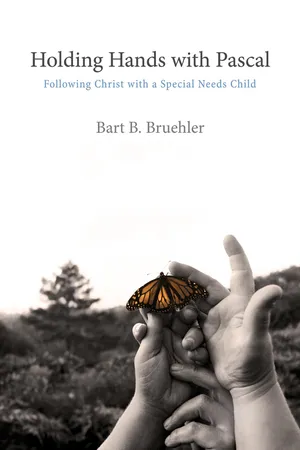
Holding Hands with Pascal is about the story of one family's journey to follow Christ with a special-needs child. The chapters intertwine memoir, biblical study, and theological reflection to reveal that weakness is a gift from God that is indispensable for our discipleship. Ranging from creation through daily life to the return of Jesus, a father tells of how the unusual and challenging life of his son, Pascal, has affected their entire family and where they have found morsels of grace in scripture and community to help sustain them. For families with special-needs children, groups seeking to grow as disciples, and churches seeking a way of faith-in-weakness, Holding Hands with Pascal offers insights and an inspiration for the way.
Information
Topic
Theology & ReligionSubtopic
Christian Ministry1
How Everything Started
And whoever welcomes a little child like this in my name welcomes me.
—Matthew 18:5
This book delves into what it means to live as followers of Christ with a special needs child. Much of it will circle around the life of our son, Pascal, but even more it will explore our experiences while holding hands with our son. Thus, these reflections are about our life as a family. The story of our family begins with the relationship between my wife, Anne, and me. It is through our love and union that God brought Pascal into the world; it was into our home that Pascal came; and it is with our family that Pascal lives and will continue to live (perhaps for the rest of his life). The beginning starts with the beginning of our family. Let me share the story of how Anne and I met.
I had transferred to Asbury College in Wilmore, Kentucky after two years at another college in Ohio. I was trying desperately to graduate in four years and move on in my education, wanting ultimately to get my doctorate. I was taking a very full load of classes to try to make up for credits lost in the process of changing schools midstream. But after working constantly one semester with discipline and sincerity, I still found myself facing a huge assignment due the next day that I had not even started. With visible annoyance and grim determination, I decided to pull an all-nighter—something I had never done before in my college career. I worked all night and arrived at 4:30 in the morning with two results: I had finished my project on the gospel of Mark, and I resolved never to end up in a situation like that again. That resolution led me to stay at Asbury College one more year to enjoy my studies without pushing myself too hard. That following fall Anne started as a new student at Asbury College. Little did I know all of the ramifications that would result from that early morning resolution.
The fact that our paths ever crossed is a sign of the mysterious workings of God’s grace through the people of God. I was a fifth year senior and she a freshman. As a transfer student I had become close to several guys who moved into the dormitory hall of Johnson 2nd East at the same time I did. My group of friends was more about where I lived than it was about when I entered college or what my major was. It just so happened (by providence) that Anne was oddly placed in a hall in a woman’s dorm that had about half freshmen and half upperclassmen. Some of those junior and senior ladies were friends of mine and my other guy buddies. We met regularly for dinner in the “grey room” off the beaten path on one far side of the college cafeteria. We went to coffee houses and bookstores on the weekends, and we hung around campus and played games. We talked and dreamed about the future, often what the future would look like if we all stayed together. Those were good times, hopeful memories.
Little did we know while we were living that life and making those memories that God was already shaping us, directing us toward the path that lay ahead. Anne and I dated very little outside of that group of friends for the first year of our relationship, and we stayed connected to those friends. It was that group of fellow believers that placed the first stamp of Christian community on our relationship. We came to know and eventually love one another surrounded by and engaged with other followers of Christ. This trend continued into the future. I started graduate school at Asbury Seminary (just across the street from the Asbury College). A year later we were married. By this time some of our friends had graduated and moved on, some were more connected to other groups, and we now lived together off campus. During this time we became deeply involved in a church re-start with the Open Door Free Methodist Church in nearby Nicholasville. This fulfilled the role of Christian community in our lives for two years in the difficult transitions of marriage, off-campus living, and graduate school. We worked closely with a small group of people (mostly from the Asbury community). We became good friends with Bruce and Jessie Crocket and their two boys. Bruce and Jessie showed us what a marriage between followers of Christ looks like with its many joys and occasional difficulties. They shared life with us and so they became the unofficial pre-marital counselors who prepared us for and walked with us in our life together.
Our life in community only intensified from there. After we both graduated, God led us to Athens, Ohio where Anne began graduate school. She studied how to teach English to speakers of other languages (ESL) at Ohio University and we began working with Good Works, Inc., a multifaceted ministry to those in need in the Athens area. We lived in the “Hannah House”—a building that was home to us, interns serving at Good Works in a variety of capacities, and residents who had signed up for Good Works’ long-term homeless recovery program. This home was also a hostel for guests who came to visit the ministry, especially including the Work & Worship teams, usually church groups who came to join with us for a week in service. If that wasn’t enough, there was also an office and a store in the large rambling house. Good Works is a Christian community of hope that offers hospitality in a myriad of ways in order to participate in the coming of the kingdom of God.1 We became a part of this community that intensely experienced the presence of God and the power of the Spirit—we worshipped and served together, we ate innumerable meals with one another, we lived and worked together, and we forgave and loved one another in difficult times. Anne and I often say that Good Works “ruined” us for most of the diluted experiences people call “Christian community.” We loved and depended on one another in a way that consistently orbited around our shared discipleship to Christ.
At this point, I need to pause and backtrack just a bit. Sharing a group of friends was not the only thing that brought us together. First of all, we were both geeks: we liked school, and we were both valedictorians of our high school classes. We both went on to graduate school. So, our first “date” was studying together for an anthropology exam. More importantly, we both shared a passion for serving God in another culture. Anne felt called to Bible translation and I to teaching overseas. Our time together at Open Door Free Methodist Church and even more so at Good Works enriched and expanded this vision. We still loved the beauty and profundity of the variety of cultures that God has allowed to flourish in his world, but we also came to see that mission was the very heart of God reaching out to the humble and needy around the globe. Working with children from the “projects” of Nicholasville, Kentucky and walking with the formerly homeless as they found healing and wholeness for a new life in Athens, Ohio became a part of this calling to mission. We came to see that mission was about weakness and difference. God took on weakness and difference when he became human in order to bring us salvation. God cares particularly about the weak and the marginalized in the world—those whom the Old Testament sums up as “the widow, the orphan, and the stranger” (Deut 10:18, Zech 7:10), and also the poor, imprisoned, blind, and oppressed who were the special focus of Jesus’ ministry (Luke 4:18–21). It is then as we join in this mission that we recognize our own weakness and difference, coming into solidarity both with Jesus and the recipients of God’s kingdom (James 2:5).
We moved on from Athens to Atlanta where I began my doctorate at Emory University. Atlanta is a large and daunting city, and we were at a loss for where to live and worship. God opened a door for Anne to use her training in teaching English as a second language with an organization that served refugees from around the world in Clarkston, a small but densely populated area on the east side of Atlanta. Clarkston became our home. We became deeply connected to several streams of refugees who also called this strange new place home. We knew several very sharp teenage Somali girls. We became close friends with a young Bosnian couple. We lived near and loved the kids of a family from Rwanda and a widower who had fled Iran because he was persecuted as a Christian. Then there were our many Sudanese friends who were so different from us culturally but with whom we shared worship every week—I can still hear their songs ringing in my head. Our church, Cellebration Fellowship (for it was made up of “cell” churches), had a few Americans in it as well. One of those Americans, Juanita Marks, was a nurse who moved to Clarkston to work with refugees and the church. She lived with us for over a year, became our dear friend, and joined our family as the godmother of Soren, our oldest son who was born while we lived in Clarkston. Once again, now living in our own apartment and starting our family, we found community and mission together, a community deeply interconnected and thoroughly woven into our lives as a couple and as members of Christ’s kingdom.
This is a wonderful story of how God works in the lives of two people to draw them into Christ and together in marriage. It is a joy for me to relive these memories by retelling them. While this book is largely driven by the challenges we have faced as parents of Pascal, they do not in any way eclipse the joys of our love and the presence of Christ in our lives. Now I turn to describe how Pascal has caused us to both lose and to re-imagine what God is doing with us.
I mentioned how our experiences led to an expansion of our understanding of God’s mission in the world, a mission primarily directed at those we might label as “weak” and “different.” We believed for several years that God was preparing us to go overseas and serve as missionaries in another culture: Anne teaching English and I teaching Bible. We were just waiting for me to finish school and for us to start our family and then we would head off to wherever God called us. That calling, that dream is now on permanent hiatus—it often feels as if it is dead, a memory of a past life that we used to imagine but that can no longer be. Pascal’s constant, intense, and ever-changing medical needs make it irresponsible for us to live and work somewhere that does not have the most accessible and up-to-date health care and medicine available. In fact, had we been overseas for his first few years of life, I am quite sure that Pascal would be dead given the life-threatening seizures that have rocked his brain and body on more than one occasion.
And so we grieve. We grieve the loss of a dream that brought us together, of a calling that gave us direction and purpose in life. This vision of our future life together as a family with God has not really been replaced by anything nearly so stirring and clear. We are currently following God in the dark. We hope and pray that we are making the right life decisions, but ultimately, right now, we aren’t really sure because we just don’t know what the grand plan is anymore. Sometimes we have pangs of doubt and guilt. Didn’t Jesus say, “No one who has left home or wife or brothers or parents or children for the sake of the kingdom of God will fail to receive many times as much in this as and in the age to come, eternal life” (Luke 18:29–30)? Does that mean we should go ahead and pursue that calling of teaching overseas, entrusting Pascal’s fate to God’s providence and intervention?
Maybe.
Maybe.
Maybe.
In this difficult and liminal time, we just don’t know. Not only do we have the burden of trying to understand and care for Pascal and the rest of the family, but we are not even sure if we are headed in the right direction. We have asked God hundreds of times what we should do: Stay? Go? Something else? God has been frustratingly silent.
One thing that has started to make sense to us is the idea of coming into solidarity with Christ and his people by sharing in their weaknesses and differences. God, knowing how important this is and knowing our willingness to serve him in this way, took that weakness and difference and planted it rig...
Table of contents
- Title Page
- Acknowledgments
- An Introduction (That You Should Read)
- Chapter 1: How Everything Started
- Chapter 2: How Everything Really Started
- Chapter 3: From Laughter to Mourning and Back Again
- Chapter 4: The Best Thing Anyone Ever Said to Us
- Chapter 5: An Older Brother’s Burdens
- Chapter 6: Two Fathers and Their Epileptic Sons
- Chapter 7: My Wife Calls for Welcome
- Chapter 8: A Father’s Failures
- Chapter 9: Holding Hands with Pascal
- Chapter 10: The Gift of Pascal
- Chapter 11: The Gift of a Sister
- Chapter 12: The Gift of Weakness
- Chapter 13: Where Everything Is Going
- Chapter 14: Epilogue
- Bibliography and Suggestions for Further Reading
Trusted by 375,005 students
Access to over 1.5 million titles for a fair monthly price.
Study more efficiently using our study tools.
Frequently asked questions
Yes, you can cancel anytime from the Subscription tab in your account settings on the Perlego website. Your subscription will stay active until the end of your current billing period. Learn how to cancel your subscription
No, books cannot be downloaded as external files, such as PDFs, for use outside of Perlego. However, you can download books within the Perlego app for offline reading on mobile or tablet. Learn how to download books offline
Perlego offers two plans: Essential and Complete
- Essential is ideal for learners and professionals who enjoy exploring a wide range of subjects. Access the Essential Library with 800,000+ trusted titles and best-sellers across business, personal growth, and the humanities. Includes unlimited reading time and Standard Read Aloud voice.
- Complete: Perfect for advanced learners and researchers needing full, unrestricted access. Unlock 1.5M+ books across hundreds of subjects, including academic and specialized titles. The Complete Plan also includes advanced features like Premium Read Aloud and Research Assistant.
We are an online textbook subscription service, where you can get access to an entire online library for less than the price of a single book per month. With over 1.5 million books across 990+ topics, we’ve got you covered! Learn about our mission
Look out for the read-aloud symbol on your next book to see if you can listen to it. The read-aloud tool reads text aloud for you, highlighting the text as it is being read. You can pause it, speed it up and slow it down. Learn more about Read Aloud
Yes! You can use the Perlego app on both iOS and Android devices to read anytime, anywhere — even offline. Perfect for commutes or when you’re on the go.
Please note we cannot support devices running on iOS 13 and Android 7 or earlier. Learn more about using the app
Please note we cannot support devices running on iOS 13 and Android 7 or earlier. Learn more about using the app
Yes, you can access Holding Hands with Pascal by Bart B. Bruehler in PDF and/or ePUB format, as well as other popular books in Theology & Religion & Christian Ministry. We have over 1.5 million books available in our catalogue for you to explore.