- 276 pages
- English
- ePUB (mobile friendly)
- Available on iOS & Android
eBook - ePub
About this book
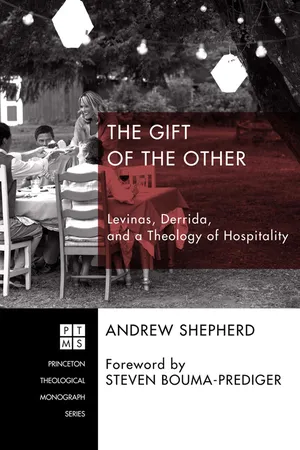
We live in an age of global capitalism and terror. In a climate of consumption and fear the unknown Other is regarded as a threat to our safety, a client to assist, or a competitor to be overcome in the struggle for scarce resources. And yet, the Christian Scriptures explicitly summon us to welcome strangers, to care for the widow and the orphan, and to build relationships with those distant from us. But how, in this world of hostility and commodification, do we practice hospitality? In The Gift of the Other, Andrew Shepherd engages deeply with the influential thought of French thinkers Emmanuel Levinas and Jacques Derrida, and argues that a true vision of hospitality is ultimately found not in postmodern philosophies but in the Christian narrative. The book offers a compelling Trinitarian account of the God of hospitality--a God of communion who "makes room" for otherness, who overcomes the hostility of the world though Jesus' life, death, and resurrection, and who through the work of the Spirit is forming a new community: the Church--a people of welcome.
Information
Topic
Theology & ReligionSubtopic
Christian Ministry1
The Transcendence of the Other and Infinite Responsibility
The Philosophy of Emmanuel Levinas
A Brief Biography
Born in Lithuania in 1906, where he received a traditional Jewish education, Emmanuel Levinas began his philosophical studies at the University of Strasbourg in 1923. It was in Strasbourg that Levinas also met and began a lifelong friendship with Maurice Blanchot. In 1928, Levinas moved to Freiburg University to continue his studies in the emerging field of phenomenology being pioneered by Edmund Husserl. Here at Freibrug, Levinas also met and sat under the teaching of Martin Heidegger, whose work Sein und Zeit (Being and Time) (1927) had recently been published. In 1930, Levinas became a naturalised French citizen and with the outbreak of World War Two was ordered to report for military duty. Captured by the German Army, Levinas spent the duration of the war as a prisoner of war, living in separate barracks with other Jewish prisoners. While his wife and daughter, with the assistance of Blanchot, found safe refuge in a French monastery, all of Levinas’ extended family, including his mother-in-law, father and brothers, were victims of the holocaust. That such experiences of hostility and hospitality clearly shape Levinas’ own philosophical thought, is made overt in his second major work Autrement qu’être ou au-delà de l’essence—Otherwise than Being or Beyond Essence (1974) which Levinas dedicates: “To the memory of those who were closest among the six million assassinated by the National Socialists, and of the millions on millions of all confessions and all nations, victims of the same hatred of the other man, the same anti-semitism.”29
After the war Levinas became a teacher at, and then later director of, a private Jewish High School in Paris, but it was not until 1961 that he gained a tertiary academic position, teaching philosophy at the University of Poitiers. Nevertheless, his work was already having a major influence on the thought of other French thinkers such as Jean-Paul Satre, Jean Wahl and Jacques Derrida. An essay on Levinas’ thought by Derrida—“Violence and Metaphysics” (1965)—along with the translation into English of his major works Totalité et infini: essai sur l’extériorité (Totality and Infinity) (1961) and Autrement qu’être ou au-delà de l’essence (Otherwise than Being or Beyond Essence) (1974), led to a growing awareness of Levinas’ philosophy amongst a broader audience.30 In recent decades numerous philosophers, religious thinkers and Christian theologians—including notably Pope John Paul II—have shown a keen interest in his thought.31 Levinas died in Paris on December 25th, 1995.
Totality, Infinity, and the “Other”
At the heart of Levinas’ philosophy is an attempt to change the nature of the Western philosophical tradition. According to Levinas, the Western philosophical tradition since the time of Plato has been obsessed with questions of ontology. This has resulted in philosophies in which the ethical relations between particular beings is subservient to universal mediators such as the Form/eidos in Plato, Spirit in Hegel or Being/Dasein in Heidegger.32 For Levinas, the problem is that in attempting to ground meaning in being-ontology, these philosophies have failed to give an account of the relationship between ethical beings. While showing the influence of Husserl and Heidegger, Levinas rejects philosophy’s traditional preoccupation with metaphysical questions about being and epistemological concerns giving instead priority to ethics. In contrast to traditional philosophy—the love of wisdom—Levinas seeks through his work to articulate a wisdom of love.
For Levinas, “totalizing” philosophies, in their quest to find meaning in ontological questions, are indifferent to the “Other” and exhibit anti-humanist tendencies which lead ultimately to the horrors of the Holocaust.33 Such philosophy, Levinas believes, is not merely incapable of responding to the ethical challenges posed by the post-holocaust world, but is, itself, partly to blame for a world of inhumanity.34 In contrast to these philosophies of Totality, Levinas articulates a philosophy of Infinity, encountered through the transcendence of the Other.
Levinas’ philosophical project centers around his use of Descartes’ idea of Infinity. In his Third Meditation Descartes argues that when we think of and conceive of infinity, infinity itself exceeds the idea one can have of it. While for Descartes this structure of infinity was applied to the divine—God always exceeds the concept of God that we as subject think—Levinas takes this Cartesian concept and applies this formal structure of thought, which emphasizes inequality, non-reciprocity and asymmetry, to the relationship of the subject to the human Other. For Levinas, the absolute exteriority of the other person means that the Other can never be assimilated or incorporated into a totality. The Other is infinite. This idea of infinity, this pre-ontological alterity, is the core principle around which Levinas’ philosophy is gathered. This pre-ontological alterity is beyond essence and being but its formal structure can be seen in the concrete phenomenon of our ethical interaction with the Other. For Levinas, “the ethical relation with the face of the other person is the social expression of this formal structure.”35
Ethics as First Philosophy
Levinas shares the concern of other French post-structuralist writers that in seeking to express an understanding of God through the language of ontology, God ceases to be transcendent. Within this perspective Western metaphysical philosophy is constantly in danger of lapsing into forms of idolatry.36 Further, his concern is that such metaphysical thinking draws attention away from the plight of the Other and fails to lead people into ethical action. A long passage from Totality and Infinity illustrates Levinas’ concern towards these twin problems of potential idolatry and ethical inaction which he sees as inherent in Western philosophy, and articulates his response to these problems. He writes:
To posit the transcendent as stranger and poor one is to prohibit the metaphysical relation with God from being accomplished in the ignorance of men and things. The dimension of the divine opens forth from the human face. A relation with the Transcendent free from all captivation by the Transcendent is a social relation. It is here that the Transcendent, infinitely other, solicits us and appeals to us. The proximity of the Other, the proximity of the neighbor, is in being an ineluctable moment of the revelation of an absolute presence (that is, disengaged from every relation), which expresses itself. His very epiphany consists in soliciting us by his destitution in the face of the Stranger, the widow, and the orphan. The atheism of the metaphysician means, positively, that our relation with the metaphysical is an ethical behaviour and not theology, not a thematization, be it a knowledge by analogy, of the attributes of God. God rises to his supreme and ultimate presence as correlated to the justice rendered unto men. The direct comprehension of God is impossible for a look directed upon him, not because our intelligence is limited, but because the relation with infinity ...
Table of contents
- Title Page
- Foreword - Steven Bouma-Prediger
- Preface
- Introduction: A World for All?
- 1. The Transcendence of the Other and Infinite Responsibility: The Philosophy of Emmanuel Levinas
- 2. Unconditional Hospitality, the Gift of Deconstruction?: The Philosophy of Jacques Derrida
- 3. Levinasian and Derridean Hospitality: Ethics beyond Ontology?
- 4. Gifted, Called, and Named: Trinitarian Personhood and an Ontology of Communion
- A tête à tête: Wrestling with the Other—Getting to Grips with Hostility (Genesis 29-33)
- 5. “LOGOS,” “Sacrificial Substitute,” and “Eikon”: Christology and the Overcoming of Hostility
- A tête à tête: Seen by the Other—The Call to Faith (John 1:35-51)
- 6. Dwelling in Christ and the In-Dwelling Other: Forming the Ecclesial and Eschatological Self
- A tête à tête: A Drink with the Other—Gift-Exchange and Transformed Identity (John 4:1-42)
- 7. Performing a Different Script: Participation in the Practice of Ecclesial Hospitality
- A tête à tête: Hosted by the Other—The Journey to Hospitality (Luke 6:12-16; 9:1-6, 10-17, 51-55; 24:13-35)
- Conclusion: Grounded Hospitality—Community, Ecological Care, and Inter-Faith Relationships
- Bibliography
Trusted by 375,005 students
Access to over 1.5 million titles for a fair monthly price.
Study more efficiently using our study tools.
Frequently asked questions
Yes, you can cancel anytime from the Subscription tab in your account settings on the Perlego website. Your subscription will stay active until the end of your current billing period. Learn how to cancel your subscription
No, books cannot be downloaded as external files, such as PDFs, for use outside of Perlego. However, you can download books within the Perlego app for offline reading on mobile or tablet. Learn how to download books offline
Perlego offers two plans: Essential and Complete
- Essential is ideal for learners and professionals who enjoy exploring a wide range of subjects. Access the Essential Library with 800,000+ trusted titles and best-sellers across business, personal growth, and the humanities. Includes unlimited reading time and Standard Read Aloud voice.
- Complete: Perfect for advanced learners and researchers needing full, unrestricted access. Unlock 1.5M+ books across hundreds of subjects, including academic and specialized titles. The Complete Plan also includes advanced features like Premium Read Aloud and Research Assistant.
We are an online textbook subscription service, where you can get access to an entire online library for less than the price of a single book per month. With over 1.5 million books across 990+ topics, we’ve got you covered! Learn about our mission
Look out for the read-aloud symbol on your next book to see if you can listen to it. The read-aloud tool reads text aloud for you, highlighting the text as it is being read. You can pause it, speed it up and slow it down. Learn more about Read Aloud
Yes! You can use the Perlego app on both iOS and Android devices to read anytime, anywhere — even offline. Perfect for commutes or when you’re on the go.
Please note we cannot support devices running on iOS 13 and Android 7 or earlier. Learn more about using the app
Please note we cannot support devices running on iOS 13 and Android 7 or earlier. Learn more about using the app
Yes, you can access The Gift of the Other by Andrew Shepherd in PDF and/or ePUB format, as well as other popular books in Theology & Religion & Christian Ministry. We have over 1.5 million books available in our catalogue for you to explore.