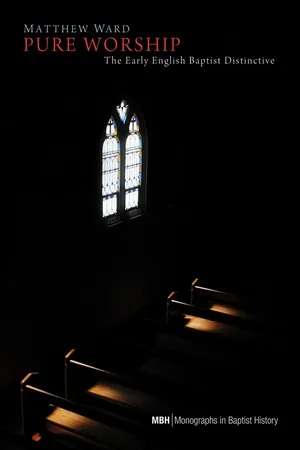
- 258 pages
- English
- ePUB (mobile friendly)
- Available on iOS & Android
eBook - ePub
About this book
Baptists are not often thought of as leading theologians and practitioners of worship. But forgotten in history is one crucial fact: the Baptist tradition formed out of a desire to worship God purely. Early Baptists devoted immense energy to questions of worship and drew conclusions of even contemporary value. Through the seismic liturgical shifts of English society in the seventeenth century, worship was both their most galvanizing and disintegrating impulse. As time passed and terminology changed and Baptists shied away from this divisive topic, this emphasis was lost. No one today considers worship a Baptist distinctive.
Pure Worship re-creates the fascinating historical context of the early years of the English Baptists. Examining many thousands of manuscript pages, Matthew Ward pieces together an entire theology of worship that not only guided the early Baptists but also attracted the attention of many elements of English Christianity. Baptist thoughts on worship were neither minor nor tangential but the very heart of what distinguished them from the rest of England. Pure Worship offers a complete reenvisioning of what it meant to be an early Baptist and reveals their overwhelming desire to be known as pure worshippers of God.
Information
Topic
Theology & ReligionSubtopic
Christian Denominationsone
❧
Introduction
With the words “worship,” “the,” “Baptist,” and “distinctive” in its title, this book must be asking for trouble. “Worship,” in addition to being rejected as a theologically and historically robust topic of study in some circles, stirs up intense and sometimes quarrelsome feelings. “The” simply puts people on the defensive by connoting finality or superiority. Just about everyone has drawn some sort of conclusion about “Baptists,” and few want to hear anything else about those Baptists and their “distinctives.” But please bear with this book’s presentation, for it will offer a benevolent approach to a trendy matter of surprising historic significance. As more Christian traditions, including Baptists, seek new (and old) resources for local church worship, it might be refreshing to learn that Baptists once had a great deal to say about its foundational principles and practices.
The book’s overall argument culminates in a Restoration declaration, “But the Lord grant that we all may be pressing after more Purity both in the Form and Spirit of Holy-Worship; not declining to any thing that is not of Divine Institution.”1 Innocent as that request may sound, it was part of a hugely destructive debate among London Baptists about corporate worship that at least one layman wanted to end “for the preservation of the Peace and Purity of the Baptized Churches.”2 In other words, the purity and unity of their Baptist movement was tied to the purity of their churches’ worship. Individual church actions in worship could not be overlooked any more than doctrinal declarations in a sermon. Most importantly, this layman understood that a church’s identity and its worship were inseparable.
That such an idea, particularly the intrinsic relationship between worship and a church’s foundation, might be foreign to some readers is an obstacle this book seeks to overcome. An important group of early Baptists, the primary subjects of this book, so prioritized the pure worship of God that they shaped their entire tradition around it. Their conclusions about worship were unique, ultimately setting them apart from many surrounding Christians and even at odds with one another. Worship was their central distinctive, more so than concerns of polity, hermeneutics, or even baptism, for each of those concerns was birthed or driven by a quest for pure worship. Baptists have long been known for their driving commitment to key principles or “distinctives”; it is perhaps telling that worship is not longer recognized as one of them.
The Winding Quest for a Baptist Distinctive
Many Baptists today care about their identity—what they prioritize and what makes them unique.3 Baptist history is one of controversy upon controversy with respect to their distinct identity as various groups have competed for associative supremacy, claiming to represent the true Baptist way.4 Alexander Campbell drew away thousands of Baptists by claiming to be the true restorationist of his generation. J. R. Graves nearly redefined Baptist identity through “old landmarks,” ultimately costing W. H. Whitsitt his position at Southern Seminary for arguing that English Baptists had not always practiced baptism by immersion. Cities and counties rehashed old prejudices as they trumpeted the superiority and antiquity of the traditions that came to be known as Charleston and Sandy Creek.5 As questions of biblical orthodoxy began to dominate denominational talks in the middle part of the last century, Baptist leaders and historians argued amongst themselves into which theological lineage they should trace their roots.6 When it became evident that a conservative faction would claim key victories that would enable them to direct the Southern Baptist Convention, their opponents claimed that their tactics and beliefs ran contrary to the traditional Baptist identity, the outcome of which has been numerous splits and secessions.7 Even more recently, Baptist leaders have lined up on both sides of the debate over Reformed theology, in each case appealing to a traditional Baptist identity in their support.8
There are countless challenges in any study of this nature. One should already be evident: so far, this introduction has used the terms “distinctive,” “identity,” “way,” “tradition,” and “principle” almost interchangeably, though each has a unique meaning. The word “distinctive” is particularly problematic because technically it does not exist as it is being used (as a noun); there might be “distinctive Baptists,” but not “Baptist distinctives.” The connotation is clear enough, and the word has already embedded itself in this debate.9 In common usage, it seems to mean “that which distinguishes Baptists from other Christian traditions.” This definition of a distinctive immediately points to a second challenge to this quest: that a traditional Baptist identity exists and that it is distinct from other Christian traditions. Acknowledging “a” Baptist identity creates further problems because it assumes that there is some kind of characteristic that unites all of the different groups who claim to be Baptist (or baptist), and that they will agree on those characteristics. The previous paragraph perhaps established the wistfulness of such an assumption.10 As a result, the word “distinctive” will take on a unique connotation in these pages.11 Finally, the idea of “distinction” tends to put different groups on the defensive in a world that is getting ever smaller. To be “distinct” from someone else implies a type of superiority, and indeed some Baptists have used their “distinctive identity” in such a condescending way.12 At no point will “distinct” ever mean “superior” in this book. One of the beliefs the early Baptists championed was the concept of a kingdom of priests (1 Pet 2:4–10; Rev 1:4–7) in which all Christians stood together before God the Father, all fallen, all forgiven, and yet given different gifts and put in different circumstances. When these chapters consider that which made Baptists unique, it is only to tell the story of part of God’s people, believing that their struggles and conclusions are worth identifying and remembering.13 Explaining the arguments for or against certain beliefs is not meant as a value judgment of those who held them.
To help set the stage for any reader who may not be familiar with Baptist history or theology, consider these illustrations. Baptists in America have claimed a number of distinctives over the years, including believers’ baptism by immersion, regenerate church membership, soul competency, biblical inerrancy, and modified Calvinism.14 Others could easily have been chosen, including religious liberty and the missionary mindset. And Baptists will disagree strongly as to exactly what each of these examples could or should mean (discussions of Baptist distinctives become hazardous quickly). Further, a number of other Christian groups hold to one or all of these beliefs, so “distinctive” rather entails a distinct combination or tenacity with which Baptists hold such beliefs. Discussions of a particular distinctive often follow one of these paths abbreviated below.
The name “Baptist” generally encourages one to think about baptism, namely believers’ baptism by immersion. Those joining a Baptist church from a tradition with a different understanding of baptism often have to be “re-baptized” as a term of joining.15 Baptism itself is a commitment (a symbol or a seal) reserved for those who have knowingly professed to follow Jesus Christ. This view of baptism creates a formal distinction between Baptists and many other Christians, though very few authors actually start their list of Baptist distinctives with baptism.16 Instead, the priority of believers’ baptism by immersion often comes from an argument from history. A number of Baptist historians have said not that baptism is a primary distinctive today but that it was so to the early English Baptists.17
Baptists often point to their regenerate church membership as that which distinguishes them from many other Christians. Related to believers’ baptism by ...
Table of contents
- Title Page
- Foreword - Malcolm B. Yarnell III
- Preface
- Abbreviations
- Chapter One: Introduction
- Chapter Two: The Liturgical World of the English Reformation
- Chapter Three: Free Worship and a New Concept of the Church
- Chapter Four: True Worship and a New Appreciation of the Scriptures
- Chapter Five: Gospel Worship and a New Purpose of the Gathering
- Chapter Six: Baptist Worship and a New Identity of the Faithful?
- Chapter Seven: The Importance of Pure Worship
- Bibliography
Trusted by 375,005 students
Access to over 1.5 million titles for a fair monthly price.
Study more efficiently using our study tools.
Frequently asked questions
Yes, you can cancel anytime from the Subscription tab in your account settings on the Perlego website. Your subscription will stay active until the end of your current billing period. Learn how to cancel your subscription
No, books cannot be downloaded as external files, such as PDFs, for use outside of Perlego. However, you can download books within the Perlego app for offline reading on mobile or tablet. Learn how to download books offline
Perlego offers two plans: Essential and Complete
- Essential is ideal for learners and professionals who enjoy exploring a wide range of subjects. Access the Essential Library with 800,000+ trusted titles and best-sellers across business, personal growth, and the humanities. Includes unlimited reading time and Standard Read Aloud voice.
- Complete: Perfect for advanced learners and researchers needing full, unrestricted access. Unlock 1.5M+ books across hundreds of subjects, including academic and specialized titles. The Complete Plan also includes advanced features like Premium Read Aloud and Research Assistant.
We are an online textbook subscription service, where you can get access to an entire online library for less than the price of a single book per month. With over 1.5 million books across 990+ topics, we’ve got you covered! Learn about our mission
Look out for the read-aloud symbol on your next book to see if you can listen to it. The read-aloud tool reads text aloud for you, highlighting the text as it is being read. You can pause it, speed it up and slow it down. Learn more about Read Aloud
Yes! You can use the Perlego app on both iOS and Android devices to read anytime, anywhere — even offline. Perfect for commutes or when you’re on the go.
Please note we cannot support devices running on iOS 13 and Android 7 or earlier. Learn more about using the app
Please note we cannot support devices running on iOS 13 and Android 7 or earlier. Learn more about using the app
Yes, you can access Pure Worship by Matthew Ward in PDF and/or ePUB format, as well as other popular books in Theology & Religion & Christian Denominations. We have over 1.5 million books available in our catalogue for you to explore.