- 150 pages
- English
- ePUB (mobile friendly)
- Available on iOS & Android
eBook - ePub
About this book
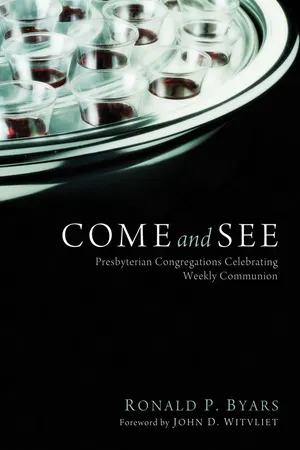
Why has there been such an increase in the number of Presbyterian congregations celebrating the Lord's Supper every week? Come and See explores the following causes: generational change, ecumenical convergence, revisiting Reformed roots, heightened interest in spirituality, new perspectives offered by ritual studies, and the postmodern opening to a deeper appreciation of Scripture.
Worship that is a balance of Word and Sacrament is incarnationally serious, recognizing that human persons are embodied beings who bring to worship all of our senses--not only the ability to process words.
Presbyterian congregations celebrating weekly Communion are discovering ways of being and thinking missionally as they link their experiences of being nourished at the Holy Table to the needs of people who are physically as well as spiritually hungry. Come and See describes a number of congregations who have made the transition to weekly Communion and tells how they did it, working within Presbyterian polity and local cultures. Some are traditional, established congregations, while others are new church developments. They may be found in the north and south, east and west, across the broad Presbyterian theological and demographic spectrums.
Information
Topic
Theology & ReligionSubtopic
Christian DenominationsOne
Come and See
They Shall Come from East and West . . .
Neal Presa, pastor of the Presbyterian Church in Middlesex, New Jersey, was elected Moderator of the 220th General Assembly of the Presbyterian Church USA (PCUSA). Middlesex, a town of about fourteen thousand residents just forty-five minutes west of New York City, is a predominantly Italian-American community with a large Roman Catholic parish but also two or three large nondenominational churches nearby. While nominally Catholic for the most part, many Middlesex residents send their children to catechism but are not themselves active in the parish. Though highly churched, the ambience of the community tends to be secular.
Middlesex Presbyterians recently celebrated their fiftieth anniversary, the congregation having been chartered on Pentecost in 1962. The congregation is small, with fewer than a hundred members, about half of whom have grown up in the community while the other half are more likely to be from West Africa—Cameroon or Sierra Leone. It is not uncommon for the West African members, about half of them cradle Presbyterians, to be highly educated. If you should decide to visit Middlesex Presbyterian Church at its service on Sunday morning, you will see that the Communion Table has been prepared with Bread and Cup, and the service will lead to the meal. Is it the first Sunday of the month? Maybe. But if you come back on the second Sunday or the third, or any Sunday at all, you will find the Table prepared for you and for all the people of God.
If you were to travel 1,767 miles west from Middlesex, you might choose to worship with Faith Presbyterian Church in Colorado Springs, whose pastor, Tom Trinidad, is Vice Moderator of the 220th General Assembly. When you hear the name Colorado Springs, your mind may turn to Focus on the Family or another evangelical organization such as the Navigators, Young Life, or Youth for Christ, all of which have offices there. A lot of people in Colorado Springs go to church, and many to very conservative churches, but it is a big city (population 660,319), and there is a large, growing and increasingly public and vocal minority report, according to the Vice Moderator. Those who do not go to church have some idea of either what they have rejected or what they think they have rejected.
When Tom Trinidad interviewed at Faith Presbyterian, the committee described the church as relatively small in a sea of megachurches and moderate in a flood of conservative expressions of Christianity. He was impressed by their directness and by their integrity. Faith Church, organized in 1955, records a membership of about two hundred, and it is growing. Worship attendance rose 13 percent in the past year, and the average age of worshipers is getting younger. At Faith, as at Middlesex Presbyterian, the Table is set every Sunday.
Faith Church no longer advertises in the yellow pages but reaches out primarily through the Internet. Their website makes it very clear that they are a PCUSA church and that worship includes weekly Communion. The sign in front of the church is equally explicit. Some newcomers come because they are committed to the PCUSA. Others are drawn by weekly Communion, including some who were accustomed to that in other denominations, but also Presbyterians and others who had been used to quarterly or monthly Communion but know they want more and have come looking for it intentionally.
Ordained PCUSA ministers, nearly all of whom have had to pass an ordination exam in Worship and Sacraments, know that the denomination’s Directory for Worship (part of the Book of Order) says that “it is appropriate to celebrate the Lord’s Supper as often as each Lord’s Day.”1 Accordingly, the Service for the Lord’s Day in the denomination’s Book of Common Worship sets forth weekly Eucharist as the norm to which all would do well to aspire. However, although a significant number of respondents to a Sacramental Practices Survey undertaken in 2011 by the PCUSA Office of Research Services would prefer Communion every week, that practice is the exception.2 It is still a surprise when visiting a Presbyterian church to discover a congregation that shares the meal in at least one service every Lord’s Day. Even more surprising is to find a church whose only service is always a service of Word and Sacrament, like both Middlesex and Faith Churches.
And South and North . . .
And yet, in more and more congregations—from California to New York, and Alabama to Vermont (Presbyterians east and west, south and north)— are moving toward Lord’s Day worship in which the Word is proclaimed in Scripture and sermon and then sealed in the Sacrament every Sunday. Harrison, in northwest Arkansas, is a town where it is more likely that the houses will have a front porch than a deck on the back. A visitor is likely to see a lot of cars with Confederate flags in this town of twelve thousand where there are seventy-six churches and a huge Wal-Mart that can swell the population to forty thousand during shopping hours. As you might expect, there is a strong Southern Baptist presence here, but the religious culture is also influenced by the Churches of Christ, who use no musical instruments in worship. When Charles (“Chip”) Andrus, an Arkansas native, became pastor in 2006, First Presbyterian Church had a membership of about 280, and by 2011 it had grown by over 20 percent. No doubt it helped to have a new building, completed four months after his arrival, but Chip’s commitment to deepening the worship life of the congregation mattered, too. They have been celebrating the Lord’s Supper every Sunday morning for several years and continue weekly Communion even as Chip has answered another call.
Far from Harrison but closer to Middlesex is the Madison Avenue Presbyterian Church, situated on the Upper East Side in one of the wealthiest areas of New York City, but with members from all over the metro area as well as from the Tri-State Area of New Jersey, New York, and Connecticut. This is the church where a young man named Frederick Buechner heard George Buttrick preach so compellingly that it changed the direction of his life.
Since February 2002, under the leadership of its pastor, Fred Anderson, Madison Avenue Church has been celebrating the Lord’s Supper weekly at both of its two morning services and at its 7:30 p.m. service as well. Like Faith Church in Colorado Springs, Madison Avenue is experiencing growth in the number of younger members. Why? “I think a younger generation—folks right up into maybe their early forties—have a very different expectation about what worship should be,” Anderson commented. Some new members are looking for a different way to worship, for a way that’s less about instruction and more about the mystery of meeting Christ. “The whole notion of the Eucharist is that it is where we encounter the presence of Christ now,” says Anderson. At Madison Avenue, they are celebrating adult Baptisms three, four, and five times a year, and the service of both Word and Sacrament has become a part of the congregation’s identity. Young families presume that weekly Communion is simply normative.
Anderson, who served on the task force that developed the PCUSA’s official Directory for Worship, had earlier served as pastor of Pine Street Presbyterian Church in Harrisburg, Pennsylvania, which he also led to weekly celebration of the Lord’s Supper. Pine Street has been celebrating the Eucharist every Lord’s Day at both of its morning services for over twenty years. When Fred Anderson left in response to a call to Madison Avenue in 1992, the Session and the Mission Review Committee at Pine Street determined that weekly Communion had become central to the spiritual nurture of the congregation as well as an important part of the congregation’s identity, and further recommended that support for weekly Communion be a criterion for the selection of the next pastor. Accordingly, the person invited to be the new pastor accepted the call in part because he felt drawn by their practice of weekly Communion. Russell Sullivan, the current pastor, is the second to follow Anderson’s pastorate, and he also delights in the identity of the congregation as a weekly Word and Sacrament church.
Owensboro is a small city of about fifty-eight thousand people in western Kentucky, near the Indiana border. Jonathan Carroll became pastor of First Presbyterian Church in January 2005. It is a congregation with a reputation for being highly educated, erudite and well-to-do, but as times have changed, so has the congregation, and it has become more diverse. While the congregation still includes plenty of physicians, attorneys, teachers, and college and university faculty, it has also become more blended both socially and educationally. When Jonathan Carroll became pastor, the congregation hoped to recover from a substantial loss of members in the wake of a difficult and distressful time in its life.
The Owensboro congregation was trying something new when they celebrated the Lord’s Supper every Sunday in Advent 2007. After Christmas, they reverted to their traditional schedule. They planned to celebrate the Sacrament weekly again in Lent of 2008 but revisited that decision, opting instead for weekly Communion on the Sundays of Eastertide. During those weeks of celebrating the meal every Sunday, the Session engaged in serious reflection about the Sacraments, and resolved not to suspend weekly Communion at the end of the Easter season but to continue for a full liturgical year. At the end of that year, concluding at Pentecost in 2009, the Session decided to make weekly celebration permanent. Many of those who had left the congregation have returned, membership is increasing, attendance is growing, and financial support has increased as well. The congregation is completing a renovation of its building.
From Quarterly to Monthly to . . .
Many Presbyterian congregations have moved from the traditional quarterly to monthly Communion, often simply designating a specific Sunday of the month—usually the first—as Communion Sunday. Of course, while that practice provides for regularity and predictability, it is not related at all to the Christian year, so that a congregation may celebrate the meal on a first Sunday but not on the following Sunday, which may be Easter or Pentecost. When David Batchelder was pastor of the Latrobe (Pennsylvania) Presbyterian Church, that congregation combined both practices, following the suggestion of the PCUSA’s first Supplemental Liturgical Resource of adding Communion in festival seasons to Communion one Sunday a month.3 This usually means adding Sundays such as the First in Advent, the Baptism of the Lord, Easter and Pentecost, Trinity Sunday, and Christ the King. In Latrobe, they added the big occasions in the liturgical calendar but also celebrated weekly Communion every Sunday between Easter Day and Pentecost as well as on the first Sunday of each month during ordinary time, that long period that stretches over the summer and into the fall between Trinity Sunday and the Reign of Christ (Christ the King).
David Batchelder now serves the West Plano Presbyterian Church in the Dallas–Fort Worth area metroplex, a congregation that celebrates the sacred meal weekly. The West Plano church, established in 1975, had deliberately sought a pastor who would support them in sustaining and deepening their rich liturgical tradition, and David followed the call even though it led him from a larger to a smaller congregation—not a typical move.
In 2003, when David arrived in West Plano, the public schools reported that they enrolled students from ninety-two national backgrounds. Collin County was and still is growing fast. It is, by and large, an affluent community, but one may still find people there who are struggling with homelessness. When David began his ministry, the congregation had two Sunday morning services, but attendance at the second service had begun to decline. They had been celebrating the Lord’s Supper every week at the early service since the early 1990s, beginning the practice under the leadership of the congregation’s third pastor, the Reverend Wes Lackey. The second service celebrated the Eucharist frequently, but not every Sunday, following the pattern of festival seasons and the odd Sundays (first, third, and sometimes fifth) during ordinary time. West Plano began a weekly celebration at both services in 2006. Having had a positive experience with a single service during the summer, and having adequate space, they chose to move to a single service in 2009, with weekly Communion.
The Edgewood Presbyterian Church is located in Homewood, the oldest suburb just south of the city of Birmingham, Alabama. Edgewood was founded in 1912 as members from two Cumberland Presbyterian churches came together to organize a congregation to be affiliated with the PCUSA, the so-called Northern church in that time decades before reunion. In the early twentieth century, Homewood was largely rural, and Edgewood was the first church of any kind to be organized there. It functioned as a community church, including people from several denominations. When the congregation called a pastor who was (so to speak) “too Presbyterian” for the Baptists, they left and started their own church. The Methodists followed soon after. With a population of about twenty-five thousand people, Homewood now has many churches, a number of them very large.
In 1978, two-thirds of the Edgewood membership followed the pastor out of the denomination and into the Presbyterian Church in America. The faithful remnant was left to pay off the mortgage on what was then a new building. After a dozen years of struggle, Sid Burgess came to be their pastor in 1990, serving another Presbyterian congregation at the same time. The remaining Edgewood members numbered around fifty...
Table of contents
- Title Page
- Foreword
- Preface
- Acknowledgments
- Abbreviations
- Chapter 1: Come and See
- Chapter 2: Will It Bring the Numbers Up?
- Chapter 3: Problems, Obstacles, and Opportunities
- Chapter 4: Introducing Change Successfully
- Chapter 5: Where Are We Going and How Shall We Get There?
- Chapter 6: Owning the Practice
- Bibliography
Trusted by 375,005 students
Access to over 1.5 million titles for a fair monthly price.
Study more efficiently using our study tools.
Frequently asked questions
Yes, you can cancel anytime from the Subscription tab in your account settings on the Perlego website. Your subscription will stay active until the end of your current billing period. Learn how to cancel your subscription
No, books cannot be downloaded as external files, such as PDFs, for use outside of Perlego. However, you can download books within the Perlego app for offline reading on mobile or tablet. Learn how to download books offline
Perlego offers two plans: Essential and Complete
- Essential is ideal for learners and professionals who enjoy exploring a wide range of subjects. Access the Essential Library with 800,000+ trusted titles and best-sellers across business, personal growth, and the humanities. Includes unlimited reading time and Standard Read Aloud voice.
- Complete: Perfect for advanced learners and researchers needing full, unrestricted access. Unlock 1.5M+ books across hundreds of subjects, including academic and specialized titles. The Complete Plan also includes advanced features like Premium Read Aloud and Research Assistant.
We are an online textbook subscription service, where you can get access to an entire online library for less than the price of a single book per month. With over 1.5 million books across 990+ topics, we’ve got you covered! Learn about our mission
Look out for the read-aloud symbol on your next book to see if you can listen to it. The read-aloud tool reads text aloud for you, highlighting the text as it is being read. You can pause it, speed it up and slow it down. Learn more about Read Aloud
Yes! You can use the Perlego app on both iOS and Android devices to read anytime, anywhere — even offline. Perfect for commutes or when you’re on the go.
Please note we cannot support devices running on iOS 13 and Android 7 or earlier. Learn more about using the app
Please note we cannot support devices running on iOS 13 and Android 7 or earlier. Learn more about using the app
Yes, you can access Come and See by Ronald P. Byars in PDF and/or ePUB format, as well as other popular books in Theology & Religion & Christian Denominations. We have over 1.5 million books available in our catalogue for you to explore.