- 336 pages
- English
- ePUB (mobile friendly)
- Available on iOS & Android
eBook - ePub
About this book
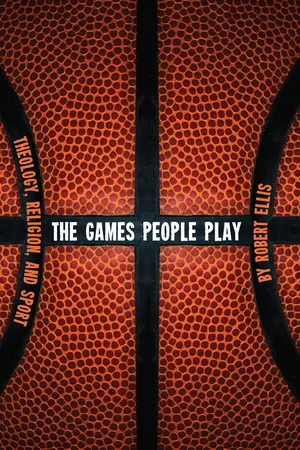
In The Games People Play, Robert Ellis constructs a theology around the global cultural phenomenon of modern sport, paying particular attention to its British and American manifestations. Using historical narrative and social analysis to enter the debate on sport as religion, Ellis shows that modern sport may be said to have taken on some of the functions previously vested in organized religion. Through biblical and theological reflection, he presents a practical theology of sport's appeal and value, with special attention to the theological concept of transcendence.
Throughout, he draws on original empirical work with sports participants and spectators. The Games People Play addresses issues often considered problematic in theological discussions of sport such as gender, race, consumerism, and the role of the modern media, as well as problems associated with excessive competition and performance-enhancing substances.
As Ellis explains, "Sporting journalists often use religious language in covering sports events. Salvation features in many a headline, and talk of moments of redemption is not uncommon. Perhaps, somewhere beyond the cliched hyperbole, there is some theological truth in all this after all."
Information
Topic
Theology & ReligionSubtopic
Christian Church1
Reaching for the Heavens
A (Very) Brief History of Religion and Sport
To those whose association with sport is mainly a matter of the grandstand or the TV, or indeed the sports center or swimming pool, it may come as a surprise to discover that the study of sport has become a major growth area in universities across the Western world. The sports pages of our newspapers give ample evidence of an interest in the physiological and even psychological aspects of sports performance, but in the academy scholars have been gainfully and increasingly employed on tracing the history of sports, in studying sport as a social phenomenon, and also considering sport’s relation to religion—a relationship which properly and inevitably presents itself for scrutiny in any serious study of sport. Historically, taking a rather grand view and simplifying somewhat, we can say that the relationship between religion and sport (specifically, between Christianity and sport) has been characterized by three kinds of attitude. These attitudes have tended to predominate (or are very well illustrated) in particular historical phases and it permits the narrative which follows to be arranged into three distinct parts.
In ancient times sport appears to have been seen as a vehicle for communion with the divine and for regulating humanity’s relationship with God or the gods. In such a world, sport was a sacred practice that enabled humans to reach for the heavens, so to speak, and many historians argue that the roots of modern sport are to be found in religious rituals of one sort or another. While few would seriously speak of religion and sport as being coterminous today, there are some contemporary attitudes to sport that might be seen as similar to aspects of these ancient characteristics.
By contrast, another response typical of some early Christian and post-Reformation attitudes has been to see sport as a dangerous diversion, a frivolous exercise, a distraction from the serious business of living. If not sinful in itself, then it is quite likely to lead its performers and spectators towards sin and needs to be treated with caution or even hostility. This attitude has often been manifested in official pronouncements from church authorities, though various pieces of evidence suggest that the situation “on the ground” has often been more hospitable. Those who opposed games and sport did so because, far from believing that it allowed people to reach through sport for the heavens, they feared that it might lead them instead to hell.
A third response, again evident in antiquity but also in Christian responses within the last two hundred years, has seen sport as a means of character-building and moral improvement, and as such a highly appropriate activity for Christian participation. According to a typical instance of such an attitude, sport may not have any intrinsic religious substance but it may be an instrument in developing godly habits or states of mind. Alongside approval for sports generally we frequently see its instrumental usefulness—for spiritual growth, as an attention-grabbing tool in evangelism or a wholesome pastime for the disadvantaged, or indeed for more commercial purposes: sport has been useful to all kinds of people, some of them Christian ideologues and practitioners. Sport might be the ladder upon which its players might climb to godliness.
As we consider the history of sport we will see these three broad types of response manifested chronologically. To some extent all three are still characteristic of our contemporaries’ more ambivalent responses to sport, and all three will offer fruitful themes for our later theological reflections.
In chapter 4 we will define sport more carefully, but a word about what is meant by “sport” will be useful for us as we begin—if only to show that in this sphere, as in so many others, complex human activity defies neat definition. We need to distinguish “sport” from both “play” and “games,” though the three terms may be said to nest inside one another. This will be significant when we consider the theology of sport, because we will also need to consider play and games in that context. “Play” is generally thought to be an unstructured activity, entire to itself and for its own sake. Some scholars thus speak of play as “autotelic”1—it has no end or purpose beyond itself. Play is throwing a Frisbee to a friend on the beach or trying to hit a can with pebbles, or it may be a child’s make-believe game. In sporting terms though, a “game” may also involve playing Frisbee on the beach but now there are makeshift rules, changing and possibly unequal teams, common agreement on what might constitute a score. But this remains very local. There may or may not be an agreed finish time, though it is quite likely that it will be set by external requirements (dinner) or just fizzle out as people leave. Frisbee becomes “sport” when the rules that govern the game are universalized and bureaucratized. They are fixed away from the location of the game, and they remain the same on repeated playing of the game. Soccer on the beach will have many of the universalized rules (goals, equal teams, fouls, and free kicks) but probably not all: touch lines, off sides, referees, standardized measured goals with posts, and so on. These types of activity perhaps cannot be entirely and definitively separated from one another, there will be transitional instances such as that soccer game on the beach, which show how they bleed into one another. Generally, full rules (and, we might say, “true sport”) are found on the playing field and the court. And we should also note that wherever and whenever this sport has manifested itself, other things have tended to be found too: in particular, commercial interests have never been far away. Someone will sell the spectators a drink, and there is a good chance that someone else will open a book to take bets. Those who lament the lost innocent days of sport are lamenting an illusion. In fact, even when sport was primarily a religious ritual it is likely that commercial considerations intruded.
The term “sport,” then, refers precisely to a relatively modern phenomenon. What we now mean by “sport” in our everyday conversation, “modern sport” in its universalized and bureaucratized forms, may generally be said to be less than two hundred years old—though a case could be made in a few instances to go back further. However, as we shall see, the sport of the ancient Greeks has many features in common with “modern sports,” while many of the major public spectacles of the Romans perhaps had rather fewer such common features. By the Middle Ages, most of the activities that we might consider in a history of sport are not really sports at all in the sense in which I have defined them. I use the term “sport,”2 then, with some elasticity in my historical narrative. The ancient proto-sports have some connection with our modern activities, but were also technically different in important ways. It would be tiresome to note this at each and every juncture but the reader ought to bear the differences in mind.
Sacred Sport?
Sport appears to have its ancient origins in religion and ritual. Nowhere is this more graphically evident than in an ancient and deadly Meso-American ball game that was very important for three thousand years until the invasion of the Conquistadors and had a number of permutations. It was played on a court rather than a field, and more than fifteen hundred of these courts have been discovered. Mayan records suggest a mythology relating to the sun and the moon played out in the ball game: the game is variously described now according to the narrator as a cross between football, lacrosse, basketball, and volleyball. It appears that any part of the body except the hands could be used to hit the ball, and in some variations what we might call rackets and bats were used. In some early versions it is likely that the ball had to be played with the hip. The goal was a ring only slightly larger than a basketball hoop, placed high on a wall at right angles to the center of the court. A five-foot-high wall in front of the main wall and under the hoop meant that a direct angle of approach was not possible—the ball had to be bounced off the wall into the goal. Each team had seven players.
Sometimes the game appears to have been played for entertainment alone, often on more or less improvised courts, but the ceremonial version of the game was a much more serious affair. It seems that the ball may have been a symbo...
Table of contents
- Title Page
- Introduction: A Grandstand View at the Cotswold Olimpicks
- 1. Reaching for the Heavens: A (Very) Brief History of Religion and Sport
- 2. A Question of Sport: Sport in Contemporary Society
- 3. 1851 and All That: Losing My Religion?
- 4. Play and Sport: Initial Theological Explorations
- 5. “A Matter of Life and Death”? Playing and Winning
- 6. “To Boldly Go”: Sport as Divine Encounter?
- Conclusion: “The Theology Behind All Cultural Expressions”
- Bibliography
Trusted by 375,005 students
Access to over 1.5 million titles for a fair monthly price.
Study more efficiently using our study tools.
Frequently asked questions
Yes, you can cancel anytime from the Subscription tab in your account settings on the Perlego website. Your subscription will stay active until the end of your current billing period. Learn how to cancel your subscription
No, books cannot be downloaded as external files, such as PDFs, for use outside of Perlego. However, you can download books within the Perlego app for offline reading on mobile or tablet. Learn how to download books offline
Perlego offers two plans: Essential and Complete
- Essential is ideal for learners and professionals who enjoy exploring a wide range of subjects. Access the Essential Library with 800,000+ trusted titles and best-sellers across business, personal growth, and the humanities. Includes unlimited reading time and Standard Read Aloud voice.
- Complete: Perfect for advanced learners and researchers needing full, unrestricted access. Unlock 1.5M+ books across hundreds of subjects, including academic and specialized titles. The Complete Plan also includes advanced features like Premium Read Aloud and Research Assistant.
We are an online textbook subscription service, where you can get access to an entire online library for less than the price of a single book per month. With over 1.5 million books across 990+ topics, we’ve got you covered! Learn about our mission
Look out for the read-aloud symbol on your next book to see if you can listen to it. The read-aloud tool reads text aloud for you, highlighting the text as it is being read. You can pause it, speed it up and slow it down. Learn more about Read Aloud
Yes! You can use the Perlego app on both iOS and Android devices to read anytime, anywhere — even offline. Perfect for commutes or when you’re on the go.
Please note we cannot support devices running on iOS 13 and Android 7 or earlier. Learn more about using the app
Please note we cannot support devices running on iOS 13 and Android 7 or earlier. Learn more about using the app
Yes, you can access The Games People Play by Robert Ellis in PDF and/or ePUB format, as well as other popular books in Theology & Religion & Christian Church. We have over 1.5 million books available in our catalogue for you to explore.