eBook - ePub
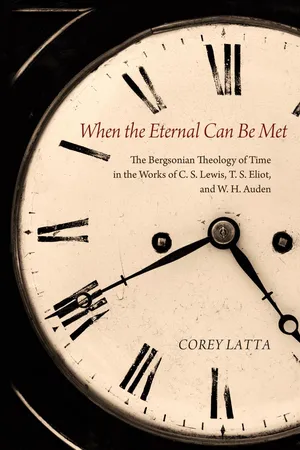
When the Eternal Can Be Met
The Bergsonian Theology of Time in the Works of C. S. Lewis, T. S. Eliot, and W. H. Auden
- 234 pages
- English
- ePUB (mobile friendly)
- Available on iOS & Android
eBook - ePub
When the Eternal Can Be Met
The Bergsonian Theology of Time in the Works of C. S. Lewis, T. S. Eliot, and W. H. Auden
About this book
When the Eternal Can Be Met excavates the philosophy behind the theology of the twentieth century's most prominent Christian writers: C. S. Lewis, T. S. Eliot, and W. H. Auden. These three literary giants converted to Christianity within little more than a decade of one another, and interestingly, all three theological authors turned to the theme of time. All three authors also came to remarkably similar conclusions about time, positing that the temporal present moment allowed one to meet the eternal.
Decades before Lewis, Eliot, and Auden sought to creatively construct a fictive or poetic theology of time, the prominent philosopher Henri Bergson wrote about time's power to transform an individual's emotional and spiritual state, a theory well known by Lewis, Eliot, and Auden. When the Eternal Can Be Met argues that one cannot fully understand Lewis, Eliot, and Auden's theology of time without understanding Bergson's theories. From the secular philosophy of Bergson dawned the most important works of literary theology and treatments of time of the twentieth century, and in the Bergson-influenced literary constructs of Lewis, Eliot, and Auden, a common theological articulation sounds out--time present is where humans meet God.
Information
Topic
Theology & ReligionSubtopic
Literary Criticism❧ 1
The Task of Theologizing Literature
in the Twentieth Century
Christian theology is the schema by which Lewis, Eliot, and Auden conceived and implemented their writings. Their Christian faith subsumed their treatments of those themes most pressing to the twentieth-century mind: epistemology, the human condition, the self’s relationship to the other, man’s experience with the divine, and time, all of which were employed in these authors’ writings. Not only did Lewis, Eliot, and Auden look at literary themes through a theological lens, but they also engaged in the act of constructing theology, as will be shown in their works on time. However, though their Christian faith influenced their individual productions of art, Lewis, Eliot, and Auden never collectively formulated a Christian view of art, nor did they conceive of any uniform theological hermeneutic or way of viewing the theological in literature.
Other than their occasional correspondence with one another, Lewis, Eliot, and Auden had no contact that would produce a common theological approach to writing as a whole or a particular literary theme. Because the three authors thus never intended to create among themselves a theory of theological literature, I will look elsewhere for such a theory to describe the nature of theologized literature in the twentieth century. So in this chapter I will look at the work of philosopher Charles Taylor and theological writer Dorothy Sayers, who have both produced seminal works about theologized literature.
A note on my use of the word “theology” is in order. “Theology,” the study of God, has referred to a variety of fields in the Christian tradition. Dogmatic theology, also called systematic theology, refers to a taxonomic study of theological concepts, such as God, eternity, salvation, and the like. The categories and conclusions of dogmatic theology have traditionally been based on either the Bible or the creeds of the ancient Christian church. Examples of dogmatic theology are Louis Berkof’s Systematic Theology (1932, revised in 1938), and Paul Tillich’s Systematic Theology (1951–63), from which I will occasionally cite. Besides dogmatic theology, there is also biblical theology, which looks to the pronouncements of scriptures as the primary sources for theological truth. Often works of biblical theology focus solely on the theology of the Old or New Testaments, and examples are Walter Brueggemann’s Old Testament Theology (2001) and I. Howard Marshall’s New Testament Theology (2004). In addition to dogmatic and biblical theology, there is also the field of confessional theology, also known as creedal theology. Confessional theology formulates its doctrinal beliefs in accordance with the church’s creeds, as articulated and accepted throughout Christian history. Examples of confessional theological works are The Drama of Doctrine: A Canonical Linguistic Approach to Christian Doctrine by Kevin Vonhoozer (2005) and Paul Hinlicky’s Divine Complexity: The Rise of Creedal Christianity (2010).
It should be briefly mentioned that since the time of Lewis, Eliot, and Auden’s theological works from the 1930s and 40s, the term “theology” has been extended to include various theologies in the traditions of Friedrich Schleiermacher and Otto Ritschl. Both theologians constructed their theologies on human experience and scientific inquiry rather than any notion of authoritative revelation from Scripture or the creeds of the church. Before engaging pertinent twentieth-century theological thinkers, I will explore the task that Lewis, Eliot, and Auden assumed: encoding both theology and philosophy into their literary works for their twentieth-century audiences.
Composing theologized literature in the first few decades of the twentieth century was a unique task, as social upheaval, political tumult, and major ideological shifts in philosophy and religion shook the world of Lewis, Eliot, and Auden. The Christian thinker writing in the early- to- mid-twentieth-century faced the challenging task of effectively conveying theology, a task that Alfred North Whitehead described as “the endeavor to frame a coherent, logical, necessary system of general ideas in terms of which every element of our experience can be interpreted.”22 As will be evidenced below, the ability to frame theological truth in such a way that accounts for human experience with the divine was of crucial importance to twentieth-century theological thinkers. Lewis, Eliot and Auden are no exception.
Lewis, Eliot, and Auden each saw the creation of a theology of time as a way to account for man’s experience with God. And like many theological thinkers in the first half of the twentieth century, Lewis and company turned to new theological articulations. One such method of articulating the theological was conjoining it with the philosophical. Theological thinkers contemporary to Lewis, Eliot, and Auden were intensely interested in discovering how theology could effectively cooperate with secular philosophy. Scholar of twentieth-century theology George Thomas captures the theological zeitgeist of Lewis, Eliot, and Auden’s day, when he asks:
Can a philosophical reason which has not been fully “converted” by the Christian faith correctly formulate the “structure” and “categories” of Being and raise the deepest “questions” implied in existence? If not, will not the Christian “answers,” whose form is determined by the nature of the “questions,” be distorted or obscured?23
Here Thomas captures a major concern for theological writers in the twentieth century. Thomas implies that a philosophical reason cannot “correctly formulate” a precept or sufficiently address the deepest questions about Being and existence without it first being “converted” by the Christian faith.24 And if a Christian answer can be given to a philosophical question, then it must reflect that philosophical question by assuming its nature, because articulations of theology are connected to the philosophical questions that prompt them. An example from Christian history of this mutual relationship between theological articulation and philosophical categories would be Thomas Aquinas’s Summa Theologica (1265–74), which systematically treats theological topics through logic and philosophical allusions ranging from the Aristotelian to Augustinian.
This marriage of theology and secular philosophy defined theological articulation in the early- to mid-twentieth century; Lewis, Eliot, and Auden assumed this task of theologizing with the aid of Bergson’s philosophy. As more and more theological writers like Paul Tillich, Karl Barth, and novelist Charles Williams came to see old articulations as inadequate, the growing conviction was that for theology to be effectively communicated it must address twentieth-century concerns.25 The need for new theological expression was due to radical ideological shifts away from Christianity. Indeed, with the twentieth century came widespread dissolution of religious beliefs, new anxieties about human experience, and a movement away from the theological toward the theme of the “self.” These ideological shifts are evidenced by the literature of the early- to mid-twentieth century. A newfound concern with the social world and man’s relation to it was a pillar of twentieth-century literature. Several works of modernism explored the theme of discovery of the social world and the haunting realities that characters in their texts must face upon this discovery. Texts like D. H. Lawrence’s Women in Love (1920), Ernest Hemingway’s A Farewell to Arms (1929), and E. M. Forster’s A Passage to India (1924) unveil the disturbing nature of the social and relational that lies behind the façade of conventional society. Emphasis on the socially privileged outer life, man’s existential being, and experience became central motifs in twentieth-century literature. As will be seen, Lewis, Eliot, and Auden explore this disturbance between man and his world in heightened fashion by shifting experience to the world of time; experience is no less important in their works, but experience in society is replaced with the more theologically important theme of experience in time—a theologically motivated replacement of no little literary and philosophical importance.
Furthermore, understandings about reality—particularly through Western perceptions—underwent skeptical interpretations that divorced the material world from the world beyond. Because of the predominance of scientific rationality, a type of thinking which Bergson will vehemently address, meaning beyond the sensory world yet immanently connected with it had become imperceptible, unknowable, and unattainable to many modernist writers. As a scholar of European Modernism, Richard Sheppard, has argued, though there was a universal sense that trees were not just trees, water not mere water, and houses more than wood and nail, many t...
Table of contents
- Title Page
- Introduction
- Chapter 1: The Task of Theologizing Literature in the Twentieth Century
- Chapter 2: Bergsonian Conceptions of Time
- Chapter 3: Meeting the Eternal in the Present
- Chapter 4: T. S. Eliot’s Bergsonism “Always Present”
- Chapter 5: W. H. Auden’s Themes of Time and Dualism
- Conclusion
- Bibliography
Trusted by 375,005 students
Access to over 1.5 million titles for a fair monthly price.
Study more efficiently using our study tools.
Frequently asked questions
Yes, you can cancel anytime from the Subscription tab in your account settings on the Perlego website. Your subscription will stay active until the end of your current billing period. Learn how to cancel your subscription
No, books cannot be downloaded as external files, such as PDFs, for use outside of Perlego. However, you can download books within the Perlego app for offline reading on mobile or tablet. Learn how to download books offline
We are an online textbook subscription service, where you can get access to an entire online library for less than the price of a single book per month. With over 1.5 million books across 990+ topics, we’ve got you covered! Learn about our mission
Look out for the read-aloud symbol on your next book to see if you can listen to it. The read-aloud tool reads text aloud for you, highlighting the text as it is being read. You can pause it, speed it up and slow it down. Learn more about Read Aloud
Yes! You can use the Perlego app on both iOS and Android devices to read anytime, anywhere — even offline. Perfect for commutes or when you’re on the go.
Please note we cannot support devices running on iOS 13 and Android 7 or earlier. Learn more about using the app
Please note we cannot support devices running on iOS 13 and Android 7 or earlier. Learn more about using the app
Yes, you can access When the Eternal Can Be Met by Corey Latta in PDF and/or ePUB format, as well as other popular books in Theology & Religion & Literary Criticism. We have over 1.5 million books available in our catalogue for you to explore.