eBook - ePub
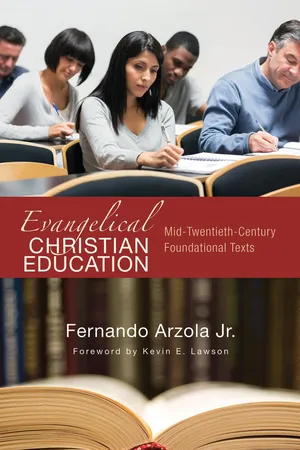
Evangelical Christian Education
Mid-Twentieth-Century Foundational Texts
- 118 pages
- English
- ePUB (mobile friendly)
- Available on iOS & Android
eBook - ePub
About this book
Evangelical Christian Education provides five of the most significant mid-twentieth-century foundational texts from the leading experts in the field of Evangelical Christian education.
Charles B. Eavey - Frank E. Gaebelein - Findley B. Edge - Lois E. LeBar - Lawrence O. Richards
Information
Topic
Theology & ReligionSubtopic
Christian Church1
Charles B. Eavey
Principles of Teaching for Christian Teachers (1940)

Regardless of how good a teacher may be, he is not prepared to teach a class until he knows the members of that class. He cannot study the lesson properly or decide intelligently upon his aims and the methods he should use unless he knows whom he is to teach the truth of that lesson.
About Charles B. Eavey
Charles Benton Eavey (1889–1974) was born in Hagerstown, Maryland. He was raised in a family environment that didn’t nurture religious affections; however, he later joined the Brethren in Christ. After his non-supportive father died, Eavey dropped out of school at the age of eighteen and worked on the farm in Kansas taking care of his mother and siblings. He returned to school at the age of twenty-one. Eventually, he obtained his PhD from New York University. He taught at Messiah College (1922–1928) and Wheaton College (1930–1942). Eavey established the undergraduate major in Christian education, and laid the foundations for what would later become a Masters in Christian education.1
Unfortunately, Eavey was not granted tenure at Wheaton due to various reasons, not the least of which was his confrontational style. He worked odd jobs before securing a position in the personnel department of a Chicago-based corporation. Eavey took this “opportunity” to reorganize his teaching notes into books, of which more than a dozen were published.2
About Principles of Teaching for Christian Teachers
His first and most widely read book, Principles of Teaching for Christian Teachers enjoyed over twenty printings. Thoroughly evangelical, it also utilized insights from the social sciences. 3
This is highlighted by the Robert Lay as he writes, “Eavey was both progressive (as his education shows) and evangelical—nurtured in the theologically conservative Brethren in Christ Church and shaped by the evangelistic revivals of the 1910’s and 1920’s.”4
Principles of Teaching for Christian Teachers is a dense and technical work. It is both philosophical and methodological. Much of the insight is common knowledge today; however, as a work published in 1940, its popularity is understandable, and one can see how it laid the foundation for many of the future teaching methods books, particularly within evangelical Christian education.
Selected Text:
“The Christian Teacher Preparing to Teach”5
“The Christian Teacher Preparing to Teach”5
The first task of this treatise was to present certain principles that must be considered basic in all Christian teaching; next, the importance of and the necessity for Christian teaching were stressed; then, the aims of the Christian teacher were discussed. In the previous chapter, consideration was given to the subject of what the Christian teacher should be, especially as a person. The task now at hand is to advance some thoughts on the subject of the teacher’s preparation for teaching. In a sense this represents a continuation of the subject because development of good teaching personality is one of the most important forms of preparation that can be made for Christian teaching.
But there are other forms of preparation that he who would teach effectively must undergo. Emphasis has been placed on the fact that the teaching process is a twofold one, including both learning and teaching. It has also been seen that whenever teaching is done, there is a person who is to learn, a person who is to stimulate, guide, and direct the learning, and a content to be learned. It would seem to be obvious, then, that the effective teacher would need to know the one taught, what to teach him, and how to teach. And logically it would seem also that to teach aright one would need to know the school in which he is teaching.
This gives knowledge as one essential for good teaching. An art as intricate as teaching can be learned best by observing how others do it; hence observation is a second essential. And without practice, one could scarcely hope to attain any high degree of success no matter how much he may know or how much he may observe; therefore, doing becomes a third essential. The effective teacher must know, observe, and do.6 Obviously, preparation for teaching is important, as is also the means available for the training of teachers. The subjects that will be discussed in the present chapter are, then: (1) the need for teacher preparation; (2) learning to know: (a) the pupil; (b) subject matter; (c) how to teach; (d) the school; (3) observing as preparation for teaching; (4) doing in preparation for teaching; (5) means available for teacher preparation.
1. The Need for Teacher Preparation
The teacher is the all important factor in any school. Quite evidently, every single thing that has any bearing upon the pupils in a school affects the quality of the teaching. Thus, the type of building, the equipment and materials, the organization and administration of the school, the conditions of home life, the ideals of the community, and everything else that affects the life of the pupil exerts influence on the teaching of Christian truth in the church school.
The teacher is the most important factor in a school. But the factor that looms highest in importance is the teacher. Of what avail is it if the school is housed in the finest building equipped with the best in material things if the teaching is not done well? Of what worth is a good curriculum and expert administration if the teacher in the classroom does not know how to teach? What can ideal home life and good public sentiment accomplish, so far as the work of a school is concerned, if the teacher in that school is so poorly prepared that he cannot teach efficiently? In fact, poor work in the classroom, as was pointed out in an earlier chapter, can do much to inculcate wrong habits and attitudes in children. On the other hand, one truly and fully prepared to teach may do very effective work without the aid of these external advantages, valuable as these may be for the accomplishment of worthwhile results.
Teacher training is necessary. Effectiveness in teaching depends largely upon the adequacy of preparation. Well-trained teachers make good schools where pupils learn what they are taught. But if preparation has been superficial, haphazard, or misdirected, pupils cannot learn well, if at all. This fact is recognized in secular education. No public-school teacher can come to his task without specific preparation for the particular work he is to do. Then he does his teaching in buildings designed for educational purposes with all the equipment and materials necessary for effective accomplishment. And the public-school teacher works under conditions intended to make for definite improvement in teaching.
Training of Christian teachers must be adequate. Why should children of today be denied the right to as much opportunity to learn Bible truth as they have to learn history, science, arithmetic, and the other subjects commonly taught in the public school? And if children have a right to Bible knowledge, do they not have the further right to efficient teaching of the Bible? Is it true that just anyone, whether he has had training or not, is sufficient for impartation of knowledge of the Bible while only the highly trained are permitted to teach secular subjects? Does the putting of names such as “Sunday,” “Sabbath,” “Bible,” or “Church” in front of the word “school” mean that some mystical occurrence will make it unnecessary for the teachers in that school to be prepared? Certainly any person who is at all interested in the highest welfare of children and who has any conception of relative values and eternal verities would not hesitate for a moment to say, “It is the right of every child to have teachers of Bible who can present the Word in the most effective manner.”
The Christian teacher of today unprepared for his specific work is at a tremendous disadvantage, and his being at a disadvantage reflects discredit not only upon him but upon the cause for which he stands. How can a boy or a girl who attends public school five days a week where he gets the very best instruction from a well trained teacher have much respect for an unprepared or a poorly prepared Sunday-school teacher under whom he or she sits for an hour of undirected or misdirected activity on Sunday? How much value is such a boy or a girl likely to attach to that which the Sunday-school teacher is supposed to be teaching? And how much respect can he or she have for a church that perpetrates upon him the outrage, having the audacity to call the work “Christian education”? Any normal boy or girl makes the comparison between the work done in the public school and that done in the church school as inevitably as he would make the comparison between riding behind an ox-team and riding in the latest model of automobile, were he required to use the former means of transportation in this modern age. That the comparison is less striking because it is perhaps less conscious does not make the attitude formed without the most untoward results
Dr. Walter S. Athearn has spoken words in this connection the truth of which may well be pondered and weighed by all:
Society protects its land from the ravishes of unskilled tenants; it insists that justice be not thwarted by untrained jurists; it guards the bodies of its citizenship from the untrained “quack”; it excludes the charlatan from the schoolroom that the minds of our children may not be maimed and crippled by unskilled workmen; but the souls of children have been left unprotected from malpractice at the hands of well-meaning, but untrained workers in the field of religious education.
It is strange that the last resource that society has attempted to conserve is the spiritual life of the children. It is just now beginning to dawn upon Christian people that there is such a thing as spiritual malpractice, and that the pious, well-meaning church-school teacher may ignorantly pull up by the roots and destroy the very elements which enable the soul to bring fort...
Table of contents
- Title Page
- Foreword - Dr. Kevin E. Lawson
- Preface
- Acknowledgments
- Permissions
- Chapter 1: Charles B. Eavey
- Chapter 2: Frank E. Gaebelein
- Chapter 3: Findley B. Edge
- Chapter 4: Lois E. LeBar
- Chapter 5: Lawrence O. Richards
- Bibliography
Trusted by 375,005 students
Access to over 1.5 million titles for a fair monthly price.
Study more efficiently using our study tools.
Frequently asked questions
Yes, you can cancel anytime from the Subscription tab in your account settings on the Perlego website. Your subscription will stay active until the end of your current billing period. Learn how to cancel your subscription
No, books cannot be downloaded as external files, such as PDFs, for use outside of Perlego. However, you can download books within the Perlego app for offline reading on mobile or tablet. Learn how to download books offline
Perlego offers two plans: Essential and Complete
- Essential is ideal for learners and professionals who enjoy exploring a wide range of subjects. Access the Essential Library with 800,000+ trusted titles and best-sellers across business, personal growth, and the humanities. Includes unlimited reading time and Standard Read Aloud voice.
- Complete: Perfect for advanced learners and researchers needing full, unrestricted access. Unlock 1.5M+ books across hundreds of subjects, including academic and specialized titles. The Complete Plan also includes advanced features like Premium Read Aloud and Research Assistant.
We are an online textbook subscription service, where you can get access to an entire online library for less than the price of a single book per month. With over 1.5 million books across 990+ topics, we’ve got you covered! Learn about our mission
Look out for the read-aloud symbol on your next book to see if you can listen to it. The read-aloud tool reads text aloud for you, highlighting the text as it is being read. You can pause it, speed it up and slow it down. Learn more about Read Aloud
Yes! You can use the Perlego app on both iOS and Android devices to read anytime, anywhere — even offline. Perfect for commutes or when you’re on the go.
Please note we cannot support devices running on iOS 13 and Android 7 or earlier. Learn more about using the app
Please note we cannot support devices running on iOS 13 and Android 7 or earlier. Learn more about using the app
Yes, you can access Evangelical Christian Education by Fernando Arzola Jr. in PDF and/or ePUB format, as well as other popular books in Theology & Religion & Christian Church. We have over 1.5 million books available in our catalogue for you to explore.