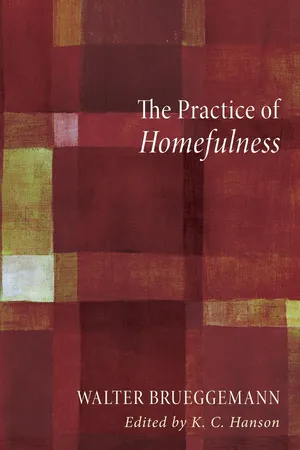
- 118 pages
- English
- ePUB (mobile friendly)
- Available on iOS & Android
eBook - ePub
The Practice of Homefulness
About this book
Contents
1 The Practice of Homefulness
2 A Myriad of "Truth and Reconciliation" Commissions
3 Bragging about the Right Stuff
4 A Culture of Life and the Politics of Death
5 Elisha as the Original Pentecost Guy
6 The Stunning Outcome of a One-Person Search Committee
7 The Non-negotiable Price of Sanity
8 The Family as World-Maker
Information
Topic
Theology & ReligionSubtopic
Biblical Studies1
The Practice of Homefulness
It is my conviction that learning to reread the Bible is not only enormously interesting, but enormously urgent, for in rereading the Bible, we will be permitted to reread our social reality. This double rereading is important, I believe, because what we need in relation to this problem of homelessness is not information, but courage, energy, will, freedom, and impetus. And those permits will come, not from socioeconomic, political analysis, important as such analysis is, but from our deepest texts where we hear a voice of holiness that can intrude upon our settled sense of self and our settled social reality.
The preacher has an important opportunity to connect the problem of homelessness (which is much on our minds) with texts on homefulness as willed by God. Preaching is so urgent because the homelessness generated by our economy can be resituated in a context of evangelical homefulness. I will consider a series of texts and then draw some conclusions. I have as a very modest goal that we together might see one or two texts differently, and thereby see one piece of our crisis differently.
Return to Yahweh
My first text, on which I will dwell at some length, is a throwaway line in Hos 14:1–3. Verses 1–3 are a final invitation in the book of Hosea to repent:
Return, O Israel, to Yahweh your God,
for you have stumbled because of your iniquity.
Take words with you and return to Yahweh;
say to him, “Take away all guilt;
Accept that which is good, and we will offer
the fruit of our lips.
Assyria will not save us; we will not ride upon horses;
we will say no more, ‘Our God,’ to the work of our hands.
In you the orphan finds mercy.”
“Return to Yahweh.” That’s the first line, reiterated in the second verse. The following verses answer the question, return from what?:
• return from iniquity, for you have stumbled into false faith;
• return from wrong speech, where you have embraced self-deceptive ideology,
• return from horses and Assyrians, mistaken security in arms,
• return from the work of our hands, self-sufficiency.
That is a lot to give up: false faith, false ideology, mistaken security, self-sufficiency.
As is usual in Hebrew poetry, the last line circles back on the first line. Notice, nothing yet has been said to characterize Yahweh, the one to whom return is to be made. What would it mean to return to Yahweh? Then comes the punch line, the most important line: “In you, the orphan finds mercy!” What a line! Critical scholarship says it is a late gloss in the poem.1 But there it is. The statement has three phrases. In you, in the God of Israel, the liberator of slaves, the giver of commandments, the patron of covenant, the provider of land. “In you” recalls and makes present the entire long history of Yahweh, the history of the only God who cares about land, food, clothing, houses, material well-being.
The second phrase is the orphan. Remember, this text comes out of a tribal society with large, extended families with inheritance, genealogy, pedigree, and patrimony. It is a society in which everyone has a place and belongs, and is known there and named and cared for...unless your daddy has died. The problem about being an orphan is not that you grieve over your dead daddy. It is rather that you lose your place. If your daddy died, you do not belong, you are without name, genealogy, pedigree, patrimony, defense, rescue, advocate, avenger. You are always, everywhere at risk and in jeopardy. That is how the world was ordered in the olden days. And if we reflect long, we see that the realities of social power have not changed much. It is a high risk deal to have lost your place in the tribal world.
Thus in the first two phrases of this poetic line, we have an odd juxtaposition. There is Yahweh who has this long, faithful history of intervention and provision, and there is the orphan, who has no name, no history, no prospect, no chance in the world. Yahweh is the guarantor, the orphan is the one who has no guarantees.
Everything hinges on the third term of the poetic line, find mercy. It is in mercy that the guarantor and the one without guarantees get together. The two are linked in mercy, the mercy that comes from Yahweh and goes to the orphan. The term “mercy” denotes womb-like mother love, massive attentiveness and solidarity, fidelity that cuts underneath merit to give guarantees.2 This is the one who gives guarantees for life to the one who has no guarantees for life. Thus, the entire rhetorical unit says, a) leave off false faith, false ideology, mistaken security, and self-sufficiency; b) get back in obedience to the one who gives guarantees to those who lack every guarantee. I suspect that this text will do for us both because of its powerful witness to God, and because it is precisely such foundational repentance that is required, if we are to have any serious housing revolution.
This marvelous text, however, is open to an insidious and mistaken reading. I take “mercy to the orphan” to be a fairly precise equivalent to “homes for the homeless,” because the homeless are the genuine orphans in our society, for they have no protective tribe. In such a context, “mercy” translates into “a house,” which bespeaks membership in a protective community.
The danger for interpretation is that mercy for the orphan, homes for the homeless, comes from Yahweh. It is entirely possible, even if dead wrong, to take the text as an invitation to quiescence and abdication, to conclude that God gives mercy to orphans, and if God gives homes to the homeless, then homelessness is settled, overcome, and not our problem. And of course with a bad theology of otherworldliness, the church has often invited such a reading. When the Bible is read so transcendentally, then the human dimension of the housing crisis is cut off from our theological confession, and only knee jerk libe...
Table of contents
- Title Page
- Foreword - K.C. Hanson
- Preface
- 1. The Practice of Homefulness
- 2. A Myriad of “Truth and Reconciliation” Commissions
- 3. Bragging about the Right Stuff
- 4. A Culture of Life and the Politics of Death
- 5. Elisha as the Original Pentecost Guy: Ten Theses
- 6. The Stunning Outcome of a One-Person Search Committee
- 7. The Non-Negotiable Price of Sanity
- 8. The Family as World-Maker
- Bibliography
- A Select Bibliography of Walter Brueggemann
Trusted by 375,005 students
Access to over 1.5 million titles for a fair monthly price.
Study more efficiently using our study tools.
Frequently asked questions
Yes, you can cancel anytime from the Subscription tab in your account settings on the Perlego website. Your subscription will stay active until the end of your current billing period. Learn how to cancel your subscription
No, books cannot be downloaded as external files, such as PDFs, for use outside of Perlego. However, you can download books within the Perlego app for offline reading on mobile or tablet. Learn how to download books offline
Perlego offers two plans: Essential and Complete
- Essential is ideal for learners and professionals who enjoy exploring a wide range of subjects. Access the Essential Library with 800,000+ trusted titles and best-sellers across business, personal growth, and the humanities. Includes unlimited reading time and Standard Read Aloud voice.
- Complete: Perfect for advanced learners and researchers needing full, unrestricted access. Unlock 1.5M+ books across hundreds of subjects, including academic and specialized titles. The Complete Plan also includes advanced features like Premium Read Aloud and Research Assistant.
We are an online textbook subscription service, where you can get access to an entire online library for less than the price of a single book per month. With over 1.5 million books across 990+ topics, we’ve got you covered! Learn about our mission
Look out for the read-aloud symbol on your next book to see if you can listen to it. The read-aloud tool reads text aloud for you, highlighting the text as it is being read. You can pause it, speed it up and slow it down. Learn more about Read Aloud
Yes! You can use the Perlego app on both iOS and Android devices to read anytime, anywhere — even offline. Perfect for commutes or when you’re on the go.
Please note we cannot support devices running on iOS 13 and Android 7 or earlier. Learn more about using the app
Please note we cannot support devices running on iOS 13 and Android 7 or earlier. Learn more about using the app
Yes, you can access The Practice of Homefulness by Walter Brueggemann, K. C. Hanson, Hanson in PDF and/or ePUB format, as well as other popular books in Theology & Religion & Biblical Studies. We have over 1.5 million books available in our catalogue for you to explore.