- 104 pages
- English
- ePUB (mobile friendly)
- Available on iOS & Android
eBook - ePub
About this book
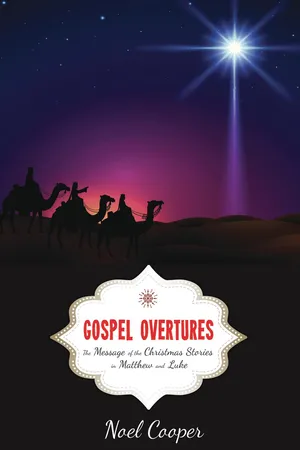
Christmas is a charming and memorable season for children, and it is perfectly reasonable for well-informed adults to enjoy cribs, candles, carols, decorated trees, presents, and family feasts. It is not possible, however, to be a well-informed adult believer without adding to the value of the Christmas celebration by searching for the deeper meaning of the gospels, a meaning that is beyond the comprehension of young children. Gospel Overtures offers a detailed analysis of the Christmas stories in the Gospels of Matthew and Luke, as well as suggestions for personal reflection. Christianity is primarily a religion for adults, and the gospel narratives are intended to inspire adult faith. Gospel Overtures is intended to help readers appreciate the depth of the gospels and to grow as believers.
Information
Chapter 1
Background
The New Testament Context
1. Jesus’s Most Important Teaching
According to at least three of the gospels, the teaching that Jesus considered most important was expressed in his simple and frequent proclamation of what he called good news: “The kingdom of God has come near” (Mark 1:15; Luke 10:9). Jesus devoted most of his teaching to the kingdom of God: many of the parables are introduced with the words “The kingdom of God is like . . .” He also presented his healings as examples of what can happen when the kingdom of God enters a person’s life (see Luke 11:20).
The kingdom of God was central to Jesus’s proclamation, but unfortunately, the phrase means very little to many modern believers. In truth, it is a credible and attractive teaching that can have a profound effect on our lives.
The reign of God1 is God’s loving initiative to make us whole. Jesus’s most important teaching was not about what we should do (for example, “love one another”), but about what God offers to do for us.
The reign of God is very much related to our life on earth. In Luke 17:20–21 Jesus says, “The kingdom of God is among (or within) you.” Even the phrase “kingdom of Heaven” refers to life on earth rather than to life after death. In Hebrew understanding, heaven was the home of God and the angels. One professor suggested that we understand the kingdom of Heaven as the spiritual power of God (God’s influence, God’s grace) that comes from heaven to us.
To repeat, the reign of God is the action of God in our lives. Jesus proclaimed repeatedly that God offers to reign in our hearts. If we open our hearts to the influence of God, if we allow God to rule our lives, God will transform us and enable us to grow toward wholeness,2 to love generously and to be true to ourselves and in that way to be faithful to God. The reign of God is something God does for us. It is not something we accomplish on our own; it is not something we earn; it is God’s gift.
The reign of God has a communal implication as well. None of us can open our hearts to the action of God in isolation. No one grows to wholeness alone. The Christian community is composed of believers who have chosen to allow God to rule in their hearts, and who support each other by expressing their faith together, by trying to live as followers of Jesus, and by praying together. We need each other if we are to grow toward wholeness.
The reign of God is good news, since it assures us that we are not expected to grow toward wholeness by our own efforts. As we shape our lives by our decisions, as we seek to be free, happy, loving and fully human, Jesus offers us the power of God’s love working within us, leading us to wholeness. God offers us ongoing spiritual support, helping us to be wise as we deal with what life brings us, to make sense of our lives, to know what is the right thing to do, to have the courage to do what we know is right, and to perceive where we belong in the universe with reverence and awe.
The preceding paragraphs have expressed in several ways the meaning of Jesus’s teaching about the reign of God. In a different way, they respond to a question that all believers must consider: what can we ask of God? Prayer that asks God to change circumstances miraculously is problematic. Prayer that asks God to support us spiritually as we face the challenging circumstances of our lives is more believable.
What we are invited to do, then, is to accept God’s offer: open our lives to the transforming action of God, allow God to reign in our hearts, and cooperate with the grace of God as we make the responsible decisions that shape us as faithful followers of Jesus.
The teaching about the reign of God is central to every gospel, and is the focus of the infancy narratives, the overtures to the gospels of Matthew and Luke. The gospels challenge believers with the fundamental question: will you let God reign in your life?
2. Biblical Truth and Historical Fact
When the ancient peoples wished to express an important truth, they didn’t write history books or philosophy books. Often, they wrote stories. The parables of Jesus are an excellent example. When he was asked, “Who is my neighbor?,” he didn’t give a conceptual response (such as the definition I learned as a child, “mankind of every description”). Instead, Jesus told a story. When faced with that question, he told the parable of the Good Samaritan (Luke 10:25–37), a memorable example of fiction used to teach a lesson. There was no historical “Good Samaritan”; he is a fictional character whose actions teach us what it means to be a good neighbor. Hearing the statement that the Good Samaritan is a fictional character, students would invariably ask, “So it’s not true, right, sir?” My answer always was, “It is true; it teaches important truth about God and human values. It’s just not a historical fact.”
People of the twenty-first century prefer to rely entirely on factual information, and tend to dismiss as “untrue” anything that isn’t factual. As a society and as a community of believers, we definitely need greater respect for the truth expressed in literature and poetry, and for the depth and meaningfulness of symbolic writing. The Bible (including the infancy narratives) is less “newspaper report” than “reflection on the place of God in human life,” often expressed in poetry, myth, or other forms of symbolic language—a matter of great importance that is far deeper than a presentation of simple facts. What is truly significant is recognizing meaning, getting to know Jesus, believing, and considering the importance of his teaching for our lives.
3. The Development of the New Testament
The New Testament developed over a period of some eighty years after the death and resurrection of Jesus. For several decades, the narratives were passed by word of mouth from parent to child to grandchild in the context of various communities of believers. The following brief description of the process is told with a specific focus on the gospel accounts of Jesus’s birth and childhood.
The Letters of Paul
Our earliest written Christian documents are the letters of Paul. Paul never met Jesus, and indeed persecuted the early Christian communities before unexpectedly converting to Christianity within ten years after the death of Jesus. After becoming a disciple, Paul apparently understood the greatness of Jesus better than his good friends, who were mostly illiterate Galilean workers. It was Paul, proud as he was of his Jewish heritage, who understood that Jesus’s proclamation of the reign of God was intended for all humanity. The letters that were actually composed by Paul himself were written between the years 49 and 65 of the first century. By the time of Paul’s death, no gospel had yet been composed. The traditions that were later put in writing as gospels existed primarily in oral form for more than four decades after the resurrection. Paul knows nothing of what we call the Christmas stories; his only references to the birth of Jesus are found in the Letter to the Romans 1:3 (“descended from David according to the flesh”) and in Galatians 4:4, where he describes Jesus as “born of a woman, born under the law [of Moses].”
The Gospels
The gospels are statements of faith. The first of them, Mark, was likely completed shortly after the year 70 CE.3 From an early age, everyone should be aware that the accounts of Jesus’s life are not like newspaper reports. They aren’t biographies or history books: they are gospels. That word means “good news.” The people who wrote the gospels were convinced that Jesus is good news for us; he provides the answers to the deepest questions of life. The gospels do have a basis in fact: Jesus really lived, and we have some very good information about his life and his teachings. Still, the accounts of his life evolved during the decades of oral transmission before they were written down.4 Some scholars attempt to discern which details are historically reliable, but the important purpose of learning about the gospels is to get in touch with Jesus and his teaching, rather than to be concerned primarily about historical facts.
The good news of Jesus was transmitted to numerous communities in western Asia and later in Europe by word of mouth for a few decades after his death and resurrection (which took place likely before the year 30 CE). Oral transmission is fundamentally conservative: anyone who has read a book to a child knows that children will not permit variations (like skipping a couple of pages). The “broken telephone” activity often used in classrooms (where a message is whispered to one person, and then is passed to others one by one before it emerges garbled at the end of the string) is exactly the opposite of oral transmission, where a whole community receives the story and participates in the retelling of it. When stories evolve as a result of developing insight, the whole community takes part in the process. Secrecy and whispering are not part of the procedure. Still, there is no question that accounts do change as the result of evolving faith.
After more than forty years of oral transmission, the written gospels began to appear. The four that we consider most important developed in four communities that probably had little contact with each other. Each of them presents the greatness of Jesus in its own distinctive way. Today, we cherish the di...
Table of contents
- Title Page
- A Word to the Wise
- Acknowledgments
- Introduction
- Chapter 1: Background
- Chapter 2: The Christmas Stories in Matthew
- Chapter 3: The Christmas Stories in Luke
- Summary
- Bibliography
Trusted by 375,005 students
Access to over 1.5 million titles for a fair monthly price.
Study more efficiently using our study tools.
Frequently asked questions
Yes, you can cancel anytime from the Subscription tab in your account settings on the Perlego website. Your subscription will stay active until the end of your current billing period. Learn how to cancel your subscription
No, books cannot be downloaded as external files, such as PDFs, for use outside of Perlego. However, you can download books within the Perlego app for offline reading on mobile or tablet. Learn how to download books offline
Perlego offers two plans: Essential and Complete
- Essential is ideal for learners and professionals who enjoy exploring a wide range of subjects. Access the Essential Library with 800,000+ trusted titles and best-sellers across business, personal growth, and the humanities. Includes unlimited reading time and Standard Read Aloud voice.
- Complete: Perfect for advanced learners and researchers needing full, unrestricted access. Unlock 1.5M+ books across hundreds of subjects, including academic and specialized titles. The Complete Plan also includes advanced features like Premium Read Aloud and Research Assistant.
We are an online textbook subscription service, where you can get access to an entire online library for less than the price of a single book per month. With over 1.5 million books across 990+ topics, we’ve got you covered! Learn about our mission
Look out for the read-aloud symbol on your next book to see if you can listen to it. The read-aloud tool reads text aloud for you, highlighting the text as it is being read. You can pause it, speed it up and slow it down. Learn more about Read Aloud
Yes! You can use the Perlego app on both iOS and Android devices to read anytime, anywhere — even offline. Perfect for commutes or when you’re on the go.
Please note we cannot support devices running on iOS 13 and Android 7 or earlier. Learn more about using the app
Please note we cannot support devices running on iOS 13 and Android 7 or earlier. Learn more about using the app
Yes, you can access Gospel Overtures by Noel Cooper in PDF and/or ePUB format, as well as other popular books in Theology & Religion & Biblical Criticism & Interpretation. We have over 1.5 million books available in our catalogue for you to explore.